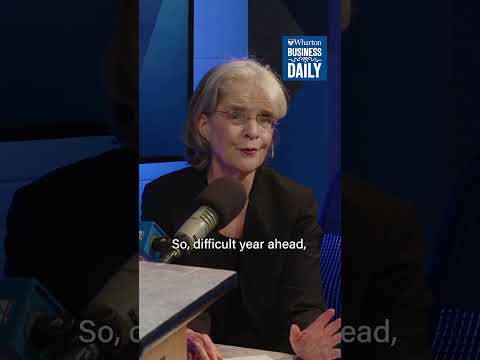
Jeremy Siegel’s 2026 Economy Forecast & Predictions for the Markets
Ask about Knowledge at Wharton
Episode Description
ABOUT THE EPISODE In an interview on the This Week in Business podcast, Wharton School Professor Emeritus of Finance Jeremy Siegel looks back at 2025 and provides his 2026 economy forecast, making predictions for what to expect for the markets in the new year.
Topics and questions covered: 00:00 - Introduction 00:25 - State of the U.S. economy as 2025 concludes 01:35 - Analyzing jobs report and inflation data 03:53 - How Wall Street and equities in the markets will do 05:17 - Trends with AI stocks 06:55 - What to watch for in 2026
ABOUT THE PODCAST This Week in Business features interviews with Wharton faculty about the latest news, fascinating trends, and issues impacting both consumers and the business world. Episodes are recorded at the Wharton School and published twice per week.
#economicforecast #economicpredictions #useconomy #marketforecast #stockmarketforecast ----- The Wharton School of the University of Pennsylvania is committed to sharing its intellectual capital through Knowledge at Wharton, the school’s online business analysis journal.
Launched in 1999, Knowledge at Wharton offers free access to:
- Articles, podcasts, and videos highlighting Wharton faculty research and analysis of current business trends - Interviews with book authors from Wharton School Press - In-depth series of curated content like Wharton Executive Education’s Nano Tools for Leaders - A searchable database of more than 10,000 articles covering all aspects of business - A weekly newsletter that delivers Knowledge at Wharton insights directly to your inbox
Visit the Knowledge at Wharton homepage: https://whr.tn/3qUpSBE Subscribe to the Knowledge at Wharton YouTube channel: https://whr.tn/3DEAgAU
Read the full transcriptHide the full transcript
- and great to be joined as we have him every month. Uh Jeremy Seagull, Wharton ameritus professor of finance and also a
- senior economist at Wisdomree. Jeremy, great to talk to you and happy holidays, sir.
- >> You too, D. >> Great. Uh let me start out by just getting your general thoughts on the
- state of the economy as we wrap up 2025 and obviously this coming at a time where the Fed just made a a recent cut
- to rates. >> Yeah. Um, I think there's uh there's two bumps we have to get over in the next
- two months. First of all, uh uh the an expected ruling from the Supreme Court on the tariffs. Um that could churn
- things up uh depending on how it's stated and and all the rest that generates even more uncertainty. Um you
- know, I'm not a fan of tariffs. I've never been one. I I think it should it was not legal to begin with. Uh but
- nonetheless uh uh the fed uh the Supreme Court making that uh determination and not giving Trump time if it if they
- don't and I hope they do give him time to work with Congress to make it legal uh will turn the pot. Uh and secondly,
- another potential government shutdown uh January 30th. >> Uh we don't want that. No one wants
- that. And yet that is looming. There is still no uh you know the Dems have made healthc care a big issue. um and uh I
- think you're going to stick to it and uh there's no seemingly no progress in Congress towards moving towards a
- compromise on this issue. So those are two near-term bumps. I would say the data is starting to roll in as well. We
- got the jobs data a few days ago. Uh October was a negative. November was a positive. We've just gotten some
- inflation data as we're taping this uh right before uh the Christmas holiday. give us your thoughts on on what that
- data is telling us right now. >> Well, first of all, the the inflation data was extremely good and we're
- finally getting the the lower shelter prices which are so important um into the index and that's a major reason why
- we it came in as well as it did. And uh you know we are getting a bump from Trump tariffs but it's much more minor
- than we had feared um for a number of reasons including lower rates than we had feared would would go and and and as
- a result I I think the inflation outlook looks quite good for 2026. I think we would be between two and 2 and a half%
- which is very close to the Fed uh uh target. Let me talk about the employment data and I'll go into the Fed uh where
- it should be. um slow growth maybe slightly negative if we make a correction. You know, we're getting on
- the private side positive. We got a big negative on public because of the you know the Musk uh option of you know
- quitting in nine months and that was nine months ago and now we in October we got a big jump there. Um but the private
- sector is I would say just about producing near zero jobs. So the only increase in GDP is productivity gains at
- this uh particular juncture and I I expect it to be maybe 1 to 2% this quarter but really
- we're we're just getting some data because of the delays to actually look at what this quarter is going to do. But
- the two I think there's there's a lot of tailwinds next year. There's inflation I
- think lower than people fear which is going to be a positive. I also think that the tax cuts are going to be money
- in the pockets of a lot of consumers that they may not be counting on now and uh you know also in the in the hands of
- corporations that can pay for expansion uh profits and and wages. Um so I I think that once we go over these two
- bumps I think actually 2026 looks good uh in terms of the economy. How do you think that Wall Street and and equities
- and the markets will probably do? >> Yeah, you know, I've always said the Fed should be in the 3 to three and a half%
- range. We're almost there. Uh it should be 100 basis points below the 10 year. The 10 year is 410. So that would put
- Fed funds at 310 and uh so we still got 25 to 50 basis points to go, which I think is the direction there. What about
- equities? Well, I really beginning to see more signs of rotation, real rotation, a lot of head fakes with
- rotation. What I mean by rotation is away from MAG 7 to the broader economy. Uh really uh the you know the the MAG
- the MAG group has had uh headwinds over the last two or three months. Um and um their valuations although not crazy are
- do not leave room for any disappointment. I expect that a lot of the other firms might be able to take
- advantage of some of the AI um technologies that could increase their margins and their profits. But uh you
- know, is that a certainty? I don't know. But overall, I would not be surprised to
- see uh gains uh on the S&P next year at 5 to 10%. Okay, good, but much more modest than
- the previous three years. Is it a surprise that that the AI stocks have been taking kind of the hit that they
- have in the last few weeks? >> Well, not with the questions that are being asked about them over building
- potential. Data centers are costing a lot more and we've hearing signs of delay. There's always a threat of new
- chips that might really not make those data centers as as necessary. You we understand what's happening with Oracle.
- you know, it says it's going to spend 360 billion. Market does not like that. Um, there's always threats from China on
- undercutting. Uh, so and I mean, and you take a look at Open AI, you chat G GPT and you know, all of a sudden we got
- Gemini who jumps up in the number one place. Well, then there's competition on uh all the large language models and
- what kind of premiums can they charge. Uh so there there's a lot of things going on. Um I think the the you know
- it's it's might have surprised people that the only mag 7 that really has just recently put into high territory is test
- and it's really on self-driving. I think I think self-driving is the the first big thing that AI uh is
- going to uh is going to accomplish. It means millions of drivers are not going to have jobs. Um, and it's probably, you
- know, I think self-driving is going to be a a reality in five years for a majority of uh trucks and long hauls as
- well as taxis. >> What are you most watchful then about as we head into the new year?
- Well, I mean, again, there's the I'm looking at the Supreme Court and whether the Congress can in fact uh negotiate uh
- to avoid another shutdown. Uh um and then of course we we'll see the progress on AI. I mean, there's always that
- threat. There's the the AI that someone's going to, you know, remember what happened when DeepC came out, you
- know, five months ago, the Nvidia stock. I mean, I mean, is there going to be another surprise? Oh my god. Um because
- we all remember what happened in the internet when everyone wanted fiber optic cable and they were booming and
- then all of a sudden we decide we we learn how to put 10 times the amount of information in a single fiber optic
- cable and all of a sudden the demand for that collapsed. All those things can happen. They're good for the consumers
- obviously but very bad for the firms that are producing it. Um so there could be a lot of churn depending on you know
- AI developments which are really uh these technological developments seem to be occurring faster and faster.
- >> Jeremy always great to talk with you. Look forward to doing it again throughout the course of 2026. All the
- best. >> Thank you very much. >> You got it. Jeremy Seagull uh Wharton ameritus professor of finance and senior
- economist at Wisdomree.
Brief Summary
Jeremy Seagull discusses economic trends, inflation, job growth, and market predictions as 2025 ends.
Key points
- Economic Outlook for 2026. Despite near-term bumps, the economy looks promising for 2026 with lower inflation.
- AI and Job Displacement. Self-driving technology could eliminate millions of driving jobs in the next five years.
Episode highlights
- Economic Outlook for 2026Despite near-term bumps, the economy looks promising for 2026 with lower inflation.“I think actually 2026 looks good in terms of the economy.”3:52Dec 31, 2025
- AI and Job DisplacementSelf-driving technology could eliminate millions of driving jobs in the next five years.“Self-driving is going to be a reality in five years for a majority of trucks and taxis.”6:46Dec 31, 2025