Why Record Holiday Sales Could Be Misleading
Ask about Knowledge at Wharton
Episode Description
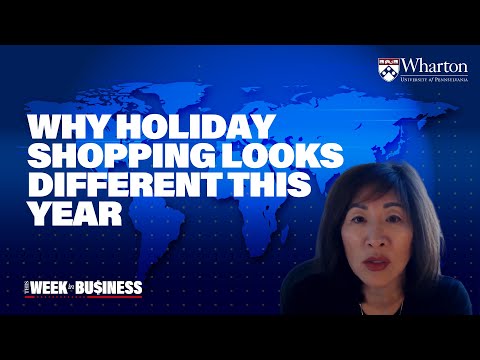
ABOUT THE EPISODE Record holiday sales do not necessarily mean the economy is thriving. Inflation and uneven consumer spending are making this year's retail outlook more complicated than the headlines suggest.
Peter Fader, Wharton Professor of Marketing, explains why holiday sales forecasts can be misleading. He discusses the K shaped economy, Black Friday discounting, the limits of AI shopping agents and why malls remain important to the holiday shopping experience.
ABOUT THE PODCAST This Week in Business features interviews with Wharton faculty about the latest news, fascinating trends, and issues impacting both consumers and the business world. Episodes are recorded at the Wharton School and published twice per week.
----- The Wharton School of the University of Pennsylvania is committed to sharing its intellectual capital through Knowledge at Wharton, the school’s online business analysis journal.
Launched in 1999, Knowledge at Wharton offers free access to:
- Articles, podcasts, and videos highlighting Wharton faculty research and analysis of current business trends - Interviews with book authors from Wharton School Press - In-depth series of curated content like Wharton Executive Education’s Nano Tools for Leaders - A searchable database of more than 10,000 articles covering all aspects of business - A weekly newsletter that delivers Knowledge at Wharton insights directly to your inbox
Visit the Knowledge at Wharton homepage: https://whr.tn/3qUpSBE Subscribe to the Knowledge at Wharton YouTube channel: https://whr.tn/3DEAgAU
Read the full transcriptHide the full transcript
- Well, we are getting to that time of the year where businesses are starting to put
- out holiday decorations. That means that people will start thinking about holiday shopping.
- And at least for this year, it seems like retailers may eclipse the $1 trillion mark
- in sales coming up. But there is a little bit of a catch because part of that growth in sales
- could be connected to both inflation and tariffs. Pleasure to be joined by Wharton Professor of
- Management, Peter Fader, who joins us to discuss this. Peter, great to catch up with you again.
- How are you, sir? Well, Dan, it's always good to talk to you, but I hate to talk about this
- topic. Every year we rendezvous around this one and I express all kinds of skepticism about these
- measures and their implications. And not only is this year no exception, this year just really amplifies it.
- The bottom line is we have no idea what's going on, but let's dive in. Well, okay, so, I mean, every year, it
- seems like we see a measurable growth, whether it's like between three and 5% in
- terms of what holiday sales are going to be. Let me start with that. Why do we continually see that growth every
- year? Is it what the retailers are providing? Is it the marketing? Is it something else?
- What drives the gains every year? Well, you hit two of the factors there, and of course the third one, which is
- a big, broad one, would be the macro economy. So there's just so many different factors in
- place. And the influence that they have on consumers is tremendously variable for different individuals, for different
- groups. So to kind of put our finger on one thing that's driving that number, it's impossible
- at the best of times, but this year in particular, it's all over the place. And the other part to it that maybe
- not a lot of consumers realize is how early companies have to get their orders in
- in order to get products in so they're ready for the Christmas season. It's not only the supply side issues, but
- it's also just the absolute battle for people's attention. As we record this a few days before
- Halloween, right now we got all those giant skeletons everywhere. We know that next weekend they come down
- and Santa goes up. So part of it is cultural as well as kind of business driven.
- But that's kind of been the shift it seems like. And I was at El Lowe's this weekend
- and all of the Christmas decorations were out for sale. Businesses have just moved this up and maybe
- Amazon is tied to this a little bit with doing Christmas in July sales, but they
- have moved the needle three, four weeks in advance of where it was 10 to 20 years ago.
- Which makes sense. Part of it is smoothing out demand. Part of it is stimulating demand over a
- longer period of time. Part of it is trying to get people's attention at a time when some of the
- media on it might be just a little bit less overwhelming. So it makes a lot of sense for
- that to happen. And there's all these cultural reasons just like there is with Halloween.
- Everyone talking about summerween these days. So it's a variety of factors, which therefore
- makes it harder to do a year over year type of comparison. But okay, so when we're talking about a
- scenario like this and we've seen inflationary periods before, what kind of impact do you think
- that this kind of scenario that we've seen play out with retail over the last six
- to 12 months may actually have when you factor in a level of inflation, you factor
- in, for some families, it's a little bit tighter, the wall is tighter, gasoline prices are
- higher. There are outside factors that could have an impact on what people spend during the holiday
- season. In the end, I hate to say this, I hate to kind of jump on the bandwagon, but it's true.
- It's the old K-shaped thing. Yeah. That for some people, they're enjoying the best
- of times. For others, it's the opposite. And you can't just say, oh, it is this, a segment of people that's on the
- high end and this segment of people that's on the low end. And the nature of inflation has been so
- variable across different goods in the economy. So it's a differential impact even there.
- So that's why it's just a big jumbled mess. It would be great if we could kind of get down to the level to decompose
- and understand those things. Easier said than done. As a marketing professor, when you think about
- how companies approach this, what are the most important components that you look for in how
- companies approach this window of, I wouldn't say two months, but it's now more like three
- months. The thing that I'm most interested in and most troubled by, it's not just the overall
- holiday season, it's Black Friday. And one of the things that I was pretty, I don't wanna say cheerful about because
- I sound like the Grinch here, but one of the things I saw as movement in the right direction was, in and just after
- COVID, when we saw less reliance on just all of that heavy duty discounting, often aimed
- at kind of the worst customers, my spidey sense tells me back to that. Not a ton of evidence for it, but
- I do think that some of it's gonna be driven by a lot of this uncertainty that we're referring to.
- Part of it is trying to get folks to open up their wallets in a way that they might not otherwise, given the circumstances.
- So I think we're kind of going back to the bad old days when companies are gonna do a lot of things to try
- to boost those numbers, but actually could be more harm than good in the long run
- for them. But as businesses, from a historical perspective, do they incorporate a component of discounting in no
- matter what the economy is doing, because you're also heading towards the end of the year
- as well. Sure, and that's a problem. So many factors coming together. So to answer the question, yes and no.
- Some companies do indeed lay out what their plans will be, including the depth and nature
- of discounts months in advance, and that's great if it's part of an overall strategy.
- But I think an equal kind of source would just be kind of desperation. A lot of companies just kind of at
- the last minute say, yeah, I know, I know we had this more disciplined plan, but
- it's a mess out there. Let's ratchet up the discounts. So it's really hard to say how much
- of it is really, again, pre-planned, deliberate. We know what we're getting into.
- We're willing to kind of take some short -term losses, long-run gains, all that sort
- of thing, and how much of it is bordering on desperation. How is the supply chain side going right
- now? You and I are talking, you mentioned it before, but we talked when the pandemic was
- around and how much of an issue it was for retailers to try and get product in because of the pandemic and the ships
- being basically backed up out in the harbors, beyond the harbors. Where are we now, especially with all the
- geopolitical stuff going on? So the geopolitical stuff will certainly have an impact on pricing, no question about it.
- But it seems like from a pure getting stuff to the stores, we're okay. I think, look, in that sense, firms, either
- the firms that really are sort of supply chain type firms or those who benefit on
- them, that doesn't seem to be the biggest problem they're facing. It really is more of this macroeconomic uncertainty
- and uncertainty about the consumer behavior. So it's kind of nice to know that while it's a perfect storm of questions and
- uncertainty, this is one factor that's harder to lay blame on. We have seen that, as I said, that
- growth from year to year, but it seems like the consumer kind of adjusts with it
- as they go on year to year as well. And maybe they have set aside $500 for Christmas shopping.
- They're willing to maybe go over that number a little bit, but it's that percentage maybe
- that the consumer really looks at in just to how much they are willing to go over that, that number that maybe they targeted
- earlier on. That's right, and it's not just overall spend. That's one of my big concerns here.
- There are really kind of four factors at play from the consumer standpoint. It's how many people are going to participate
- in the holiday season. That tends to be fairly constant. It's how many trips to the mall are
- they going to make and how many gifts are they going to buy, the amount that they're spending, as well as beyond the gifts,
- just the things they're buying for themselves, the trips, the travel. So there's a lot of different factors to
- point to and to try to just say the number is 4% doesn't really do justice to that kind of complexity and the
- range of how those numbers vary across people. So online continues to be a growing component
- of this, but the dynamic I want to ask you about is AI and the online component, and what you are, if you're starting
- to see an impact with AI and how retailers are thinking about some of this stuff.
- A lot of talk about it. I'm going to say it's a lot of smoke and not much fire right now.
- So there's no doubt that consumers, retailers are using AI, focusing more on what we call
- GEO instead of SEO, knowing that people are going to be searching for information, trying to
- find that just right gift and even kind of tracking what they're doing using AI.
- That's great, that's great. But as far as agents that are going in there and doing the buying for you
- and so on, negligible. And really my observation has been, it's been pretty bad.
- The agents just aren't ready for prime time just yet, maybe 2027, but for now, between
- the technology not being there, people not trusting it and it's the holidays. So the idea that the act of purchasing
- is part of the way that we celebrate. It's not just a matter of kind of, you know, checking boxes to get out of
- the way. And what's still interesting is the fact that while we may shop more online during the
- majority of the year, during this two month window, we still like to go to the mall and do our shopping.
- And that's what I assume has really saved a lot of the malls over the last few years.
- I mean, obviously stores have changed, but malls are still there and a component of the
- shopping experience. And it's not just the shopping experience, it's the experience experience.
- Retailers and brands have just gotten smarter about pulling people in, not just to put money
- and credit cards across the counter, but to be part of the overall experience. You know, in the old days it was
- sit on Santa's lap, which is great, it's fine, nothing against that. But there's just so many more experiential activities
- taking place these days, whether they're directly related to the holiday season or just in general.
- If we look at malls, there's just such a bigger component of them where it's people
- just go in there to do stuff and not necessarily to buy things at all. So that's a big cultural change that's taking
- place and that's gonna fit less into the gifts we buy for people, but the gifts that we get for ourselves to go have
- fun while we're shopping. So again, I'll finish up on this. What is your feeling on how this holiday
- season will play out for retailers? Well, you're pressing me for a number, Dan. It's gonna be in that same, you know,
- three and a half to four and a half percent type thing. And I'm not saying that from any research
- I've done, just kind of reading the tea leaves and reading just a lot of different
- expert reports. But like I said, that number is meaningless between the multiple sources of uncertainty, the K
- -shaped economy, and even the differential way that the K is impacting different people.
- I really wish we could get away from the single number. I mean, this year is a shining case
- study for it, but people want the number. Peter, always great to talk with you. Thanks very much for your time and have
- a happy holiday season. Thanks, same to you, Dan. Take care now. Peter Fader, who is a marketing professor here
- at the Wharton School.
Brief Summary
Peter Fader says holiday sales may rise 3.5% to 4.5%, but inflation, uneven household budgets, and uncertain shopping habits make that forecast misleading.
Key points
- Holiday sales forecasts hide a messy reality. Retailers may report growth, but inflation, tariffs, and uneven consumer finances make the headline number hard to interpret. Fader says a single percentage cannot capture how differently people are spending.
- The holiday season keeps moving earlier. Retailers are putting decorations and products out weeks earlier to spread demand and compete for attention. The shift makes year-over-year comparisons more difficult.
- Discounts could signal desperation. Fader worries that uncertainty may push companies back toward heavy discounting to get shoppers to spend. Last-minute markdowns can be a sign of desperation—and may do more harm than good over time.
- AI shopping agents aren’t ready for the holidays. Retailers are using AI to help shoppers find gifts, but agents that make purchases for people remain unreliable and untrusted. Fader says the act of shopping is part of the holiday celebration.
- Malls sell an experience, not just products. Holiday shoppers still head to malls, where retailers draw people in with activities and experiences beyond buying gifts. Some visitors go simply to do things, not to shop.
- The forecast is 3.5% to 4.5%—but may mean little. Fader offers a rough growth estimate based on expert reports, not his own research. He cautions that economic uncertainty and the K-shaped economy make the single number misleading.
Episode highlights
- The holiday season keeps moving earlierRetailers are putting decorations and products out weeks earlier to spread demand and compete for attention. The shift makes year-over-year comparisons more difficult.1:55Oct 28, 2026
- Discounts could signal desperationFader worries that uncertainty may push companies back toward heavy discounting to get shoppers to spend. Last-minute markdowns can be a sign of desperation—and may do more harm than good over time.4:58Oct 28, 2026
- AI shopping agents aren’t ready for the holidaysRetailers are using AI to help shoppers find gifts, but agents that make purchases for people remain unreliable and untrusted. Fader says the act of shopping is part of the holiday celebration.“I'm going to say it's a lot of smoke and not much fire right now.”9:13Oct 28, 2026
- Malls sell an experience, not just productsHoliday shoppers still head to malls, where retailers draw people in with activities and experiences beyond buying gifts. Some visitors go simply to do things, not to shop.“It's not just the shopping experience, it's the experience experience.”10:24Oct 28, 2026
- The forecast is 3.5% to 4.5%—but may mean littleFader offers a rough growth estimate based on expert reports, not his own research. He cautions that economic uncertainty and the K-shaped economy make the single number misleading.“I really wish we could get away from the single number.”11:40Oct 28, 2026