AI’s Impact on Financial Services – Wharton Future of Finance Series
Ask about Knowledge at Wharton
Episode Description
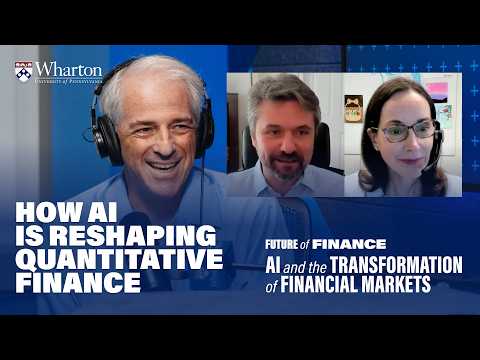
Artificial intelligence is changing how financial professionals research, analyze information, and get work done — while raising new questions about the skills people will need in an AI-enabled industry. In this episode, host and Wharton professor Itay Goldstein speaks with Wharton professor emeritus Jeremy Siegel and Jeremy Schwartz, Global Chief Investment Officer at WisdomTree, about AI’s impact on financial services. They discuss the technology’s potential to increase productivity, transform investment research and workflows, reshape the financial workforce, and change how firms think about hiring and developing talent. They also examine why human judgment, trust, and accountability remain important as AI takes on a larger role in finance.
SERIES OVERVIEW Hosted by Wharton finance professor Itay Goldstein, this limited series takes a deep dive into the cutting-edge insights and pioneering perspectives of experts in finance, academia, and industry. Discover how artificial intelligence is reshaping financial markets and institutions as we explore its impact on investing, financial stability, the economy, and the future of work in finance.
---- The Wharton School of the University of Pennsylvania is committed to sharing its intellectual capital through Knowledge at Wharton, the school’s online business analysis journal.
Launched in 1999, Knowledge at Wharton offers free access to:
- Articles, podcasts, and videos highlighting Wharton faculty research and analysis of current business trends - Interviews with book authors from Wharton School Press - In-depth series of curated content like Wharton Executive Education’s Nano Tools for Leaders - A searchable database of more than 10,000 articles covering all aspects of business - A weekly newsletter that delivers Knowledge at Wharton insights directly to your inbox
Visit the Knowledge at Wharton homepage: https://whr.tn/3qUpSBE Subscribe to the Knowledge at Wharton YouTube channel: https://whr.tn/3DEAgAU
Read the full transcriptHide the full transcript
- Hello uh welcome to the future of finance podcast. This is our third season in which we are talking about AI
- in finance. The various ways in which AI is introduced into finance and how this
- is promising to reshape the financial industry, financial regulation and the economy uh more broadly. Today we have
- two perfect guests to talk about how AI is changing financial services. First I have uh Jeremy Sigel who is my colleague
- here at Wharton. He is now an emeritus professor at Wharton Finance. Jeremy Seigull has written the book stocks for
- the long run which is one of the most essential reads for asset managers uh and is something that has shaped the way
- people are thinking about investing in financial markets to this day. Hello Jeremy. It is great to have you.
- >> Happy to be here. Eay. >> And then with him we have uh Jeremy Schwarz. Jeremy Schwarz met Jeremy
- Seagull as a student here at Walton and joined him very uh shortly after that in
- Wisdom Tree. Uh Jeremy Schwarz is now the global chief investment officer at Wisdom Tree. uh together uh Jeremy Sigel
- and Jeremy Schwarz are hosting the podcast behind uh the markets where they talk about issues at the frontier of uh
- finance and asset management. Uh Jeremy Schwarz is also on the advisory board of
- the new masters in quantitative finance that we have here at Walton. Maybe you can give us a broad overview of why AI
- is so consequential for the financial services industry and what it might do to the financial services industry.
- There's no question AI is the top market consideration. The professor could talk
- about all the macro level impacts and what it means for the markets. You know, back from when I was studying under him
- at Wharton in 2000, you had the big tech stocks back in 2000 and now where you are today. You know, clearly the AI
- stocks are driving the markets. is driving earnings. You know, we see actually the markets continue to be
- supported by very strong earnings driven by a lot of the AI and technology names.
- For companies like ours at Wisdomree who are, you know, creating investment strategies for it, it makes you think
- how do you position within the markets? What are the different products you're offering? How do you do them
- efficiently? We're certainly seeing things like our AI thematic oriented products being the top performers and
- leaders. And then how do you run those strategies? you're using AI tools to do that uh increasingly as a way to cover
- more companies to expand your capabilities and you know really transform all of your workflows
- throughout the organization. So it's both very macro level for the markets and uh then specific towards how do you
- run all of your investment strategies. >> Great. Uh Jeremy, >> we are very positive on AI. I've written
- an article about no AI labor apocalypse. uh we believe that the increased productivity is going to be very
- positive for the economy. I actually believe that this is really perhaps the new industrial revolution and and we
- survived that. Certainly certain professions go away but we we actually have survived that. There are so many
- aspects on AI. Uh Jeremy mentioned a few about the investment. We all know the MAG 7 uh and you know most of those are
- AI uh you know we can now maybe add SpaceX and call it the MAG 8. you know the AI firms are very very topheavy in
- in the market but uh in contrast to the dotcom firms that we saw 26 years ago in
- in the bubble 2000 they were many were not earning anything and it was all on just a promise these firms are now there
- are a few that are not you know SpaceX is showing a loss uh but on on the MAG 7 they are earning And in fact their price
- earnings ratios are not unreasonable uh given their growth. I think here and I'm
- talking about we could talk about the impact on finance itself but I I do want to talk about the the market their
- growth is spectacular. If if it would continue they would actually justify much higher prices. The reason why
- they're not and still like 20 25 times earnings is the fact that the breakthroughs could be so large that the
- moes that given have given these stocks such high record profit margins could be
- be threatened by breakthroughs. Um, and then that's what happened in the dotcom revolution uh with the multiflexing
- through the fiber optic cable. Um, is it it might be very well possible that that
- we're going to see some breakthroughs and all of a sudden the Blackwell chip that uh Nvidia has uh can be superseded
- at much lower cost um and and and that would cause a disruption. Now all that is good for the user
- but certainly would threaten the valuations uh that we now see in the marketplace.
- So you have to you have to talk about what is a macroeconomic effect of of it and then of course what
- is the going to be the stock market effect. Um and there certainly could be differences.
- >> So you touched on the article that you wrote about the fact that you don't think there is uh an AI apocalypse. So
- let let's dive in a little more into that. I think the core of the argument uh of people who think that there will
- be an apocalypse is that AI is gradually replacing humans in all tasks. And unlike other uh technological
- revolutions that we have where uh the technology can replace humans in some tasks and then humans are finding other
- tasks. what is unique now is that uh AI can then step up and replace humans in the new task and so on and and so there
- there is really not much hope for the labor force and I understand that you don't buy uh this uh argument uh so
- maybe you can elaborate on this a little more >> we have to realize that 90% of the white
- power labor force is a funible skill and what I mean by that is that they're trained in certain professions there's
- trained in the certain skill sets into certain companies. But their skills which is discipline, you know, uh you
- know, basic being being able to file orders and and and and do those tasks could be spread to many many different
- types of industries. And um they don't have to stay in if their if their industry gets replaced, there's going to
- be the the the a tourist industry that is going to be exploding that will need their services. I mean, one one of the
- examples I I like to point out is that travel agents at the high end have actually seen a tremendous increase in
- demand over the last 10 or 20 years. LinkedIn actually says it's one of the 10 top growing of all professions and
- many people thought that you know travel agents would disappear in the in the world of AI in the world of uh everyone
- making their you know own reservations online. The thing is that that highlevel personalized type of services
- uh is still in demand. There's going to be so much more output. A person could do it that much faster, but the increase
- in that output will still cause a demand for his or her services. You know, all that is really going to be multiplied.
- Some people call it the Jevans effect that actually lower the price, you use it actually so much more. It's not it's
- a little bit different than that in economics, but it is in effect that the growth of AI will enable people to
- increase their levels of consumption, GDP output and expand industries uh that now uh uh greatly that uh will
- absorb the labor that is lost because of the efficiencies in in some of the industries. through AI.
- >> Yeah, the these are very important points about the fungeability of uh human uh labor and how new jobs can be
- created as a result of that. So, so I want to turn to you Jeremy Schwarz and uh think about how this is reflected in
- financial services from what you see uh how is uh human labor interacting with AI? Do we see AI agents replacing uh
- humans or do we see humans finding new ways to do things that they have done before but now do it better?
- >> Well, I could tell you know some anecdotes from how Wisdom Tree itself is being impacted by this and some other of
- the the the things I see in the industry. Um you know Wisdom Tree today is about 400 people globally about 170
- billion across the world. There's this narrative out there that you're going to want less software engineers because now
- you know the first task AI is good at is it can replace all the software people.
- Um I've always felt constrained on tech resources. Do we have enough tech people
- developing all the support and now really everyone has the ability to develop their own software using you
- know we have access at wisdom tree to chat GBT to claude. Um and so we're using both of those. because I think
- over time we'll probably want to get an open source model but to to manage your token spend but you're using tokens in a
- way to develop a lot new output and actually you know there's this whole narrative about I want less young people
- because the there's this fear that the the young analysts because now anybody could put in something to ch we don't
- need as many analysts because we could get the basic common information surfaced much quicker just by by talking
- with one of these LLMs in some ways I actually want more of the young people because, you know, you think about
- having to to get people to change their workflow, change their protocols. The young people who grow up using these
- tools and trained using these tools, they know no other way, you know, but you in many of what you see, you you you
- often need to deploy AI ushers, what we call AI ushers or AI enablers to work with the business people to develop the
- capabilities because it's hard to get people to learn new tricks. Um, and you know, when they have a daily workflow,
- spending, you know, two hours a day trying to change their workflow is not always the easiest frame of mind. So, I
- want more young people. I want more of these people doing it. And then we're building more apps. Like in the just the
- last few months, our teams built probably 40 different apps without the software engineers. It's like my own
- team developing our own system with more analytics and capabilities. So, there's
- a flood of new information. Um, and you know, I think one of the the things you see is like the cost of asking a
- question goes to zero. You're gonna ask a lot more questions and build a lot more things, but now you got to have
- judgment on those questions. So, you got to you still have to have people who can
- parse through all the additional insights you're getting. I see wanting more young people trained with these
- skills, not less. And um, you know, I do think it is definitely changing the workflows that that that we have.
- >> Let let me let me follow up on on on that. I mean, think about uh you know, you want to research an in an industry.
- You want to know uh whether it's good to invest in or not. You want to know what
- the major firms are. Now, it used to be you you got your research analysts, you gave them a week, you assigned them to
- different aspects of this, and then you got together to talk about it. Think about what AI can do. I mean, you now
- put the question in AI, instead of a week, it's an hour. Um and in fact, you You can ask it to put out
- recommendations. So what are you going to do? You're going to sit around and talk. You should talk about well how
- good is its recommendations? What is its sources? What and all the rest? you are
- you have just sped up the process by multi orders of magnitude in in terms of where
- you're going to start the discussion about all right is this a place I'm going to I mean this is going to
- increase efficiency I think throughout the whole economy because investigations and information gathering is just going
- to be so cheap that you're already there the question is is it able to actually make those innovation. Are we are we
- there to the point where AI makes the innovations when we know it's sol it's solving mathematical theorems some of
- which have been unsolved for you know ever decades um there's so many aspects of finance I mean uh but but in terms of
- economics can it be actually used to develop innovation uh I think I think eventually it can
- which speeds up productivity growth it can actually suggest ways to go forward and then you usually you you
- know uh that it might take you weeks to do beforehand. So so you you're both very uh bullish about the innovation and
- the potential for the future. Maybe we can take a moment to also reflect on what are some of the potential negative
- aspects or what things we should be uh concerned about or just watch out for if there are any risks uh to the financial
- industry or more broadly that that you still think we should keep in mind? >> Well, I think you know I I've always
- said this with or without AI and and AI may actually I I think magnify this is cyber security. I mean and and we all
- know you know with mythos you know anthropic and trying you know to find you know are we gonna invent AI so good
- that it can break through our own systems I think that's a big I think that's the biggest threat
- >> and do you think that we are doing enough for that do you think there is enough investment in cyber security
- >> well I I mean obviously you know the good guys staying ahead of the bad guys one step ahead we we need
- to do that and I mean that needed to be done even with, you know, before Chat GPT was developed, you know, three years
- ago, four years ago now, I guess. I mean, we we knew that there were there were people that were trying to hack
- into our system and now they can do it even faster and and so we we got to stay one step ahead.
- >> Uh Jeremy Schwarz, do you see any risks? What worries you? >> New technologies can be used for good or
- for bad. And so it is a race of of you know what are those risks of the bad actors using the new technology. Socks
- for long run have this optimistic bias. You know we we do believe in a very positive future and we do believe in
- this enabling us and in the world at large to to to make progress forward on on all these
- things. >> Yeah. I mean I'm I'm also thinking we we haven't really talked about what about
- about the ordinary investor. We talked a little bit about AI stocks and you know
- there there there are some you know incredible growth but risks of breakthrough that is always present but
- there's also the whole question of what will we be a very a totally indexed market I mean what what is the role of
- the analyst in that case well if everyone has all the relevant you know information um well don't
- forget AI still learns from what has been written And of course it could take what has
- been written and try to push through logic. Can it develop a brain that that could do better than the best investor?
- We we know there's a very few handful of people that that have beat them the market in the long run. And often times
- um even they have their periods where they they don't uh will AI develop it and then of course if if it's freely
- available or cheaply available then then everyone will go into that and we'll get
- better pricing we'll get more efficient pricing on on on assets which spurs you know productivity. I mean, if prices are
- closer to being right, we won't spend as much capital on projects that AI tells us this is not going to be profitable
- while today without AI, we might do that. That's another thing that just speeds up uh productivity through the
- through the asset pricing uh system that we have. So, um I mean and I mean certainly there's there's a lot of
- questions going on there. We're not there yet, but um it's certainly fascinating to to try to envision.
- >> Of course, one of the fundamental paradoxes that we have in finance is that if everyone is just learning from
- the price system, no one will invest. >> Yeah. Grossman stiglets if every if Yeah. The impossibility of an totally
- efficient market. >> Yeah. If everyone's in index, no one is determining relative prices, which means
- the first person that does that is going to make incredible profits, right? In a
- way, uh so I mean there's there's that that balance. The question is, you know, if AI starts picking, I mean, it would
- be very interesting, you know, you know, would would a clawed AI optimal portfolio be the same or
- different than a a chat GPT or a a G gra or perplexity or whatever else comes in.
- It would be really quite interesting. Would they converge or would are slight differences in in learning processes
- going to give them bigger differences in portfolios? Well, there are a few interesting
- experiments being run online um including by a former Wharton professor um who's who's working on a bunch of
- these. But you know that that they you could you could see on social media them talking about clawdriven portfolios,
- Grock driven portfolios, chat GBT driven portfolios, Deepseek. Uh there's a whole
- host of the AI competitions trying to pick stocks and seeing which ones are doing better. Um you know there are and
- you people have been using quantitative strategies which you know really what AI is doing
- is is running a bunch of models and and and putting it all together. I think you
- know that there's this AI is very good at generating the consensus idea out there. So like can it find the
- contrarian idea is one big question. So so talking about uh education financial education and of course this is an
- important part of what we do here at Won and Jeremy Seigull you've been on the faculty for about 50 years I I think uh
- Jeremy Schwarz you were a student here and now you are on the advisory board of our new program. So what would you like
- to see introduced into uh the curriculum in finance uh to prepare people for this
- new era of AI and finance? >> You know a lot of people do you know people ask about
- you know h how how would you teach in a role when in a world where AI is giving such good answers instantly. And often
- what I would do is the following. I I I would come into class and I would give them the AI answer and and say you write
- a critique on the AI answer that does need your own brain or or say why is AI ignoring this. I think teaching is still
- as powerful and important and that's the way you should start. You should start with the AI answer and critique it from
- there. Of course, that's after learning the principles that you know we teach in
- the you know the 101 classes, >> right? Yeah. No, these are these are great ideas. Uh Jeremy Schwarz, what do
- you think? >> Yeah. If there's a fear of using AI in the classrooms, I would be I really want
- the students to come out of the program with actually specific training on how best to use the tools. Like the people
- who I really want to hire are natively using it to their best capabilities. like we are hiring people because of
- their AI experience. I don't want them to be afraid of using it in the classroom setting and so being fully up
- to date on all the developments. What is the best use cases? How can you build your own tools with it? People have
- experiencing building things on their own using the tools, you know, because some of the young people can do 10 times
- as much as others because they're using the tools. And so they got to be trained
- in all those fundamentals and the principles of good data science work and quantitative finance and all the things.
- But they also need to know inherently how to get their stuff done with by coding and all these others using codeex
- and claude co-work and all these things to to move things forward. >> If you could try to imagine how the
- financial industry how financial services are going to look like 10 years from now, what would you highlight?
- >> Some things may not change like if you think the end if you're a financial adviser working with clients, what might
- change is how we actually deliver the solutions. the back office, the middle office, the team supporting the funds,
- but you know, finance is pretty highly regulated. I think the end client experience may be similar. I mean,
- there's as new generations inherit wealth, you know, there are the the young people might want to be served in
- a different way than the older generation. But financial adviserss, consulting clients, you know, there
- might be more customization for people, more tools, more solutions that are more
- unique because, you know, the the cost of servicing a customized solution drops. Um, but I actually still think
- people will want advice and whether they're getting the advice from, you know, themselves more, it will lead to
- more do-it-yourself. It may, you know, I heard from anecdotes from advisers saying their their clients are saying,
- "Hey, Claude surfaced these this ETF portfolio. Why do I need you?" there is so there's fear of that but I you know a
- lot of people still want the trusted advisor and so for the next 10 years I don't think it's a complete shift to do
- it yourself I I think that you know a lot of it won't change actually and it'll just be how things get serviced
- that uh is is what's really behind the scenes >> let me let me follow up you know I I've
- often said even though you know I'm a big fan of indexing um uh I often said the biggest gain that financial advisors
- earn their worth and their fees is is keeping people in markets uh when times get bad and that involves
- emotion and we all know about behavioral finance which you know 30 years ago wasn't a topic but is now integrated
- really I think very much with traditional finance and human emotion to keep that under control when I wrote the
- book stocks for long run I concluded hey stay in the market during all bad times
- if you're long you long term and that will be the best thing and that you know that requires
- you to be you know not just the intellectual ability to do that but an an emotional
- um convincing of that and that's someone that's trusted that's someone you trust
- say I'm not selling right now I know times look bad >> but history has told me I mean that is
- something that I don't know whether AI will ever really you know will you ever trust a robot more than a human being
- that you have spent 20 years with trusting before. >> Yeah. So the these are certainly
- important points. Trust and accountability I guess are still uh unique to to humans
- and probably hard to see how machines take over. So we can uh leave it at that. This was a really fascinating
- conversation about how AI can change financial services, how it affects the workflow in finance, what new skills we
- are looking for, what humans will do uh together with uh AI, how we can change the educational process. You gave us so
- much to think about. So, thank you very much uh Jeremy Sigel and Jeremy Schwarz.
- Again, I am Itai Goldstein here, a professor of finance at Walton. Uh this is the future of finance podcast season
- 3 where we uh dive in to understand better how AI is changing finance. Thank you very much.
Brief Summary
AI is reshaping finance, enhancing productivity, and creating new job opportunities, while also posing cybersecurity risks.
Key points
- The Role of AI in Finance. AI is reshaping the financial industry, driving earnings and changing investment strategies.
- The New Industrial Revolution. AI is seen as a transformative force in the economy, akin to a new industrial revolution.
- Risks of AI in Finance. Concerns about cybersecurity and the potential misuse of AI technologies are raised.
- The Role of Advisors. Financial advisors play a crucial role in keeping clients invested during tough times, leveraging emotional support.
- The Future of Financial Services. Experts discuss how financial services may evolve in the next decade, emphasizing the importance of trust and human connection.
Episode highlights
- The Role of AI in FinanceAI is reshaping the financial industry, driving earnings and changing investment strategies.“AI is the top market consideration.”1:50Oct 5, 2026
- The New Industrial RevolutionAI is seen as a transformative force in the economy, akin to a new industrial revolution.“This is really perhaps the new industrial revolution.”3:17Oct 5, 2026
- Risks of AI in FinanceConcerns about cybersecurity and the potential misuse of AI technologies are raised.“New technologies can be used for good or for bad.”14:53Oct 5, 2026
- The Role of AdvisorsFinancial advisors play a crucial role in keeping clients invested during tough times, leveraging emotional support.“"The biggest gain that financial advisors earn their worth is keeping people in markets when times get bad."”22:40Oct 5, 2026
- The Future of Financial ServicesExperts discuss how financial services may evolve in the next decade, emphasizing the importance of trust and human connection.“"Trust and accountability are still unique to humans."”23:50Oct 5, 2026