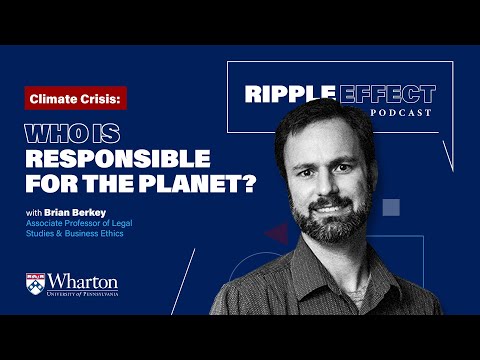
Climate Crisis: What Is Greenwashing and Why Is It Concerning? | Sarah Light — Ripple Effect Podcast
Ask about Knowledge at Wharton
Episode Description
EPISODE OVERVIEW: "Climate Crisis: Why Is Greenwashing So Concerning?" How can regulators stop the deceptive practice of greenwashing without violating firms’ right to free speech? Wharton professor Sarah E. Light explains why this question is so difficult to resolve and what legal steps are being taken to protect the public from false and misleading environmental claims.
Topics and questions covered: 00:00 - Introductions 0:54 - What is ‘greenwashing’? 3:58 - Misleading claims from companies 7:26 - Analyzing greenwashing studies 9:43 - Assessing greenwashing's impact 13:37 - Corporate influence on regulation 17:35 - Social media’s role on climate policy 19:55 - Strategies for corporate transparency
PODCAST OVERVIEW Every day, business scholars answer pressing questions in their research — but what do their insights mean for you? In this podcast, Wharton faculty dive into what inspired their studies and how their findings resonate with the world today. Learn how research insights translate into knowledge you can use, with host Dan Loney.
Learn more at http://whr.tn/rippleeffect
----- The Wharton School of the University of Pennsylvania is committed to sharing its intellectual capital through Knowledge at Wharton, the school’s online business analysis journal.
Launched in 1999, Knowledge at Wharton offers free access to:
- Articles, podcasts, and videos highlighting Wharton faculty research and analysis of current business trends - Interviews with book authors from Wharton School Press - In-depth series of curated content like Wharton Executive Education’s Nano Tools for Leaders - A searchable database of more than 10,000 articles covering all aspects of business - A weekly newsletter that delivers Knowledge at Wharton insights directly to your inbox
Visit the Knowledge at Wharton homepage: https://whr.tn/3qUpSBE Subscribe to the Knowledge at Wharton YouTube channel: https://whr.tn/3DEAgAU
Read the full transcriptHide the full transcript
- in the last few years there's been a kind of shift in the way that greenwashing has entered the public
- Consciousness for many years it was really all about product-based claims but what the shift has been is over the
- past few years firms have increasingly been making claims about their environmental impact as a whole or their
- climate impact welcome to the ripple effect the podcast that takes you on a journey through the minds of Wharton
- faculty I'm your host Dan Loney and in each episode we'll be diving deep into the inspiration behind the
- groundbreaking research that Wharton professors have conducted and exploring how their findings resonate with the
- world today we'll be covering a diverse range of topics bringing you the latest insights and knowledge that you can
- apply to your life and to work so get ready to dive into new ideas with the ripple effect
- all right so this topic of green watching we've heard it talked about a lot in the public it's obviously come up
- with a lot in the media for those that maybe don't have a total grasp on it give us a definition of what green
- watching is absolutely so green washing is kind of this umbrella expression that
- refers to situations in which an entity is publicly making statements about its environmental impact or the
- environmental impact of its products or services that are not actually borne out
- by the evidence so it could be a directly false claim like this product made by this company is 50 recycled
- material when in fact there's no recycled material in it at all it could be um a kind of more vague you know our
- product is all natural we don't really know what that means um and it could be sort of there are
- many many different other forms but what's really important to understand about greenwashing is that it can refer
- not only to a product like a specific advertisement or a product or a service it can also refer to sort of efforts to
- paint the entire firm as being more environmentally conscious than it is and I think that's the way in which it's
- been coming up a lot more recently so what was it that piqued your interest about green washing and also kind of
- also about the First Amendment as well absolutely so as you know from our many conversations over the years
- um I'm a professor at Wharton in the legal studies and business ethics department and
- um and so my interest in kind of uh the intersection of business and environment
- relates primarily to the legal rules and sort of the legal and policy environment
- that addresses the ways in which business firms interact with the environment and green washing is this
- really interesting case because you know not only has it been coming up kind of more and more as firms are becoming more
- and more aware of the fact that their stakeholders want them to be more environmentally friendly or aware
- um but the question of are these claims real are they backed by evidence or are they greenwashing has raised questions
- about how we need to think about enforcement and how can we prevent firms from misleading members of the public be
- they consumers or investors or Regulators about the kind of Bona fidas of their environmental marketing claims
- so um so that's kind of The Big Picture answer about how I'm you know why I'm interested in this topic the most
- specific answer actually is um is that in the last few years there's been a kind of shift in the way that
- greenwashing has entered the public Consciousness for many years it was really all about product based claims
- you know this product contains recycled material when it doesn't or this product
- is you know um non-toxic but it's toxic but what the shift has been is over the past few years firms have increasingly
- been making claims about their environmental impact as whole or their climate impact so for example more than
- a thousand firms in the past few years have made public statements or commitments that they're going to get to
- Net Zero greenhouse gas emissions by 2050. some of those claims may be uh real and
- bet you know backed by evidence and others may be just kind of puffery and kind of trying to go along with the flow
- and so what I'm really interested in and what piqued my interest was situations in which the firm itself is kind of
- trying to characterize itself or its business as making a transition to Net Zero uh by 2050 World
- um when in fact many of the firms are kind of continuing business as usual or you know uh sort of how to tell the
- difference so that's really what piqued my interest in this project a few years ago how prevalent do you think green
- washing is out there in the in the business Community these days right so the truth is I think it's really hard to
- tell I think that um in a way the prevalence depends very much on what your definition is and it's
- this is the really hard part right because when you think about certain legal terms like assault or murder or
- something like that or you know fraud those terms have legal definitions a court can say is this fraud well is it a
- material misrepresentation of fact that harmed you know that that caused harm right there are elements green washing
- is not a legal term of art green washing is like the word that we all use when we
- feel deceived and so you might have a much broader definition of greenwashing than I do or I may have a broader
- definition than you do right and so when I teach the topic of greenwashing to my
- students this is actually really interesting I give them a set of examples that are based on reality
- um you know real life uh cases and I ask them is it greenwashing or is it not brainwashing and of the six examples
- that I give you know two of them at the very extreme ends one is clearly everybody's hand goes up yes this is
- definitely green washing and On The Other Extreme not a single hand goes up definitely not green washing but in the
- middle you get kind of 50 50 and it's really hard to know and part of the reason why is because there can be
- directly false claims where you know either it's factually true or factually not true and you can test it like the
- content of a product um but then they're the kind of misleading ones like a major fossil fuel
- company having an ad that um uh highlights its investments in renewable energy and those Investments
- are real but those Investments comprise less than one percent of the entire business right
- and so it's trying to create an impression or a kind of halo effect that may be misleading
- um as customers or investors are thinking well should I buy this stock or that stock should I go fill up my tank
- at this gas station versus that gas station right and so it affects consumer choices in the marketplace as well as
- investor decisions so it's really the truth is it's really really hard to tell there have been a few studies
- um particularly looking at for example The Net Zero claims by Major firms in like the SNP S P 500 and one recent
- study um uh suggested that the while you know the firms in the sample had uh stated
- publicly that they were going to get to net zero emissions uh by 2050. in fact they were only going to get about 40
- percent of the way there so that's one study but that's kind of the the range that we're dealing with so
- on the other side of this as I alluded to there's a component of First Amendment here yeah uh and I guess the
- question is with the rights that we have under the First Amendment does the issue
- of green washing violate those great so super interesting question and um and you know the reason why I think
- the First Amendment comes into play here is because the since 1976 the Supreme Court has protected not only political
- speech right like I'm gonna vote for so and so but also certain forms of commercial speech as long as that
- commercial speech is truthful and accurate and not deceptive or misleading and before 1976 there was essentially no
- protection like you couldn't say I have a First Amendment right to advertise for
- my business right um you know a state could say no your your lawyers cannot advertise right and
- that wouldn't pose a First Amendment problem but beginning in 1976 the the court basically said even commercial
- speech is protected what's interesting about it is that the reason why the Supreme Court decided to protect
- commercial speech like advertising or marketing claims um is not based on the kind of autonomy
- interest of the speaker it's not about you know the Chevron corporation's autonomy to say what it wants in the
- marketplace it's about you and me as listeners and our interest in the marketplace in
- ensuring that there is accurate factual information so that we can make choices in the marketplace and we can make
- choices about how we want to regulate the marketplace that's basically what the Supreme Court said
- so yeah go ahead so so when you think about that that issue of misinformation yes and you think about the the
- potential impact that it might have on the marketplace there are a variety of different elements where it could have
- impact from bottom line benefit to the company to the impact on its uh shareholders to the public you know
- there are so many areas that could potentially be impacted here absolutely absolutely so we know from Empirical
- research some of which has been done by my Wharton colleagues that um as well as people from other schools
- of course um that uh marketing information about firms sort of corporate social responsibility or
- their environmental programs um can have an impact in kind of two primary ways the first is on the
- consumer so there's one study that demonstrates a kind of halo effect um for products uh produced by a firm
- that engages actively in corporate social responsibilities so participants in this study
- um were provided information about you know firm a donates money to X cause and then we're asked to rate
- um a hair regrowth product um a tooth whitener and a uh an optical character recognition text scanning
- program to to basically rate the programs rate these products as to how good they were you know how wide are the
- how much hair grew back how how clear is the scan um and another group of participants
- were asked to rate the same product but were given no information about donations by The Firm
- and the participants who learned that the firm had engaged in corporate social responsibility rated the teeth as wider
- the text is clearer and the hair is fluffier um and this is sort of a really clear
- demonstration of a halo effect right so when you you know when there are other studies that say that or that
- demonstrate that when consumers learn that a firm makes product X using renewable energy or in some other kind
- of you know environmentally conscious way they attribute that environmental Consciousness to the firm's other
- products they'll say oh well if that product is made with renewable energy then you know all the products may be
- made with renewable energy there's an assumption to that effect so there's kind of this Halo of greenness that
- comes about and if I'm making a choice in the marketplace about whether to purchase you know from firm a or firm B
- and I find out that firm a is using renewable energy I might buy from firm a and so if that's true that I'm making a
- good choice if that's green washing and in fact the firm isn't using renewable energy or they're only using it in some
- really limited way but they're hyping it up and they're advertising um then I'm being misled and maybe I
- would have chosen the other product right so it distorts voices in The Marketplace the second Major Impact
- relates to um our role not as consumers but as voters and there are a number of different
- studies that show that when when um in sort of in both directions that there are policies delivers so on the
- one hand there is the negative policy spillover meaning study has shown that when
- um participants learn that all firms in an industry are setting targets that they're going to use you know recycled
- materials in their products they're less likely to support public regulation on the same subject matter largely because
- of this impression that like the firms have got it right this is under control this isn't an area that we need to
- address with regulation on the flip side there are also studies that show that certain segments of the population may
- be more likely to support public regulation when they learn that a firm has taken action rather than like the
- state of California so my favorite study in this regard his one uh done by uh some uh faculty at Northwestern who
- basically showed participants in the study information about either California using cage-free eggs or
- McDonald's using cage-free eggs in their supply chains and then they disaggregated the participants by
- political affiliation and what they found was that if you're on the liberal side of the spectrum didn't really
- matter that much if you learned that California or McDonald's was using cage-free eggs you were generally
- supportive of laws against battery hen egg production battery cage and egg production sorry I'm not saying that
- right but you know what I mean um whereas people who identified as very conservative when they learned that the
- state of California was purchasing only cage-free eggs they weren't super supportive of public policy they're like
- you know those Tree Huggers uh they're gonna do what they want crazy State of California but when conservatives
- learned that McDonald's was purchasing cage-free eggs they were as supportive of public policy
- on cage-free eggs as liberals why maybe if a major corporation thinks that this is an issue as well as if a
- major corporation thinks that it can do this you know consistent with its profit
- maximizing goals then this is really a problem so I as a conservative and more likely to trust it if McDonald's thinks
- it's a problem than if the state of California right and so we so there's an impact
- also on like the interest in members of the public to regulate the problem so there's a component then of of trust
- that is kind of involved in that messaging as well especially when you're talking about an element of the
- government versus a a corporate entity as well yeah absolutely and I think that that's pretty well estab lished there's
- this concept credibility right so depending upon you know how I self-identify whether it's as
- a matter of partisan politics or as a matter of other you know identity-based characteristics that I may find certain
- uh sources more credible so I might find the state of California more credible than the US military someone might find
- the US military more credible than McDonald's right you can you can kind of see where it goes based upon sort of
- different values that we hold or D or you know uh different factors that that play into
- our identity but I want to mention uh just to sort of pick up your question from earlier about the first amendment
- that the way in which the First Amendment really begins to come into play is because the first amendment is a
- limit on what the government can do right the first amendment basically says I have a right not to be bothered by the
- government not to be told what to do by the government in certain types of Regulation and so if we're thinking
- about what we want to do to prevent or deter or punish green washing the First Amendment kind of sets the
- outer boundaries of what legal institutions like the Federal Trade Commission or the states or the
- Securities and Exchange Commission can do to either required disclosure of environmental information or after the
- fact to allow the government to sue a firm for a false or misleading statement and so that's kind of the way that the
- First Amendment comes into play is sort of what are the outer boundaries of what
- the regulatory State can do to address this problem so in this era that we're in right now
- where uh social is playing such an even greater role uh in our communities and with the impact around around businesses
- how much impact you think a an expectation from the public or uh uh that that that social expectation how
- much do you think that that can actually play a role in changing the mind or changing the path of a company uh around
- some of these issues so I actually think it's playing a really important role I mean I think
- it's playing an important role in in sort of multiple different ways at one level there's like the organized social
- movement that's you know boycotting company X for not doing more on choose your issue whether it's
- environmental or social or the organized environmental movement you know or the organized movement on the other side
- boycotting the company that's doing too much right I mean so there's there's sort of that level
- I think that at a kind of More disaggregated Level there are empirical studies that show that consumers have
- expressed a greater willingness to pay for products that are more environmentally friendly
- um and the fact that you know I have colleagues at Wharton who's who have said and I think that they're right that
- as soon as we begin to live in a world in which the marketplace values environmentally
- friendliness we're likely to see not only genuine environmental friendliness but also greenwashing right because
- firms want to you know some of them it may be completely benign right they want to do something they're like seeing all
- of their industry you know competitors announcing these pledges and they're like oh we've got to do something and
- they don't necessarily know quite what to do and so they make the pledge and they're not quite ready to support it
- with the facts but you know if if they can kind of get on the bandwagon then you know nobody's going to be upset and
- then there's the like really you know intentional efforts to mislead um to hide you know and I think
- okay so then what do you think needs to occur then to be able to get kind of a more
- accurate picture of what companies are doing especially if they are not telling the truth absolutely so
- um so as a lawyer it's very important to me to work in at least one or two Latin
- phrases during our conversation and so here they are we have the right we have the X ante and we have the X post so X
- Auntie means before the fact X post means after the fact so often when we think about something like greenwashing
- we think about Expo who can sue the company when they've published the ad and the ad is misleading
- um that would be the FTC the Federal Trade Commission which has power under the Federal Trade Commission act to
- um go after companies that are engaged in deceptive uh marketing practices that affect Commerce and so the FTC has
- published something called the green guides which are its interpretation of how that statute applies to
- environmental marketing claim and the FDC just a couple of months ago requested and that sort of comment on
- how it needs to update the guides it hasn't updated them since 2012 it's due for an update I will be submitting you
- know some suggestions right um but at the end of the day that's the x-post that's there was an ad somebody thinks
- that it's misleading the FTC Sues and seeks you know cease and desist orders you know take down that ad and pay a
- penalty the ex-ante approach is the one that frankly I think is probably more important and more effective and that's
- the one that's embodied in the Securities and Exchange Commission um mandatory disclosure uh ideas right
- so last year the SEC um published a proposed rule on climate disclosures that would apply only to
- publicly traded companies but basically said that in their annual you know periodic report that in addition to all
- the other information that they need to disclose on an annual basis they also need to disclose their greenhouse gas
- emissions they need to disclose if they are have made a public commitment to reduce emissions how they tend to
- achieve that goal do they plan to use carbon credits and offsets Etc um we are now waiting for the SEC uh
- issued a proposed rule has accepted comments on the rule got many many many many comments and is now working its way
- through them and we're anticipating that sometime this spring um the SEC is going to publish a final
- rule which will immediately be litigated in the courts and so not going to come into effect immediately but the idea of
- disclosure and and I'm a big fan of disclosure is you know if we're putting more accurate
- factual information out into the marketplace not only does that deter companies from putting false or
- misleading information into the marketplace but it also gives us a better handle on sort of what companies
- are actually doing in a way that we can maybe do a better job of judging when claims are false or misleading
- right yeah do you think then do you think we're on on the right path in terms of really making some significant
- change uh in this area and having less green washing out there in you know kind of in the business public business
- community and with the public as well right so I think that the I think that if the SEC does go forward with this
- disclosure rule my understanding and you know the sort of the word on the street
- is that the final rule will probably be narrower than the proposed rule based on
- the comments but you know we'll have to see I think that it will be a step in the right direction
- um I you know I think that it's really really hard for Regulators to catch up with marketing right Regulators have to
- go through these really really long and tortured processes to publish a you know
- proposed Rule and then accept comment and then a final Rule and all in the meantime more and more claims are being
- made about you know the the greenness of our you know of our our Industries and um
- and so whether it'll stamp out the problem I don't know but I think that it it's a definite step in the right
- direction and probably a better one than just you know expecting that either the Federal Trade
- Mission or the states which have similar Powers um are going to go after every advertisement right that's a very that's
- a very um laborious process thank you for listening to the ripple effect we hope you found this episode
- informative and engaging don't forget to subscribe and leave us a review so that
- we can continue to bring you the best Insight from the warden School
Brief Summary
This episode covers greenwashing, its legal implications, and the need for regulatory changes to ensure truthful environmental claims by companies.
Key points
- Understanding Greenwashing. Greenwashing refers to misleading claims about environmental impact. It's crucial to discern the truth behind these statements.
- The Role of the First Amendment. The First Amendment influences how greenwashing can be regulated, affecting both companies and consumers.
- Consumer Willingness to Pay. Studies show consumers are more willing to pay for environmentally friendly products, impacting market dynamics.
- SEC's Proposed Climate Disclosure Rule. The SEC is working on a rule requiring companies to disclose greenhouse gas emissions and reduction commitments.
Episode highlights
- Understanding GreenwashingGreenwashing refers to misleading claims about environmental impact. It's crucial to discern the truth behind these statements.“Greenwashing is a kind of umbrella expression.”1:08Apr 11, 2023
- The Role of the First AmendmentThe First Amendment influences how greenwashing can be regulated, affecting both companies and consumers.“The First Amendment sets the outer boundaries.”16:41Apr 11, 2023
- Consumer Willingness to PayStudies show consumers are more willing to pay for environmentally friendly products, impacting market dynamics.“Consumers have expressed a greater willingness to pay for environmentally friendly products.”18:49Apr 11, 2023
- SEC's Proposed Climate Disclosure RuleThe SEC is working on a rule requiring companies to disclose greenhouse gas emissions and reduction commitments.“The SEC is going to publish a final rule which will immediately be litigated.”22:38Apr 11, 2023