How to Think on Your Feet in High-Pressure Moments
Ask about Knowledge at Wharton
Episode Description
ABOUT THE EPISODE Stanford Graduate School of Business lecturer Matt Abrahams, author of Think Faster, Talk Smarter and host of the podcast of the same name, discusses how leaders can improve spontaneous communication. He explains why structure and active listening are critical in high-pressure moments, outlines his ADD framework for adding value: "Answer the question. Give a detailed example. Describe the relevance or value of the answer." He also shares practical techniques for managing speaking anxiety. Abrahams highlights how executives can approach crisis communication with clarity and credibility.
ABOUT THE PODCAST Marketing Matters is hosted by Wharton marketing professors Barbara Kahn and Americus Reed. Each week they discuss marketing and advertising trends, consumer behavior, data and analytics, the latest in retail marketing, brand-building, and much more with their expert guests. Episodes are recorded at the Wharton School.
Watch/listen on the Knowledge at Wharton website: https://whr.tn/marketingmatters
#ExecutiveCommunication #CrisisCommunication #PublicSpeaking #ActiveListening #LeadershipCommunication ----- The Wharton School of the University of Pennsylvania is committed to sharing its intellectual capital through Knowledge at Wharton, the school’s online business analysis journal.
Launched in 1999, Knowledge at Wharton offers free access to:
- Articles, podcasts, and videos highlighting Wharton faculty research and analysis of current business trends - Interviews with book authors from Wharton School Press - In-depth series of curated content like Wharton Executive Education’s Nano Tools for Leaders - A searchable database of more than 10,000 articles covering all aspects of business - A weekly newsletter that delivers Knowledge at Wharton insights directly to your inbox
Visit the Knowledge at Wharton homepage: https://whr.tn/3qUpSBE Subscribe to the Knowledge at Wharton YouTube channel: https://whr.tn/3DEAgAU
Read the full transcriptHide the full transcript
- Hello and welcome. You're listening to Marketing Matters on the Wharton podcast network. This is our weekly podcast
- where we analyze the latest in advertising, marketing, customer behavior, new product launches,
- retailing, branding. I'm Barbara Khan, the Patty and JH Baker Professor of Marketing, and I'm joined by my co-host,
- Americus Reed, the Whitney M. Young Jr. Professor of Marketing and the brand identity theorist. Hello, Americus.
- >> Hi, Barbara. So, you know, they call you the wizard of the Wharton marketing department and uh the reason why they
- call you this is that you wave your wisdom wand and magical things happen because we just get smarter about very
- specific topics. So, I was thinking about this and I was imagining the last two thought scenarios that we've been
- sort of discussing, which is what if you're the CMO of Cracker Barrel and things are going haywire online and you
- got to be able to communicate. You gota be able to come up with a strategy to be
- able to understand the right ways to persuade people of your particular position or let's say you are seuite
- leadership at Disney and you're sort of trying to struggle to figure out should we bring Kimmel back should we not bring
- him back what's going on in this ecosystem you need a strategy Barbara so I'm coming to you today to see if we can
- somehow find some insight around communication comms how to say the right things what to say when how what have
- you got for me today wizard How about the author of a book called Think Faster, Talk Smarter. Wouldn't that be a
- good solution to that problem, Americas? >> Amazing. >> So, we're so lucky today to have with us
- the author of that book, Think Faster, Talk Smarter, and the host of a podcast with the same name, Think Fast, Talk
- Smart, Matt Abrahams. Thank you, Matt, so much for being here. >> Hi, Matt. >> I am thrilled to be with you, America.
- Barbara, I wish you guys had more energy. Would you please dial it up a little bit?
- >> Yes, we're full of caffeine, sir. That might be one of your one of your protocols. I don't know. We'll see.
- >> We are so happy to talk to you. Not Not only are you a podcast, an author, but
- you also are teach at Stanford Graduate School of Business, so you're one of us.
- So, we're really happy to have you with us. Can you tell us like a little bit about your background, how you managed
- to accumulate all these accolades? >> Well, thank you. and and there's nothing more wonderful than being faculty at a
- business school. You know that the students are amazingly bright. The opportunities are fantastic and and I
- love learning. So, it's it's an opportunity to learn to teach. Uh you know, my background is I I've always
- been passionate about communication. My mother was a teacher, an elementary school teacher. My father was a lawyer.
- So, words and communication were always really important. My father was always, "How do we structure this, make this
- clear and concise?" And my mother was, "How do we make this engaging and interesting?" And so from a very young
- age I was always fascinated by communication. Uh with the last name Abrahams, I always went first in school.
- So so the my latest work has been on what I call spontaneous speaking. How do you communicate in the moment when
- you're put on the spot? And my whole life has been that way because I always knew where I sat. I always knew I was
- going to go first. So I was always put on the spot. So I think that that interest early in my life and the
- experience I had growing up really had me focus on communication. and I was fortunate enough to to study it in grad
- school and then I worked in the corporate world for over a decade. I ran learning and development for companies
- and clearly saw how critical communication is to success not just for organizations but for individuals within
- those organizations. So I've been teaching strategic communication now at Stanford's Graduate School of Business
- for this is my 16th year. We just started recently and uh I love helping students understand how they can hone
- and develop their communication skills. You know, I have a couple reactions to what you just said. One of them reminded
- me of Malcolm Gladwell's book, I forget which book it was, where he talked about
- like whether you were born in the beginning of the year or the end of the year, you're going to have some
- advantage in school or that's a really interesting thing to think about where you are in the alphabet because it does
- follow you um throughout your whole >> Absolutely. >> So much so that that I was I actually
- feel a little offended uh at Stanford's business school and you might know her given that you're in marketing. Jennifer
- Oer is aa and and so it is it is one of the very first times in my life where I have not been first and so uh well I I
- adore Jennifer and her work is phenomenal. It it is funny that I >> America's thinking fast.
- >> Yeah, exactly. >> I didn't even hear the question before you came up with the answer.
- >> No doubt. This is awesome. Very very cool. Yes. But, you know, this idea of of communication and the way America has
- put it out there with like CEOs seriously having to be on the spot to answer really quickly, what are your big
- takeaways, your big ahas on that? >> Absolutely. So, first and foremost, this is a skill that needs to be worked on.
- Many people feel I'm either born with it or I'm not. And that's not true. It is a
- skill you can learn and you develop. You can develop it. I always use the analogy
- of athletes. If you think about it, athletes in whatever their sport is, they are being spontaneous. They are
- responding to what's demanded in the moment, but they do a lot of drills and practice. So, we have to practice for
- this. That's number one. When it comes to doing that work, we have to take a two-pronged approach. It's about mindset
- and messaging. >> And with mindset, there are a lot of things we have to do. We have to get
- present. We have to listen deeply. We have to remember that these situations are actually opportunities, not threats
- and challenges. So, mindset is really important. And you have colleagues, I have colleagues that study mindset that
- really share how important the way you approach life, but particularly communication matters, but also how we
- craft our messages. Messages need structure. Structure is a logical connection of ideas. And if you train
- yourself on some of these structures, they actually give you road mapaps to help. We all know structure. If you've
- ever seen a television ad, you've seen the structure problem, solution, benefit, issue, challenge in the world.
- the product or service helps remedy it and we benefit. If you can get the right mindset, develop the right structures,
- it becomes much easier to manage in the moment. >> Let me let me pick apart a little bit of
- what you said because um and let's start with the first part before we get to the
- structure. One of the things that struck me that you said and it sounds like kind
- of obvious but it's not my experience that people do do this >> which is you said you got to do active
- listening. Um, I find in a lot of these conversations, especially with people who really know them, their stuff,
- they're real experts, that they're not really listening. They're waiting. They're waiting until you're done so
- they can say what comes next. Yes. >> And one of the best advice I ever got for teaching really and you know when
- you're a young teacher or you're in there like you're so anxious to prove yourself that I think this idea of
- active listening. I mean right there in my opinion I don't know if you agree with me on this but that's like an
- incredibly important piece of advice that I don't think people necessarily hear.
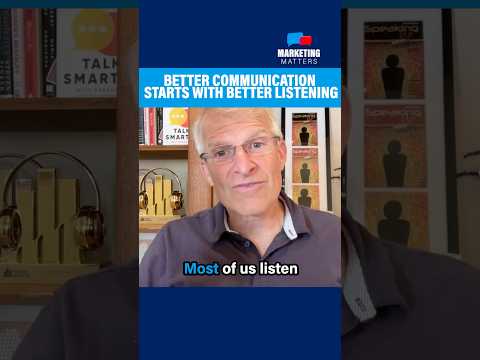
- >> 100% listening. You know as somebody who teaches communication people are often
- surprised that I spend a lot of time talking about listening. Most of us see communication as putting information
- out, broadcasting. But listening is critical, especially in spontaneous situations because if you don't listen
- astutely, you might miss what's really being asked. If it's Q&A, what's really needed, if it's feedback, I have a
- situation where in my life, this actually I screwed it up. So we I came out of a meeting with a colleague. The
- meeting did not go well. And the colleague turned to me and said, "Hey, what do you think? What what's what do
- you think? How'd we do?" I immediately heard feedback. What I missed was that he came out of the room the back door.
- He was speaking quietly, looking down. He did not want feedback. He wanted support. And when I itemized all the
- things we did wrong, I damaged the relationship. >> And you're exactly right. Active
- listening is important. But more so than active listening. We actually have to repeat back what we've heard. I teach
- people and train people, and my wife gets really upset when I teach listening skills because she thinks I'm a fraud.
- She thinks I need to do some work on this. But I I >> Wow. >> I teach >> You're being quite transparent, sir.
- It's We love We love honesty. >> You know, authenticity and being candid are critical. Um I teach people when I
- teach listening skills to listen to paraphrase. Most of us listen just for the top line of what we hear and then we
- begin rehearsing, planning, and and judging. You need to listen for the bottom line. So, I'm listening. If I had
- to summarize everything you're saying, what would I say? That causes me to listen more deeply and completely and
- then what we know from some of our colleagues who teach at Harvard just, you know, a little bit away from you all
- that if you actually pair it back, if you do that paraphrasing, not only do you demonstrate listening, but you
- actually begin to foster trust and connection. >> So listening is critical. Not only does
- it make sure you respond appropriately, but it makes sure that you connect to the person. I love the notion of a
- shared reality and we shared reality. I'll say it again and we miss that a lot. We we we'll be talking to each
- other and it'll be landing on each other totally differently and we'll have no idea. So I love this point Barbara and
- please jump in and continue what you were going to uh you know build on that it's just trying to get to a shared
- reality and that understanding of listening active listening like Barbara said as opposed to waiting for the
- silence to end. I love that point. >> You know, I mean, the other thing about this thinking just in the way America
- set it up, you know, we are a marketing um podcast, so thinking about how these skills are useful for marketers and in
- particular, as he set it up, in crisis situations where communication is critical. Another advantage of what you
- just said, not only are you really listening and forcing yourself to listen, but it gives you time. Like I
- don't know how important you think that is, but like you you know if you're you're talking about speaking fast. I
- forget thinking I forget. >> Think fast, talk smart. Yeah. Think. All right. Let's Barbara, let's practice
- together. Think fast, talk smart. There you go. >> But like I mean that almost implies I
- should think really fast. But like what you just said is if you actively listen and then take the time to repeat what
- you just said, you're actually giving yourself time. It's not like a race, you know.
- >> Yeah. So, two things I want to highlight based on what you said. First, think
- fast and think faster is all about pattern recognition. >> If you train yourself to recognize the
- patterns, you can respond better. So, you actually become faster. Expertise is often defined as pattern recognition.
- When you look at a chess master and a lot of the expertise research is done on people who play chess, uh it's really
- pattern recognition. So think faster is all about pattern recognition, not literally about thinking faster because
- that can cause you to stumble. But you're also right in situations of spontaneous communication, you can take
- some time. There are three ways I I coach and teach people to do this. One, ask for it. Say, "Let me think about
- that for a second." That's okay. In fact, there's some research that says when you deliberately pause to reflect,
- people see you as more credible because you're really trying to be present and give them what they need.
- >> Thoughtful. Second, you can ask a clarifying question. If you ask me a question, ask me to do something, I can
- ask for some clarity. That buys me some time. And then finally, what we talked about earlier is paraphrasing.
- Paraphrasing is a lower order cognitive skill, which means we can do it and be thinking of other things. So, it buys us
- some time. So, you're absolutely right. We have to buy time if we want to. And we can do so for by asking for it, by
- asking questions, or paraphrasing. I love this point. I you know something else that jumped into my mind Barbara as
- we were having this discussion with Matt and that's the idea of like how fundamental this is right anytime a
- human and another human is engaging Matt's work becomes relevant right so you can think about a million different
- marketing contexts where this might play out right a retail Matt uh Barbara is the retail guru at the Wharton school
- she knows everything about retail everything she's a wizard she's a guru that's great
- >> it's unbelievable I just love basking in her glory >> basking in her intellectual intellectual
- Matt, so so the idea of like customers, like how do you talk to customers? You know, we talked about seuite stuff, all
- of that stuff. But I want to put you in the hot seat, Matt, real quick. I want to go back to All right. So you are the
- Disney executives and you're starting to get some feedback from reactions to this
- situation with what Jimmy Kimmel said on the television show and there's licenses
- issues, blah blah blah. You're counseling Disney in the early days. Take us through the analysis. What do
- you tell them? how what pieces of additional advice, you know, above and beyond what you've talked about thus far
- would you give them and how would you help them not destroy things or keep things, you know, kind of under control
- if that's possible? Well, first, thank you for giving me a a situation that isn't inflammatory and have lots of
- challenges on it. I appreciate that. >> Don't say the wrong thing. >> Yeah. So my my advice in all of these
- types of crisis situations is first understand the situation. Often people react quickly and that actually can work
- against them. I'm not saying be slow. I'm saying take a moment to really understand what's an issue. First and
- foremost in all strategic communication you need to understand the audience and audiences you're speaking to. So what
- are what are the issues at play here? You have to lay them out in a dispassionate way to understand what's
- going on. Once you have that understanding, begin to think about what are the what are the potential solutions
- that we can deploy here. You know, they they pulled the plug very quickly. Okay.
- What then do we do with that situation? You know, now that we've made that rash or quick decision, what is it that we're
- going to do? So really think through the opportunities and and the problem solutions that you have and think then
- about the ramifications of action or no action. So if I were advising Disney, I would I would first say who are the
- constituents at play here? What are the issues involved? What are the possible solutions that you have? Look at that
- solution set. Think about the ramifications and then begin thinking about the scenarios and how they would
- plan out. So do some scenario planning. Think about the reactions. This takes a little bit of time, but it is time well
- spent. >> When you move very quickly, you then have to not only fix the mess that got
- you to that place in in the first place, but you often create another mess because you move so quickly. So, I
- really think people need to test step back, take time, think about who the audience is.
- >> Let me double down on something you said earlier about that. I complet I hear
- what you're saying and it's kind of like the structure that you're going to use to respond. Another thing I I heard you
- say in the beginning which I think is right especially in these kind of inflammatory situations is that you kind
- of have to train on these frameworks so that you can pull them up right away. I mean that's one of the things that we do
- in teaching core marketing is we try to give a a framework for immediately how to analyze. You know, we call it five
- C's, STP, four Ps, and we practice over and over. The answer to each situation is different. And then you need to
- think, you need to listen, do all those things. But there's some value in setting up these structures. I think
- that that's what you said beginning and I just want to like double down on that.
- >> Absolutely. So having having structures that you are familiar with, well practiced structures help you because
- they give you a place to go. You can make the choice to go there or not, but at least you have a direction. So when I
- teach people Q&A skills, Q&A is spontaneous speaking. I have a structure I like to teach people. I'm happy to
- share it with you in a moment. But by virtue of having that structure, you can fulfill one of the two obligations of
- spontaneous speaking. What to say and how to say it. The structure tells you how to say it. It's like a recipe. I am
- a lousy cook. Neither of you would ever like to eat a meal I make. But I am a better cook when I follow a recipe. Mhm.
- >> So I teach people a structure. It's three simple steps. A DD for adding value. Answer the question. Give a
- detailed example. Describe the relevance or value of the answer. So let if you don't mind, let's play this out. Imagine
- you are interviewing Americas though. >> I'm going to have you put me in the in the hot seat. I want both of you to
- imagine that you are the on faculty to hire somebody to teach strategic communication at your prestigious your
- prestigious business school my whichever it doesn't matter what is a reasonable interview question you would ask that
- doesn't just have a yes no answer to see if I'm qualified to teach MBA students strategic communication question just
- ask me a question and I'll try to answer it in the structure be kind that's good uh and so make sure I I'm
- going to ask another clarifying question to buy a little more time. >> To buy some time. I love what you're
- doing. And you're going to paraphrase. >> You see what I did there, Matt? Did you?
- >> I did. >> Uh, I did. >> Yeah. But so, we're interviewing someone. They're going to come in and
- they're going to start immediately, Barbara, teaching our uh, warden MBAs. So, I'm probably going to ask how what
- something to the effect of what is your philosophy on how the things that we study as an academic show up in the ways
- we need to teach in the classroom. >> I might ask a question like that. I I believe it is absolutely critical when
- teaching strategic communication skills to role model and demonstrate effective communication. In all of my teaching,
- everything from how my syllabus is put together through what I do in office hours to how the students metriculate
- and what I say as they're leaving class is all well thought out to demonstrate and role model what it is we teach in
- the class. So, if you were to hire me, I would make sure that our students not just learn the theory and practice, but
- they see it play out so they can take advantage of and understand what it looks like. So, you can tell me if
- that's a good answer or not, but it certainly followed the structure. It answered the question,
- >> gave a detailed example, >> and then it explained why that's important or what comes next.
- >> See, I need your help, Matt, because Barbara gets uh very high, you know, student ratings. I'm just I'm just
- trying to get get better. This is great advice, though. This is fantastic advice.
- >> But but you can see how having that structure. I didn't know what question you were going to ask you. That was a
- question I have was totally not knowing. I did not know it was coming, but I knew
- how I was going to answer it. I was going to give an answer, give an example, explain the relevance. So,
- because I had that path, it was easier for me to put that answer together. And that's what structure does. And back to
- what you said, Barbara, if you practice structure, not just in messaging, but in
- your approach to dealing with issues and challenges, you can more easily and readily do it. That's just like an
- athlete who does all these drills. when in the game the opportunity to deploy what they did the drill for comes up,
- they're at an advantage. >> Yeah. It's kind of like, you know, you're talking about thinking fast. I
- reminds me of the Conaman framework, system one, system two. >> That's exactly. >> And what you're talking about system one
- is automatic thinking. And if you have these frameworks and rehearse it even though the answers are going to change
- in each time you have something you can immediately go to and you know you're going to try to answer the question
- you're going to try to give an example and then you're going to try to say why it's relevant. I think I was looking at
- some of the things that you have said in the media before just you know to see which questions you were asked that I
- was particularly interested in and one of them you were asked was like how do you overcome anxiety? Like that's an
- interesting thing because a lot of people are um anxious about public speaking or they're afraid some
- interview or something like this >> and I I think that I'm guessing one of the answers to that question is going to
- be to have these frameworks to rely on. I don't know is that is that an answer to your question?
- >> Uh so so having frameworks helps take away some of the pressure. You know I spent a lot of my time helping people
- feel more confident and less anxious around speaking. It is a ubiquitous fear. Those of us who study it believe
- it is just part of being human. We see it in every culture and we see it start to develop at certain times of in
- children's development as they become uh teenagers. So this is it's it's critical
- to work on and there are things you can do to manage the anxiety. Up to 85% of people report feeling nervous and high
- stakes communication situations. Personally, I think the other 15% are lying. I'm lying
- a situation. But there are many things you can do from managing symptoms. You know, the experiences we have, the the
- shakiness in our voice, in our bodies, the sweatiness on our brow, there are things we can do to manage that. Deep
- belly breathing is a great way to to reduce some of that. We have to deal with some of the sources as well. One of
- the sources of anxiety is wanting to communicate right to do it right. I have been doing this work for decades. There
- is no right way to communicate. There are better ways and worse ways. But here's where that structure piece comes
- in. Many of us believe that if I memorize what I'm going to say, then I'm going to do it right. So the problem
- there is when you memorize, you actually split your cognitive bandwidth, your precious limited cognitive bandwidth. So
- part of it is judging and evaluating. Am I saying it right? And only part of it is in the process of actually doing the
- communication. It's much like when you have a laptop open and you have lots of windows open. Each one of those is a
- little slower. Yeah. So this is where this this is where structure helps because if I don't
- memorize, what do I have to get through my material? I have a structure. So structure is the answer to avoiding that
- perfection memorization trap. It's a really quick story, Barbara. When I did a I did a TEDex talk many years ago and
- the organizers were really all over me about send the script, send the thing because they want to put it in the the
- confidence monitor. And the day of the practice, Barbara, it was a total disaster because I just don't operate
- like in reading stuff and things like that. To your point, Matt, I said, "Forget it." The next day, I kind of
- showed up and I said, "Here are my bullet points. Put the bullet points up. Let me work through this. Give me the
- timer and I'll fit into the timer." And I it made me realize the question, Barbara, I want to ask this. Can can you
- know are there heterogeneity differences in people who yes we can practice but are there certain types of personalities
- where this person is just you know maybe maybe they're born to be a an improv comic I mean they're just good with this
- stuff or or how talk and by the way I will share with you Matt Barbara has also completed a comedy course so she is
- a master master of uh improv comedy in addition to her wizardry and retail guru >> of course master is a is a leap I, you
- know, improv, I think, is one of the best skills to train people to be effective in the moment communicators.
- Most people think improv is about being funny. It's not. It's about being present. It's about being open to
- opportunity. Yeah. Exactly. And we have lots of I don't know if Wharton does, but here at the GSB, we have lots of
- classes that infuse improvisation because a manager, a leader needs to have those skills. That said, Barbara, I
- want you to invite me to an open mic night when you're performing and I will come and be in the audience.
- >> No problem. It's hard. I like stand up better, actually. >> Okay. Well, you still have in in
- standup, you have to respond to hecklers and what's happening in the room. So, there there's a lot of spontaneity. I
- have a cousin who is actually a very well-known comic. And uh it's wonderful to see him work a room. There's a lot of
- spontaneity in that. And all of us as leaders, as people need to have those skills. I I want to kind of switch
- gears. You're saying so many things and it's so interesting. What? No, it's wonderful. I love it. Uh and so relevant
- both to communications and to marketing, but one of the things we're also interested in just because we do this
- too is not only are you at Stanford teaching and writing books, but you do have a very successful podcast. So I'm
- curious, were you like a pioneer in the podcast world? Um how did you get to grow your podcast?
- >> Yes. share some of that wisdom with us, Matt. So, as with many things in my life, it's about serendipity and
- willingness to take risk. So, uh five five and a half years ago, almost six years ago, the business school came to
- me and said, "Hey, we're interested in trying a podcast. We the the Stanford has never had the business school had
- never had a true podcast. They had classes that they would slice and dice and call podcasts, but those were
- courses that were made into podcasts." And I uh like Americus I had done a uh a talk. The talk had done really well. It
- was about communication. So they said, "We know that there's an audience for communication. So do you mind?" And and
- I've learned in my career that when opportunity comes, sure, say yes, why not? I'm I'm very driven to help people
- with their communication skills. This seemed like a reasonable way to try. Well, this is where circumstance really
- played out. And and I tell all my students, I tell my children, you can be really good at what you do, but luck
- plays a big role in life. We came out with our first episodes end of January 2020. So here we are with six episodes
- ahead of the curve >> on communication. >> Wow. >> And then the world shuts down, the
- pandemic happens, everybody is sequestered, everybody starts listening to to podcasts and people are like, how
- the heck do I communicate in this sequestered world? So here we were with content at a trusted source that was
- relevant while people had time to listen. So I think we had good content, but I certainly am under no uh no
- delusions that we were in the right place at the right time. And thankfully the audience started there and and
- because hopefully of the value we provide, the audience has grown. But you know what Justin marketing if you have
- an offering that people need then you can build a base. >> But you've been doing this now for six
- years. I'm kind of and do you do an interview show also? Do you talk to people? >> So how I'm just curious over the six
- years starting from precoid what are the natures of the guests you get on and like what are some of the topics you've
- talked about? So we we have academics. I've had several of your colleagues on Katie Milkman, Jonah Burgerer. Uh we we
- recently talked to Wendy Dear Rosa. So a lot of Wharton faculty, clearly a lot of
- Stanford faculty, but also practitioners, expert practitioners who who have something to say around
- communication. You know, the nice thing about what I teach, similar to what you teach, I mean, marketing and
- communication, those are big umbrellas. A lot of things fit under that those umbrellas. So we bring people on. Uh,
- part of the key, I think, to our success is we're very brief. Our episodes are 20
- minutes long. Our goal is at the end of every episode, you leave with at least two or three things you can implement
- right away. We've won lots of fancy awards. The one I'm most proud of is best dog walking podcast because we're
- 20 minutes. People walk their dogs for 20 minutes, they get value. Um, so, so yeah, I mean, you I mean, as marketing
- professionals, you understand you have to have a good product. It has to have it has to fit into people's lives.
- People have to see value from it. And that's what we've tried to to build. And we are very responsive to our audience.
- You know, we believe in the agile development, rapid prototyping. We try lots of things. Some work, some don't,
- but we're always in service of our audience. >> Well, Matt, in in in thinking of keeping
- it short, we are at the end of our time. So, we'd like to thank you so much for joining us today and tell our listeners
- where they can go to hear about your work, your podcast, etc. >> Well, first, thank you so much. It was a
- true pleasure. I love talking to people who are in the same world I am, both podcasting and academics. Uh, to find
- out more about what what I do and what I'm up to, go to fastermarter.io and you can always link in with me at
- Matt Abrahams on LinkedIn. Those are two great resources. Happy to connect and happy to share and continue the
- education that you all are providing to your audience. >> And you gave them a good way to remember
- your last name, right? Right in the >> Yes, exactly. There you go. >> Excellent. Love it.
- >> Anyway, thank you very much. That's all we have time for today. Thank you all
- for listening. We'd like to thank our producers Deion Simpkins and Marissa Rena. We'll be back next week. Till
- then, this has been Marketing Matters on the Wharton Podcast Network. I'm Barbara
- Khan here with America Reed. [Music]
Brief Summary
Matt Abrahams discusses communication strategies for crisis management and the importance of active listening in marketing contexts.
Key points
- The Wizard of Marketing. Americus Reed introduces Barbara Khan as the 'wizard' of the Wharton marketing department.
- Think Faster, Talk Smarter. Matt Abrahams, author and podcast host, joins the discussion on communication strategies.
- The Importance of Active Listening. Matt Abrahams highlights how active listening can improve communication and relationships.
- Crisis Communication Strategies. Matt Abrahams advises on how to handle communication during crises, emphasizing understanding the audience.
- Frameworks for Spontaneous Speaking. Matt Abrahams discusses the importance of having frameworks for effective spontaneous communication.
- Managing Public Speaking Anxiety. Up to 85% of people report feeling nervous in high-stakes communication situations.
Episode highlights
- The Wizard of MarketingAmericus Reed introduces Barbara Khan as the 'wizard' of the Wharton marketing department.“They call you the wizard of the Wharton marketing department.”0:28Sep 26, 2025
- Think Faster, Talk SmarterMatt Abrahams, author and podcast host, joins the discussion on communication strategies.“We’re so lucky today to have with us the author of Think Faster, Talk Smarter.”1:37Sep 26, 2025
- The Importance of Active ListeningMatt Abrahams highlights how active listening can improve communication and relationships.“Active listening is critical, especially in spontaneous situations.”7:11Sep 26, 2025
- Crisis Communication StrategiesMatt Abrahams advises on how to handle communication during crises, emphasizing understanding the audience.“First, understand the situation.”13:15Sep 26, 2025
- Frameworks for Spontaneous SpeakingMatt Abrahams discusses the importance of having frameworks for effective spontaneous communication.“Having structures that you are familiar with helps you.”15:42Sep 26, 2025
- Managing Public Speaking AnxietyUp to 85% of people report feeling nervous in high-stakes communication situations.“It’s critical to work on managing anxiety around speaking.”20:32Sep 26, 2025
- The Role of Structure in CommunicationStructure helps avoid the perfection memorization trap in communication.“Structure is the answer to avoiding that perfection memorization trap.”21:54Sep 26, 2025
- The Birth of a PodcastA serendipitous opportunity led to the creation of a successful podcast during the pandemic.“We were in the right place at the right time.”25:51Sep 26, 2025