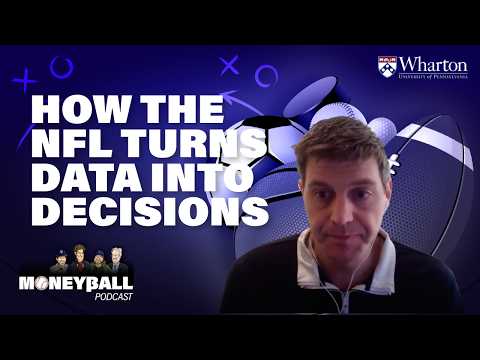
NBA Playoff Analytics, Victor Wembanyama, and the Hot Hand Debate
Ask about Knowledge at Wharton
Episode Description
ABOUT THE EPISODE Are NBA playoff runs driven more by matchups, momentum, or randomness?
Ben Alamar, author of Sports Analytics: A Guide for Managers, Coaches, and Other Decision Makers, joins the Wharton Moneyball crew to break down Victor Wembanyama’s playoff performances, advanced defensive metrics, NBA draft evaluation, and championship team building strategies.
The conversation also explores the “hot hand” phenomenon, managerial impact in baseball, NHL playoff momentum, and why golf and tennis remain some of the most unpredictable sports in analytics.
From Wharton Moneyball.
ABOUT THE PODCAST Sports is a game of numbers. Wharton experts Eric Bradlow, Shane Jensen, Cade Massey, and Adi Wyner team up to tackle the world of sports, from current events to longstanding issues such as: What sports streaks are the most impressive? How do you rank the best players? Can athletes be compared across sports? Moneyball Highlights explains how decision-makers in the game can avoid the common mistakes and embrace the data. Episodes are recorded at the Wharton School.
#NBA #SportsAnalytics #VictorWembanyama #Basketball ----- The Wharton School of the University of Pennsylvania is committed to sharing its intellectual capital through Knowledge at Wharton, the school’s online business analysis journal.
Launched in 1999, Knowledge at Wharton offers free access to:
- Articles, podcasts, and videos highlighting Wharton faculty research and analysis of current business trends - Interviews with book authors from Wharton School Press - In-depth series of curated content like Wharton Executive Education’s Nano Tools for Leaders - A searchable database of more than 10,000 articles covering all aspects of business - A weekly newsletter that delivers Knowledge at Wharton insights directly to your inbox
Visit the Knowledge at Wharton homepage: https://whr.tn/3qUpSBE Subscribe to the Knowledge at Wharton YouTube channel: https://whr.tn/3DEAgAU
Read the full transcriptHide the full transcript
- Welcome, welcome to Wharton Moneyball. Welcome to a full hour of sports analytics
- here on the Wharton Podcast Network. This is Cade Massey hosting this week, along
- with what should be the whole crew at some point. We've got three quarters of the crew in
- here at the moment. Shane Jensen from his usual perch in Philadelphia. Otty Weiner on the road as Otty is
- often on the road. In this case, he's being a road warrior, showing up after having traveled 36 straight hours.
- Otty Weiner, we're expecting nothing but clear, focused, intellectual horsepower after 36 hours of travel as
- usual. We are gonna- I will do my best, Cade. Eric Bradlow is gonna roll in. Speaking of traveling, Eric also traveling, but we
- think we're gonna get him for part of the show. We'll take him whenever he arrives.
- We're gonna run our usual format today. We'll do an interview in the first half of the show.
- We'll roll into an open topics, open lines, in the second half of the show. We have back on the show, a frequent
- guest, Ben Alomar. Ben formerly of ESPN. He's also about as good as it gets when it comes to the world of basketball
- analytics. Ben even has his own book. If you wanna jump into sports analytics rights
- and teaches on sports analytics, his book is Sports Analytics, A Guide for Managers, Coaches and
- Other Decision Makers. But I would recommend it even to fans who wanna get up to speed on sports
- analytics. Ben is based here with me in Austin, Texas. He plays around at the University of Texas
- as well as with other jobs that we'll leave silent for the time being. Ben, welcome aboard.
- Great, thanks for having me back. Really appreciate it. Glad to have you, glad to have you.
- We are freshly into the third of four rounds of NBA playoffs. We started the Western last night.
- I think we're starting the Eastern tonight, maybe. Is that right? We've got San Antonio and Oklahoma City had
- a doozy of a game one last night. Cleveland, New York gonna go off soon. Kind of a bruiser of an East Coast
- final. But we gotta hear a little bit of your thoughts on the NBA in general, but
- especially coming out of these two high powered teams and especially Oklahoma City last night.
- And Wimby continues to emerge into what people thought he might be, I suppose. He was absolutely incredible last night.
- I mean, both ends of the court. I think according to ESPN's net points metric, he had one of the top 1%
- defensive games ever in their data set. That sounds good, that sounds good. Yeah, that's pretty good.
- And his three point shot from near the half court to keep them alive in the first overtime, just absolutely incredible.
- His impact on the last end of the game and the two overtime periods, truly amazing
- performance by him. Ben, can you tell us a little bit about that defensive metric?
- Do you know enough about it to talk about it? Like that's obviously a tough thing to, it's
- different than people scoring efficiency or whatever. What can you tell us about that defensive
- metric? Yeah, so this is Dean Oliver's, future Hall of Famer Dean Oliver's metric every time, every
- time. And basically what it does is it takes a look at the amount of credit, when
- something happens, how do we split that credit between all the players involved in it?
- So when we know that Wemby was, when he's guarding somebody and we know the outcome
- of that possession, let's try and split that up between Wemby, the shooter, the defense, the
- rest of the defense, all that kind of stuff. And sort of add all that impact up to get for a total net points created
- number for the entire game or season, what have you. So does it consider things like proximity or
- is it just on, does it some notion of who's guarding who? It is based on sort of the identified
- matchup that is happening at that time. So they have, Dean's got the player tracking
- data to identify who they think is guarding which player. An imperfect metric measurement for sure, but it
- is absolutely part of how it works. Does it capture, Rick, one more follow up, and then we're going to jump to you.
- Does it capture just, I suppose it captures attempts to score that are not successful, but
- also the absence of attempts to score? Because one of the things that happens around
- Wemby is people are scared to shoot. Well, and yeah, absolutely. And that sort of kept them alive in
- the end of regulation. I think it was where, you know, Shea is driving. They have exactly what they would want.
- Shea's driving into the paint and Wemby is there. So he decides to kick it out and
- they missed the shot. Like, yeah. So I think that piece is not part of this metric.
- Something actually has to affirmatively happen to measure in this context. But absolutely.
- So it's underestimating. It was the top 1% ever, and it underestimates the impact.
- Yeah, absolutely. I mean, plausibly that is not a trivial, I mean, we're not sliding Dean or the
- analytics at all. We know that this is one of the challenges with analytics is that we don't capture
- well what doesn't happen, and yet that can be a big part of the game. That's a big part of the big man's
- defensive game. Particularly for Wemby, because you can see like with the Timberwolves we're doing in the second
- round, just couldn't, wouldn't take any shots anywhere near him. And that's, yeah, we missed that.
- Okay, Adi. Yeah, so what you're describing is a metric that measures the defensive contribution on a game
- basis by kind of looking at the individual matchups. The standard way we measure defense would be
- some sort of adjusted, regression adjusted plus minus, which probably works pretty well on the season
- level because all that stuff that Cade's talking about that isn't measured gets captured by that
- in aggregate. So I guess my, if there's a question at all here, it would be, are they
- complimentary? Or are they ultimately, if you had one, would you rather have the tracking based matchup
- version or the regularized, what we call wrap them? Some people put Bs in front of it,
- easy and regression adjusted plus minus or something of nature. Yeah, I think it's a question, a little
- bit of what you're trying to use the metric for. I think they can work in different contexts
- really well, for example, like to measure impact in a game. Yeah, I absolutely want the matchup level.
- And I think that looking at sort of an adjusted plus minus defensive metric, again, once
- you have enough sample size and so you feel confident it's a good estimate, then that
- tells you something. And then the sort of matchup base helps explain some of the why.
- And then you can see if there's, what else of the why that is forming the defense, the adjusted plus minus metric, what are
- we not capturing in that matchup based metric? And I think that's, seeing those differences really
- is always really interesting and trying to dive into those. But I just think that, I mean, Wemby's
- Rapham numbers are sick. I mean, it's not like, it's very transparent what he does to the defense.
- So what's your sense of what, how much data is required before these good plus minus?
- This is basically a plus minus. You're talking about a very fancy plus minus, but hockey was the first with plus minus
- as far as I know back in the day. It was like the stat in hockey, but the guys in hockey told me, those are
- so noisy. You need like years of data before plus minus means something. Presumably with the Bayesian and the regularize and
- all that, you can get to something stable quicker, but how much, I've always been kind
- of cautious about plus minus because of how much data is required. How much until you're confident, Adi?
- So I'll just comment. I mean, there's a lot more scoring in basketball. So you have way, way, way, way, way.
- It's like not comparable. Magnitude of 10 basically scoring level. Yeah, so the real issue is diversity.
- So it only works if you have a variance, right? So if Wemby always played with one other
- player who was equally good or better, not really, but then you just couldn't, you would
- have what we call an identity viability problem. So the adjusted plus minus is there to
- disentangle the confounders. And that's only possible if you have variance. And if variance only happens when in weird
- situations where the game's over or whatever it is, garbage time or whatever, then you're not
- really getting a full accurate picture and you're just essentially biased. But I think with basketball, with a little
- variance, players coming in and out, and I don't think you'd be wrong if you'd attribute
- most of the main effect of suppressing defense to Wemby, but you have to have some
- control group. You have to have him not playing so you can see what happens. And that's part of it.
- But I think it probably converges pretty, I wouldn't say quickly, but I think by the
- end of the season, it probably works. So I'll fire off an email and try to get a better answer from people who
- actually do this for a living. Also, I think contribute a little bit more. I think the subset, I mean, maybe Ben,
- you've got thoughts on this. I think the player substitution mechanism in basketball
- is a little bit more random. Like in hockey, they go, like they come in in lines, where there's a sign, they're
- basically, you can have a whole game where two players are basically hitting the ice and
- off the ice at the same time. Whereas with fouling and with like everything else,
- I mean, obviously you're not gonna have two centers on at the same time. There's certain correlations in there, but I don't
- know. Do you kind of think of it as a relatively randomized process or a high, you
- know, at least there's, I feel like the process contributes to a lot of the variation
- that Adi is talking about. Yeah, you definitely have more variance in the NBA. And I think you're particularly with, when you
- focus on players like Wemby, you know, particularly this season, like he missed games due to
- injury or, you know, otherwise, I think you can have some trouble when you talk, Adi
- mentioned sort of garbage time with, you know, the Spurs and the Thunder this year, like
- Wemby didn't play a lot in late, you know, a ton of minutes because he didn't need to.
- And so there's a little bit of, you know, a question about how impactful that those
- things are. You know, Shea's the same way on Pro KC, just didn't have to play a ton
- in the fourth quarters a lot. So, you know, there's load management questions. So you get a lot of variance, but
- the question is, you know, sort of those late game time is how valuable is that in terms of really measuring true impact.
- I just want to observe that bigger picture about OKC and Ben, your history of OKC
- goes back and you've got some real roots in OKC if I have it correct. But, you know, last year, rewind a year
- to Presti and the Thunder winning their first championship and having that young roster and all
- those additional picks. And everyone's like, oh my God, how many championships are the Thunder gonna win?
- And they still are pretty high expectation for championships. But I don't think anybody would have anticipated
- that only one year later, they may not make the championship round. I mean, it's amazing how little we saw
- that, how few people saw that happening because it just, they seemed inevitable for a while
- after what happened last year, given what they had on their roster and their draft capital.
- Yeah, I think, you know, San Antonio is I think surprised a lot of folks because
- I think a couple of things, Wemby sort of accelerated, you know, and took this jump
- forward that I don't think everybody was expecting. I mean, unanimous defensive player of the year,
- you know, everybody thought he was gonna be great and nobody's surprised he's the best player
- of the year. But the level which he's able to control really both ends of the court now and
- where teams are like really sometimes just giving up trying to get into the paint if
- he's there is another level. And their young, other young guys have just been, Harper during the playoffs has just been
- tremendous. Cass just, again, continues to develop and become a really, really good player.
- So that young core accelerated faster than I think a lot of folks were expecting.
- And so they've been, you know, truly had a great season. You know, it'll be interesting to see how
- this, I mean, this is the series everybody's been looking for since about mid-season.
- Like, yeah, this is gonna be it. This is essentially the teams. I don't think people believe nobody's gonna win
- other than these two teams. So, yeah, it's a good, really great start to a great series.
- Are you breaking the Knicks heart this early? I mean, come on. Is that what you're- I mean, like,
- look, if they get there, they got a chance. You know, everybody's got a chance. You know.
- So let's, one, welcome Eric into the show. Eric just landed on the West Coast and
- made his way into the show. So glad to have you, Eric. Ben, let's do jump to the East.
- Ben, I assume he was talking about the OKC and San Antonio series? Absolutely. He is, and we're gonna change gears now
- and talk about the East, because he's been very interesting to us in Philadelphia, especially.
- One, the Sixers got past the Celtics, and not only that, but in a game seven, which doesn't seem to happen very often.
- But then they dropped the second round, and with it, we lose our favorite executive in
- basketball with Darryl Morris. So let's hear a first basketball talk. You've got some thoughts on what we saw
- over the first couple of rounds in the East, and then I am curious to hear your thoughts on Darryl before we wrap up.
- Sure. Yeah, I mean, I think the Celtics series with the Sixers was interesting, because going in,
- sort of, rewinding to earlier in the season, the Celtics were surprising everybody.
- Jaylen Brown was playing well, though plus minus maybe not quite as strong as the box
- score metrics. But the team was succeeding and playing really well, and they were gonna add Tatum back,
- and Tatum came back and was great right away. And so they became the prohibitive favorite to
- win the East, even though they weren't gonna be the number one seed. And then, again, they find that against the
- Sixers, they had this great game one, then they start to often lose game two. That's the Celtics' recent history.
- And they never really got control of the series again after that. And then the game seven, they just had
- a bad shooting night, and sometimes it's hard to overcome that. So it was a tough one for the
- Celtics to sit down. Again, they were missing Tatum in game seven, so they were not full strength.
- And the Sixers were just, overall, just not quite good enough. I think the Knicks really, they changed their
- offense to really put Cat in a position to run the offense and be a distributor and really control the offense and allow Brunson
- to go off and shoot whatever he wanted. They couldn't really, they couldn't match.
- And Anubi was just fantastic in that series as well. Eric wants to jump in, our local Eastern
- Conference basketball aficionado. So Ben, what I think about, and I'm gonna make a statement you just say right
- or wrong. Towards winning a championship, I think the Sixers are in the worst position of any team
- in the NBA. And let me say why. They can't get past the second round. They have $150 million in contracts to imbued
- George and Maxie. And so what do you do from here? Have you heard of the- Winning a
- championship, I didn't say they were the worst team. I said, if the goal is to win
- a championship, how do they get there in less than the next five years? I mean, they have pieces to absolutely build
- a championship roster. Like, they absolutely can do it. They're in a much better position than a
- lot of these teams. I mean, there's the Kings. Like, I mean, these teams exist that are
- just not good. And the Sixers, they're a good team. They just won a playoff series.
- They have two young, really strong, good guards. And B, you have to decide, can you
- get something of value if you move him? Or do you move him and just say, all right, we don't believe we can build
- around him and having him come in and out isn't productive. Can you move on from him?
- Do you get any value from, I don't know. All George, same way. Like, I don't really know what you can
- get of value, but you have good, strong pieces that are proven to be effective in
- the playoffs that are on the team. And it's hard to say we're in a worse position to go try and win a
- championship when you've got that already on your team. There are teams that really don't have any
- of that, which much worse positions. So from that angle, let's talk about Maury.
- So Maury ran the Rockets for a while and now he's run the Sixers for a while. And as so often happens around the world
- of sports, people will say, I'll take Moneyball seriously when they win a championship.
- Now, Presti's won a championship. And Harry Roseman's pretty close to Moneyball.
- They've won a championship. Hadn't happened in hockey yet, technically, but here
- comes Tulski in the Eastern Conference Finals. So we'll see. But Darryl has that.
- He suffers from not having that championship. What is your assessment of Harris and ownership
- letting him go? And what's your assessment of what he accomplished and didn't accomplish in Philadelphia?
- Yeah, I mean, look, Darryl is really one of the best executives in the NBA. I mean, when you think about the teams,
- a lot of folks associate analytics with Sam Hickey in the process and you gotta lose
- to get the draft picks. And so that's the way it's gonna be. And that's, tanking has been effective for certain
- teams to get that, and that's fine. But Darryl has taken a different approach. Darryl's approach is, I wanna win every year.
- I wanna put a competitive team on the floor every single season. And nowhere was that more evident was when
- he was in Houston and the Rock, the Warriors were clearly the dominant team. And they're like, everybody assumed that we're gonna
- be going back to the finals and we're winning another championship, all this. And Steph was at the height of his
- powers and all that. And Darryl said, no, I'm going to put together a team to challenge them.
- We may not, and so he had Harden, he had Chris Paul and you went after it. And if Chris Paul doesn't pull a hamstring
- in that series, he probably beats them and they go on to be in the finals, which they would probably have won, given the
- strengths of the team. So I think that it's unfortunate, it's bad, unlucky things do happen.
- I mean, you go, you can point to moments in time and all the time that could have happened, almost got there.
- And it's recognition that there's so much luck in the outcome of sports, particularly when it
- comes to winning a championship. You can't win a championship without luck. I think Habershaw goes through this great exercise
- every year, puts an asterisk on the championship and the NBA championship and goes through why
- there should be an asterisk on the championship. I love it. You go through every single championship and how
- they got lucky to win. And just happened, Darrell just hasn't gotten that lucky.
- He's put teams together, certainly been good enough. And he puts teams together to earnestly try
- and compete every single year, which is, I think from a fan's perspective, something that you
- would love, particularly if you've been suffering through some of these other tankathons in Utah or
- Washington. To have that as a goal to say, I'm not going to tank, even if I think it might help long-term, I'm going
- to put together a team and win now. It reminds me of something that Darrell said
- after Hinckley lost his position with the Sixers. He said something to the effect of, it
- was like Sam took the fans and the ownership on a long walk into the forest, promising them this great picnic down the road,
- but he didn't. He didn't leave them enough little treats along the way. And what you're saying is Darrell believed in,
- yes, we're aiming for the long-term, but we're going to keep it competitive and entertaining
- and enjoyable along the way. But I think it also shows, Cade, which you've talked about a lot, is the massive
- uncertainty in the draft. You can have a bunch of top picks and Embiid worked out.
- Obviously, Ben Simmons did not work out as well. Markel Fultz did not work out as well.
- And you can say, well, if I had known, I would have stayed with Tatum and the Sacramento pick.
- Yeah, well, okay, if I had known. I think it highlights the fact that there is still uncertainty in the NBA, even in
- the NBA draft. Can I, I want to jump in and ask a question about it that really highlights
- exactly this issue. So this year's draft, I think there's pretty clear what the obvious, considered a very deep
- draft, at least at the top, but there's a statistical versus visual comparison that is making
- the rounds. Boozer is, Cameron Boozer, has got the best stats. It just, and it's like, when you talk
- about Rapham numbers, like on and off the court, adjusted plus minus, it's just sick.
- Yet he's not considered to be the number one or even number two pick this year because of eye test, I think.
- I mean, or something like that. I mean, maybe you can explain to me, are we really having head-to-head here
- between the numbers people and the eye people who are going to end up making the
- decisions, as we all know? Yeah, I mean, I think that they're often those pairings that go way far back.
- You know, you have Durant, Oden, and there you had, you know, a lot of folks, you know, obviously the Trailblazers went with Oden,
- number one overall pick, and left Durant for Seattle. The numbers were really clear that Durant was
- the guy and people wanted to try and sort of massage away Oden's lack of productivity
- for a variety of reasons. In terms of, you know, this current class, like what, and I haven't really dug into
- it yet in terms of projections and everything, but in terms of, you know, playing really
- well at the college level is not the same thing as being great at the NBA level.
- Like, you know, we've seen plenty of guys who are good at college level and cannot
- make it, you know, at the next level. So instead of, you know, trying to look at the actual skill levels of different players
- and then projecting those out and how they, you know, can be put together and impact
- actual NBA performance in the future, like that's what we really need to do in terms
- of understanding whether this really is a numbers versus an eye test kind of situation.
- Again, I haven't done that exercise yet, so I can't comment for sure that that's where
- we're at, but I mean, there are more and more, just from the, you know, there's a growing sense of folks that are actually
- pushing Boozer even farther down now than even the third pick. So it'll be interesting to see how that
- plays out. Super interesting, because you're saying it's not just, maybe Adi, you said numbers versus eye test,
- and I think Ben's saying, look, it's not necessarily production. Maybe the better way of thinking about what
- you said first, Adi, is production. And in college football, we talk about production
- stats or whatever. Eye test is historically kind of a pejorative way of like old school scouting.
- And what I'm hearing from Ben is, real quickly, what I think I'm hearing from Ben
- is identifying the feature that's gonna generalize to the NBA, the skill, the trait, or whatever.
- It's almost a feature building process, and it's not necessarily, stats in college won't necessarily translate,
- but we think we know the traits, and so can, but those aren't observed directly.
- It's like we have to infer them. So do I have that, am I thinking about that right, Ben?
- Yeah, I mean, that's what Ben's saying. Go ahead, Ben. Sorry, one of the really great examples I
- like to point to you about is Hashim Tabid years ago, who was just a dominant defensive force at UConn, and everybody loved him.
- Everybody wanted him, we wanted him in OKC, quite honestly. We tried, like the numbers loved him, the
- scouts loved him, it was great. And it just didn't translate to the NBA level because there was a, there's something that
- we, that I have tried to measure at times in terms of sort of basketball intelligence,
- basketball IQ that was missing that doesn't, that you really need at the next level to
- survive. You can't just do it on the fact that you're dominant physically, whether athletically or size
- -wise. Like that doesn't, if that's how you, if that's what you're relying on to be productive
- in college, which you can be, then you're not gonna survive in the NBA. Adi and Eric both wanna jump in.
- Yeah, so I just wanted to say, I mean, you're talking about latent variables that have
- a better story, actually have a story, to be quite honest, but are yet very hard
- to pin down and measure and we don't even know how they will predict versus something
- which has no story whatsoever. It's just a bunch of, it's like adjusted plus minus stats that you have track record
- on how they do and you can make forecasts and that basically you're dealing with a
- particular, this, I think Boozer in particular, I think he really is the standout.
- I mean, not just in one area or one, he just sticks out. He's only played one year in college, but
- he just was unbelievable. He comes from a legacy. His father was a professional basketball player.
- I think in some level, maybe his father hurts him because he was not a superstar.
- He was only merely very good. Let me tell a quick story. I've never told this story before and I've
- never thought about it before, but it's like this is so appropriate. I was at Duke in the early 2000s.
- It was my first faculty position. There was a grad student there named Ken Catanella who'd been, I'm sure, cross paths with
- at some point. Ken was an NBA. He had played college basketball, small college basketball,
- played in Europe some professionally. And when he got to Duke as an NBA, he talked his way onto Coach K's
- staff in some kind of assistant capacity. He was, as far as I know, I believe this to be true, the first full
- -time analyst that Coach K ever had at Duke. And while he was there, we started playing
- with numbers. So this is like, I think he might've been class of 04. So this is 2002, 2003, something like that.
- So we pulled together and this is very early. And I'm not a basketball guy. We're like, well, let's do some plus minus.
- And we were really raw basic plus minus. So this was not the B regressed, regularized
- oddy. But I can tell you that Boozer was on that team. Boozer's dad, Carlos Boozer was on that team.
- And he was not considered the top player on that team. And Sheldon Whitehead, am I making that name
- up? There was another big guy they had, Sheldon something. I think Sheldon Whitehead is the senator from
- Rhode Island. Like I said, like I said, I am not a basketball guy. So Sheldon, I forget Sheldon's last name.
- He was considered the bigger force at the time. And they had some other, they had some
- smaller players as well. Anyway, we run some basic plus minus numbers and we're like, well, are these right?
- Because Boozer kind of jumps out. And it's like, what are we doing here that's right or wrong?
- Because we didn't expect Boozer to be the one that was head and shoulders above.
- And two things about that. One, we were not expecting Boozer to be the one that was head and shoulders above.
- And two, Boozer's the one who went on to have the better professional career than his
- fellow big man that he was playing college ball with. Sheldon Williams, by the way.
- Sheldon Williams, there you go. Sheldon Williams, thank you, Eric, very much. Yeah, just to follow up with that, Boozer
- was drafted in the second round and had a high first round career. Yeah, no, he had a perfectly good, an
- NBA career, which says something. And the other thing about that, I love about that story is that it's models at
- its best. Models at their best see around the corner. They see the future a little bit better.
- They tell you something you didn't necessarily know. And we definitely had that experience with that
- early rough stuff. Catanella, Catanella went on to a long time NBA career. He was an executive NBA for many years.
- NBA, NBA teams, super interesting, super good guy. Okay, fellas, we're gonna need to wrap up
- and let Ben go. Ben, always a pleasure having you. Very enlightening. Give us something.
- We've played one game in this Western Conference Finals. We play at least three more, maybe six
- more. What do you think is one thing we're gonna be saying at the end of the Western Conference Finals that we're not saying right
- now? It's easy to overreact to one game, right? So what do you think might occur between
- now and the end of this saying that we're not anticipating properly? I think first I'm gonna lose a lot
- more sleep because I think the games are gonna, I think we're gonna go seven. I think we're gonna go long and I
- think it's gonna be great for that. But I think that we're, I think the question is, Wemby had this historic defensive performance
- and offensive, his overall, I mean, it was Wilt-like numbers, crazy. Can he keep that up?
- That's the question. Can he perform at that level? Because they absolutely needed him to win that
- game because they were about to lose that game and then he makes two plays at the end of regulation, keeps him alive and
- then dominates in both overtime periods. So that's a lot of minutes he hasn't played, he doesn't normally play that many minutes.
- Let's see if he can keep that up. If he can, then they could actually dethrone the Thunder.
- But that seems like what it's gonna take for them to do that. Ben's here, I'll make a statement just in
- five seconds. I think we'll be talking about that SGA is not that great a two-time MVP.
- I think he's gonna have a lot of trouble against the athletes. I do, I think he had a bad
- night last night and I think Dylan Harper and D'Aaron Fox when he comes back and Vassell, I don't think, I think SGA's
- gonna have some trouble in this series. I get to make a prediction, that's my prediction, that's what I'm talking about.
- That's fair, they got the guys to run at him for sure. My question's gonna be in what ways OKC
- adapts because this is the thing about high -end basketball in these seven-game series is
- that one team will adapt to the other and so they are very smart. This is what they're doing and there'll be
- some at least attempt to adapt to what they experienced in game one. That the qualification is, look, they played them
- in the regular season. It's not like this was brand new information. OK, team, why don't we let Ben go?
- Again, Ben Alomar, longtime friend of the show, former ESPN and basketball analyst, basketball author, Ben
- Alomar. Thanks for joining us, Ben. Come back and join us after the break. Welcome back.
- Welcome back to Wharton Moneyball. Welcome back to a full hour of sports analytics here on the Wharton Podcast Network.
- We are rolling into the second half of the show. Shane Jensen is here, Adi Weiner's here.
- This is Kate Massey. Eric Bradlow flew in for a bit. We'll see if we get him back for
- part of the second half of the show. We are recording on Tuesday afternoon as we
- typically do. Show will go up early Wednesday. Just off the line with Ben Alomar.
- Ben's based down in here in Austin with me. He's a former ESPN guy. Fun little perspective on the NBA.
- I need that. I need that expert perspective on the NBA. We're gonna go open lines in this half,
- and we are gonna get Eric Bradlow back, which is awesome. We'll do a little catch your eye, what
- caught your eye. But before we do that, a quick shout out, big thank you to Stephanie Lanasa and
- her family. Stephanie's a Wharton 2000 grad. They made a generous gift to Wasabi after
- listening to the podcast. It's kind. We appreciate it. Helps us do the work, not just the
- show, but the work we do with students around school. Also wanna note that the Lanasas have a
- son, Ajax, one of their children, Ajax. He is committed to play golf at UCLA. Not this next year.
- He's got one more year of high school, but beginning in 2027, be golfing at UCLA.
- You know, this is the time of year where the NCAA tournament's about to start. Great shout out, Kate.
- I think maybe a lot of our listeners don't know that everything that we do at Wharton AI and Analytics, but also obviously Wasabi,
- is fully funded through philanthropy, corporate partners, and foundations. And without that type of support, the show
- doesn't exist. All the things that you and Adi and everyone is running at Wharton don't exist.
- So very much appreciated. Stephanie Lanasa and Ajax, their son. Look forward to talking about college golf in
- the future. All right, guys, why don't we open it up? Lots of things going on. Let's do a couple of rounds of what
- caught your eye. I'm curious where you will take us. Why don't we start with our friend in
- Israel on 36 hours travel, no sleep, before he nods off mid half hour. Adi, what do you got?
- I'm happy to do so. I'm actually gonna bring up, I'm gonna mix two things. So I wanna talk about hotness, because it's
- caught my eye. The hotness is the Philadelphia Phillies, who had lost 10 games in a row, got a
- new manager, and now look like a different team. So that just, that's one data point.
- The second data point is the Yankees, who look incredible for the first 45, 40 games
- of the season, now look just, I would say lost, and have lost, they've lost the majority of the games they've played this last
- week. So that leads me to, what is this thing called hotness? And the reason why it caught me on
- my eye in particular is that I was revisiting an old result, the old paper of Gilewicz, Tversky, and Vallone, which is the classic
- paper called the hot hand fallacy. And I wanted to kind of figure out, well, what do people think?
- Where is the academic literature on hot hands? I don't know if you know, but myself
- and your now former department chair, or soon to be former department chair, Dylan Small, we
- have a paper on the hot hand. We have a paper that shows that the Gilewicz and Tversky and Vallone paper actually uses
- a very low power statistic to detect the hot hand. So we created a much more powerful one.
- And so we reanalyzed their data and a lot of other data sets and showed that there is a hot hand.
- It's not a massive effect size, but now that paper's now 10 plus years old. And that led to, yeah.
- So I'll just, I'll comment because my old professor from Stanford, Joe Romano, and one of
- his students, they revisited that data as well. And they actually did something which I had
- noticed with one of my students when he was an undergraduate and we never published it,
- was that in that paper, there was hotness when analyzed correctly, but it could be attributed
- almost entirely to one particular player who was absurdly hot. So absurdly hot that if you put him
- in, you have a statistically significant hotness. If you take him out, you don't.
- And so it's fascinating because there are so many takes on the hot hand and some
- are underpowered as you point out. I'm gonna say something that you will appreciate
- about this whole research stream because the work that you guys have done in sports and
- methodology. So what we did, Adi, you'll, and Shane, Kate, you guys will all appreciate this.
- We took this exact measure that we created for sports and just applied it to purchasing
- behavior in marketing and video consumption in marketing. So do people start binge consuming content?
- Do people have hyper state dependence where they start buying products at a hyper rate?
- So we literally took exactly the metric that we created for sports and directly applied it
- to marketing. And actually, it's now up to my second most cited paper. We didn't call it hotness, we called it
- clumpiness because I didn't wanna have a positive or negative valence, but this is a paper,
- well, you guys remember, your former PhD student in stat, Yao Zhang, worked with Dylan and
- I on this work. And it was revisiting the Gilevich and Vallone, Tversky paper, and then it was revisiting customer
- lifetime value work, which a lot of it assumes that people buy at a constant rate,
- which is not true. And so there's actually a very active literature on it, Adi, it's kind of rebirthed.
- So this also helps us understand Eric's love of momentum, I suppose, on this show.
- So, and I just wanna note that, I mean, there were a couple of economists, statisticians
- who were, I got a lot of attention for challenging the methodology of Tversky et al.
- And is it Tversky or Gilevich, first author on that? Gilevich. I should know that and I don't.
- Okay, so it's Tom Gilevich. So there's, we had that, one of those co-authors on the show.
- I have to add the behavioral element here at the end before we let go. I like what Eric said, he found a
- hot hand, but it's a very small effect. The behavioral claim would be, no matter what
- our size is actually there, the belief is much larger than the actuality. That's the behavioral piece of it that I
- would add on top of these things. So I guess what I'm kind of saying is that we see like what the Phillies
- have done. It's very hard to explain that without some kind of hotness, right? I mean, obviously you can explain it, but
- it's hard to. And if you go back to the marketing, as all my children would say, they call
- me Abba. When Abba's in a spending mood, they know it's time to get on that gravy train.
- I get in that zone. I've never been on that train. I've never seen an Abbi spending motor.
- No, it's extremely rare. But when that thing ticks on, it's like, what happens? It's like a new person.
- So Adi, just because you brought this topic up, I'll be a business person just for
- a second, because we're also a business show a little bit. So what we also address in the paper
- is, should you encourage people to binge consume or develop a hot hand when it comes
- to spending? And so we actually studied that. What we did was, we had an in -sample period where we ran an experiment.
- We would encourage people to hyper buy, and then we measured their customer lifetime value over
- a subsequent six months out of sample period. And so a separate paper we wrote was
- in, you know, our big quant marketing journal, Marketing Science, which is, should you try to
- make your customers binge consume and clumpy? And is it good for economic value in
- the long run? It turns out it is, by the way. But that was purely an experiment run on
- top of this metric that we created, as opposed to the lower power ones. And then we showed that there's actually business
- value to encourage people to go into the ABBA, Weiner, hot state. I'm pretty sure that whoever runs DraftKings and
- FanDuels read your paper, Eric. Because, yeah, it's an ad blitz, let's just say, happening for any of us watching live
- sports out there right now. Right. Well, Shane, while you got it, why don't you carry on?
- What caught your eye in the world of sports the last week? Well, I guess this kind of relates to
- the kind of momentum hotness sort of theme. I mean, I'm really intrigued, obviously, for the
- upcoming round for the NHL playoffs, and specifically here in the East with the hurricanes, you
- know, going into an 11-day break, basically, as hot as a playoff team can be, 8-0, but then having 11 days off
- while Montreal and Buffalo battled it out. And, obviously, rest and all that is a
- great thing. And, you know, if I could be on either team, I'd probably rather prefer to be
- in Carolina's situation. But it does add a bit, kind of like, you know, to the extent that there's
- a temporal momentum, whatever you want to call it, to what was going on with the
- hurricanes before this big break. Has that dissipated, or are they going to keep going?
- I guess that's kind of the question on my mind. Let me ask you a follow-up question
- to that, Shane. So what would you have to observe to say that maybe the break was too long?
- Because let's just say, for example, the Hurricanes win four games to three. Well, maybe that's what it would have been
- anyway. Like, how do you look at the counterfactual in this case? I think if they get blown out in
- four, you might say, wow. I mean, I'm not saying statistical evidence, but what would be a narrative that you would
- have to see to say that- I think I'd have to see some kind of like, not just like, not even, them losing
- the series, I suppose, in a blowout would be pretty, some evidence. But, like, you'd want to kind of look,
- I think, at the underlying sort of measurables and sort of see, you know, pop possession,
- like all these kind of other things, and see if they're really kind of lagging on,
- to the extent that those are sort of like some kind of, I think that's where you'd really, I think, see the compelling evidence
- for like some kind of like, you know, rust kind of story. That's an interesting question.
- Like, what reflects rust in hockey? That's interesting. I would also add, they have to, for
- that story to hold, they have to lose game one. That 100% have to lose game one.
- No, you have to. And really, you probably ought to lose more than one if that story's going to hold.
- But Mark, they had, you know, Mark Messier is an analyst on ESPN, and they had him on after the game last night.
- And he talked about exactly this issue. He said, back in the 80s, they had some kind of playoff round against the Flyers.
- And he said, they had, they, his team, I don't know if this was the Oilers or the Rangers.
- When did you say? Oilers. That'd be the Oilers. Yeah, the Oilers. I mean, this was the finals.
- He had a 10 game break before the finals against the Flyers. Yeah, I think, because if it was like
- an 87-88, they actually, I think, for at least a four game, for the current hockey structure, they have the record.
- They went 16-2, I think, in that playoff round. Of course, they had swept everybody.
- They just waited. Basically, they'd gone through whoever was out in the West and were just waiting for the
- Flyers in the final. So Messier said last night, he's like, look, you come back and you feel a little
- cement-legged, but you get a 10 day break in the middle of the season, and that, all season long, you never get that
- break. It's like an entirely new season. He was, you could tell in the way he was talking about it, he said flat
- out, he said the Canadians are up against it. This is a big, and this was after,
- of course, talking flatteringly about the two teams that had just played, because it was clear
- to him. I think it's clear to Messier that it's like, this is a big disadvantage, which is
- the way we talked about it last week as well. I mean, look, it's not even only just
- about this series. They're already a big favorite in this series. That break is gonna help them in the
- finals if they make the finals. I mean, they got better rest than the Avs did if the Avs make it through.
- A quick lamentation for the Sabres. That was a great series. It was game seven, overtime, that's just the
- best thing in hockey. And it was the second series clenching game that I watched where it feels like the
- team that won got outplayed. And they had this overtime goal. This was the Flyers against the Pens, overtime
- goal in game six. Freaking Canadians against the Sabres, overtime goal again. I mean, the Sabres had pounded them for
- at least the last two periods of regulation. They got outplayed probably in overtime itself.
- That hot gold tender, man. I think to the extent that we've got a hot gold tender to this playoff, it's
- the one in Montreal. Well, shout out to Sam Ventura, our friend from Carnegie Mellon who runs R&D for
- the Sabres. And by any lights, that's a great season. Second round, and they seem like they're back.
- They have a young team. There's just kids out there for that team. I think I saw, I heard that Montreal
- and Buffalo actually are the two youngest teams in the league. Pretty incredible that they were playing.
- They look like it on the ice. It looks like I'm watching my nephews, baby nephews out there playing hockey.
- All right, Eric, what do you got? So I was thinking about golf and I was thinking about Aaron Rye winning the PGA,
- but I thought about it more broadly. Like, name me a sport where the 40 -something-ranked player in the world wins the
- title. So in basketball, I know there's not 40 -something teams, but there's no chance next season,
- for example, like the Sacramento Kings are winning. In tennis, the 40-something-ranked player is
- not winning the French Open. The 40-something-ranked horse is not winning the Belmont.
- So I started to think, this is why I love golf, because you go into these tournaments and it could be 50, 60, 70
- guys that could win the tournament and that's the wonderful thing. And it gets part of the momentum.
- I thought where Adi was gonna go with his momentum story earlier, when baseball too, in
- golf, you've talked about this, Kate, you get locked in. And if you get locked in for one
- weekend, you can win a major. And Danny Willett won the Masters. I mean, who the, Danny Willett?
- Danny Willett won the Masters. And I'm just saying, you get these situations where it can happen.
- And that's what I thought about, is again, what other sport could the 40-something-ranked
- player not only win, but one by three strokes? I just, that was what caught my eye.
- Eric, let me just follow up with that. Does it make Scheffler's performance over the last
- couple of years even more impressive? Does it make it even more impressive when one guy does so well over a long
- period of time? Because that shouldn't happen, right? That shouldn't happen in what you just described.
- Well, two other things, and I know Adi wants to jump in, two other things. So Scheffler is an interesting situation because, and
- this isn't a bad thing I'm about to say, his wins and loss record when he's in contention is starting, he's young, he's 29,
- is starting to look more and more like Nicklaus than it is Woods. And let me say why I'm saying that.
- People know Jack Nicklaus has the record for 18 majors, right? He won 18, that's the all-time record.
- Do you know how many seconds Nicklaus has? Also all-time record. 19 or 20. And Tiger Woods has 15 wins, two, three?
- Like Tiger Woods is in contention. Tiger Woods wins, you guys know this stat. He's like leading after three rounds.
- He's like 54-2 in his career. Jack Nicklaus doesn't have that record. I'm starting to see it.
- This is not a problem. I'd rather be Scottie Scheffler than any other golfer right now.
- Even than Roy McIlroy. I'm not saying McIlroy doesn't have a better accomplished record right now.
- Scottie Scheffler had a bad week as far as I'm concerned. What, he ended up 15th?
- I mean, that's as bad as he can play. As bad as he can play. He missed six putts.
- I saw him miss six putts, six feet or less. He makes those putts, he's in it. So, and the worst he can play, he's
- top 15. That's the worst he can play. Yeah, so my comment is that one of the things that the reason why this happens
- is in, if you divide a golf performance into three components, so it's almost like the
- four factors for golf. You have the tee shot, you have the approach shot, and you have your putting.
- And you sort of Z-score your performance and your strokes gained it. Your strokes gained your Z-scores on each
- of those components. And you ask, well, what we've talked about since the show a lot, the tee shots
- and the approach shots, the players are really different. They are quantifiably very, very different.
- Their skill levels are vast and they're important. And in putting, they're very, very compressed.
- But if you tried to, if you had only one of those to predict who wins the tournament, which one would you want?
- If you only could pick one, which one would you? It's putting. It's putting, it's putting.
- And so that's, and that's the component that has the least amount of skill or skill
- variation. I mean, I don't want to say it's not skill. I can't do it. You guys can't do it.
- Skill of variation is the thing that determines the outcome so frequently. And so you get this 40th person because
- of that peculiarity of golf. Interesting, all right. Let me give you one and then we'll
- do another round and I'll pass on the second round since I've been kibitzing on that.
- But I'm gonna come back to hockey. I was thinking about this last night and this is something to put up against y
- 'all. Y'all react to this. It feels to me like hockey is in some sense the most exciting sport.
- And I was trying to operationalize it in my head last night. You know, there's not much scoring as Adi
- referred earlier. And so the win probability change from a score is pretty high relative to other sports.
- Certainly huge compared to basketball. It's probably, I'm curious, it's probably a little
- bit higher than baseball but scoring is comparable to baseball. It's probably a little lower than soccer.
- Soccer's even bigger. It's gotta be higher than NFL. So the win probability change when a goal
- occurs is big. But here's the thing. That combined with the fact that the trajectory
- from zero chance of a goal to a goal happens faster than it has to be any other sport.
- Like maybe with a pitcher and a home run, that's the closest thing to it. But a guy can go from the far
- end of the ice where there's no chance that a goal's about to happen to being high goal expectancy.
- Well, at least, you know, at least goal region in just seconds. And it goes back and forth like this
- all the time. You go from like utterly risk of a goal happening which is gonna lead to this
- big change in win probability to no risk and negative risk. The other team with the high risk of
- win probability. I think that vacillation, that vacillation is. Yeah, when Montreal was up two nothing in
- the game last night, early on, what was the win probability? I'm just interested.
- Like in the first period up to, was it like 80%? I doubt it would have been 80, but
- especially. Yeah, 80 would be an upper bound on what I would probably put that probability at.
- You know? Yeah, but. Sure, 70s, 75. Yeah, between 60 and 80, certainly. Between 60 and 80.
- Yeah, and that's this extremeness. And you know, and then once it's two to one, well, then all of a sudden,
- you know, it's, I don't know, 55, 60 % maybe. And then when it's two to two, you
- know, I'm a momentum guy, I'd say, well, the Buffalo's more likely to win. But do y'all buy my operationalization of,
- that's a, can we think about, can we compare sports that way? Yeah. And ask about something about the volatility of
- win probability. It just seems more compressed. Higher frequency. Divided by time.
- I think it's like a derivative. By time. Right. By time. The instantaneous change in win probability is probably
- highest in hockey, or potentially highest. Something like that. Something like that.
- I would think, Cade, that if I was, you know, starting a sports network, or thinking
- about this, and I was thinking about fan experience, the metric you just created is probably
- one that would be very interesting to look at, and probably generates a lot of excitement.
- Well, the qualifier on it is that you probably don't get huge jumps because goals don't
- happen with very high probability. So we're talking about, it's moving around like
- this, but it's going on both sides of the, it's going on both sides of the 0.5 line with high frequency.
- Okay. Let's do another quick round. Let's go back around to Shane. Or no, Adi started us off.
- Okay. If you haven't been watching whatever local sports you have. I haven't, but I don't have any quick
- takes. I have a question for you. Yeah, sure. Don Mattingly. Did we know he was going to be
- a success? Tell me about his managerial background. I mean, I don't think about Don Mattingly
- since he's been a player, but I'm sure I'm just out of it. No, he is an accomplished manager, and not
- only, obviously, an accomplished player, and an accomplished manager. I think what, just connecting on this point
- is, and in managerial prowess in general in baseball, it's something that I have a hard
- time understanding how much it's valued. I mean, we've talked about this because it's,
- in some level, the set of strategic moves that you get to make as a manager in baseball is so much smaller than the
- things that you get to do in other sports, particularly sports like hockey and basketball.
- You have all these combinations that you get to decide upon, and when people come out,
- and all that changing of players, and strategically, you have the manager in soccer manages what
- kind of team that they want to build, and the whole team is built around that, is built around that manager's understanding of the
- strategic design. Baseball's like, really, what are you really doing? In the old days, you had more to
- do because they also were, in some level, very involved in player acquisition and termination decisions,
- but here, we just don't see it, yet somehow, just, you see this mattingly effect, and
- I'm probably, if you had to ask me where I stand on it, I'm essentially saying, very, very minor factor.
- This is due to other factors, of which, a big helping of which is luck and regression to the mean.
- The Phillies were a good team, and that someone asked me what's the mattingly effect, and
- my first response is, clearly, it's regression to the mean. When you make the change when you are
- at the worst, that's when things were so horrible, and so unexpectedly horrible, that you made
- the change then, and then, therefore, my prediction for the Phillies in their next two weeks
- after the managerial change was going to be much higher, simply because of the cherry-picking,
- the tragedy, the moment. It said you had the paired comparison, the Red Sox fired their manager in about the
- same time and have gotten no better. No, they weren't as bad. They didn't, did they have a 10-game
- win? Losing streak? I don't think so. Also, I feel like you were only talking about the manager in terms of on-field
- strategic decision-making contribution, not the behind-the -scenes, getting the player to play their best,
- and that one, I think managers can have a big effect there. It's fascinating, though, because Rob Thompson, who was
- the one fired, came in and did that exact thing to the same team, basically, like
- three-whatever years ago, and somehow, so I kind of feel like the refresh often works,
- but it's weird to me. Doesn't that just suggest that you need an occasional refresh, that manager-player relations kind of
- gets stale? Adi and I are waiting for Aaron Boone, but Adi, just quickly. Yes, we are waiting for him.
- Just quickly, by the way, let's pretend, this is probably an overestimate, but just pretending that
- the Phillies were a 600 team to start the season, that's probably an overestimate, but just
- roughly. I just did the calculation. They've gone 18 and four under Mattingly. There's a 1.13% chance that they
- would do that as a 600 team, straight from a binomial tail probability, so it's rare,
- and we have to give something to it, but it's not like you would never see a team go this, like, this is a
- rare stretch, but it's not a rare, rare, rare stretch. Yeah, but the 10-game-in-a-row
- stretch is incredible. To put them back-to-back, and you get something that's really worth noting.
- To lose 10 in a row and then to go 18 and four, that's a little different. 0.6 to the 10th is really small.
- Shane, last word on Mattingly and your Phillies? Well, I'll keep it with the Phillies.
- I just kind of saw that actually, just for the, because we're fascinated with the ABS,
- I saw that Bryce Harper actually lost a challenge in the statistically worst possible situation.
- So the context was, bases empty, zero-zero count, two outs in the first inning, and
- so it's like, and it just kind of fascinated me like, I like, I mean, it makes sense that that would be the worst
- possible combination. I just, I feel like we're not tracking, you know, obviously the hitters or whatever are
- making their decision based on whether they really thought it was in the zone or not.
- I wonder if there is any kind of learning for context that can actually be there.
- Well, I actually think, I actually studied this a little bit. I'm not sure you were on when I
- gave my results about the tracking, about the ABS, the tapping. The, we are, the people, the analysts are
- tracking basically what I call run expectancy flip. And what you're pointing out here is that
- the run expectancy flip was so small here, even at stake, so little was at stake,
- that the future loss because of the expected value given how early in the game is,
- that's the piece that people are not tracking properly. I think what's happening is that hitters like
- Harper are given essentially the green light. And that's the way they're dealing with it.
- And hitters like, you know, Jazz Chisholm are being told, you don't ever challenge.
- Because you see him, you watch him hit. He's like, he's like, oh, at this point,
- you know, what the hell's going on in my head? I feel like Jazz is the opposite side
- of the spectrum from Angel Hernandez or something like that. But shouldn't, shouldn't, shouldn't the- They have
- the same amount of judgment. Shouldn't the clubs, at the very minimum, you could tell, you could imagine telling a batter
- as they leave the undead circle, you have the green light or you have a red light?
- Absolutely. It's like, it's just a game situation at the batter, at the at-bat level, it
- should be real clear that a guy can do it or can't do it, right? Absolutely. My suspicion is that someone like Harper is
- given the green light to do whatever he wants. But he shouldn't be given the green light.
- Even Harper shouldn't have the green light at that moment. But it's not surprising that Bryce Harper is
- the one that makes that decision. Especially Bryce Harper playing like he's been playing.
- He's on top of the world, he runs the world. Let me do whatever I want to do kind of thing.
- There needs to be a check on that. Okay, that was Shane's second one. Eric Bradlow.
- Just quickly, I know we're heading up on time here. All right, very sad moment for me today
- because you guys know how much I love tennis. Al Geras has already said, he just announced
- today he's not playing the entire grass court season. So he's out of Wimbledon, he's out of
- Queens Club. So he's not playing, obviously the French, he's not playing Wimbledon.
- I'm gonna start, I'm doing this, I don't care what anyone says, I'm putting Aceros next
- to Sinner's season now. He's now broken the record for the most Masters 1000 wins in a row.
- Broke Djokovic's record 36 in a row. And he's won five straight Masters events. He's now the only, the second player, shockingly,
- to win all the Masters 1000. I never realized that Federer and Nadal, neither of them won them all.
- How many are there? There's eight. And Sinner's won them all now at age 24. Eric, real quickly, give us the eight Master
- 1000s tournaments. Oh, I don't know them all. I mean, I could tell you there's a
- couple in the clay court season. The Italian Open was just one of them. There's one in Spain that takes place.
- Like Indian Wells is one of them. You know, basically, every surface has, like, call
- it two of them. They have the Grand Slam, which you might as well call the 2000 tournament, that is
- the number of points. And then there's like two of each other type. There's the Grand Slam, there's two hard court
- ones, there's two grass ones, there's two clay ones. And they're geographically distributed as well.
- Like, how many are in the States? I would say two or three of them. Oh, you know what?
- Cincinnati, I think, is one of them, is one of the, Indian Wells. There might be three in the States, maybe
- one in Australia, two or three in Europe, something like that. Look, Sinner would have to play.
- It's not even his B game. He has, I mean, I don't, I mean, injury could do it, obviously.
- Akra has got injured, but if Sinner's healthy, this is going to end up being one
- of the greatest seasons in the history of tennis, by far. I mean, it is. He can't win the Grand Slam this year
- because he didn't win the Australian, but he may win every other tournament that he plays.
- So I'm just sad from a fan's perspective. And I don't want to have to put an asterisk next to his name.
- But if he cleans up, if Akra doesn't play the rest of the season and Sinner cleans up three Grand Slams, and now he's
- at seven and Akra is at seven, I'm not feeling good about it. It's not that qualified.
- All right, you've been giving us a bit of a heads up on that one for a couple of weeks now.
- So it's coming to home to roost at this point. All right, guys, why don't we let it
- wrap there? We'll get Adi off to bed. Thanks for making it in here. And to you, Eric, on your travel, sliding
- in here. And many thanks to Shane Jensen, who has just left away. Big thanks to the debut production performance of
- Jacob Grodnick and his team, the Grod Squad on the engineering platform for us this time
- and presumably going forward for a while. So glad to have these guys in. Thanks to Deep Patel for making this whole
- thing run. Thanks to you guys for listening. Oh, and thanks to Marissa Reyna, our producer.
- Thanks to you guys for listening. Come back and join us next time. Between now and then, enjoy your sports.
Brief Summary
Ben Alomar discusses NBA playoffs, player analytics, and the impact of metrics on team performance.
Key points
- Ben Alomar Returns. Frequent guest Ben Alomar discusses basketball analytics and his new book.
- Wemby's Incredible Performance. Wemby had one of the top 1% defensive games ever according to ESPN's metrics.
- Sixers' Championship Dilemma. Discussion on the Sixers' struggle to advance and their future prospects.
- Darryl Morey's Legacy. Exploring Darryl Morey's impact and the challenges he faced in Philadelphia.
- The Role of Luck in Championships. Luck plays a crucial role in winning championships, as discussed by the hosts.
- The Uncertainty of NBA Draft Picks. The unpredictability of draft outcomes is highlighted, showcasing past player selections.
Episode highlights
- Ben Alomar ReturnsFrequent guest Ben Alomar discusses basketball analytics and his new book.“Ben even has his own book.”1:10May 20, 2026
- Wemby's Incredible PerformanceWemby had one of the top 1% defensive games ever according to ESPN's metrics.“He was absolutely incredible last night.”2:23May 20, 2026
- Sixers' Championship DilemmaDiscussion on the Sixers' struggle to advance and their future prospects.“I think the Sixers are in the worst position of any team in the NBA.”16:15May 20, 2026
- Darryl Morey's LegacyExploring Darryl Morey's impact and the challenges he faced in Philadelphia.“Darryl is really one of the best executives in the NBA.”18:51May 20, 2026
- The Role of Luck in ChampionshipsLuck plays a crucial role in winning championships, as discussed by the hosts.“You can't win a championship without luck.”20:26May 20, 2026
- The Uncertainty of NBA Draft PicksThe unpredictability of draft outcomes is highlighted, showcasing past player selections.“There is still uncertainty in the NBA, even in the NBA draft.”22:14May 20, 2026
- Wemby's Historic PerformanceWemby had a standout game, raising questions about his consistency moving forward.“Can he keep that up?”30:56May 20, 2026
- The Behavioral Piece of SpendingExploring the psychology behind consumer spending habits and the concept of a 'hot hand'.“It's very hard to explain that without some kind of hotness, right?”39:06May 20, 2026