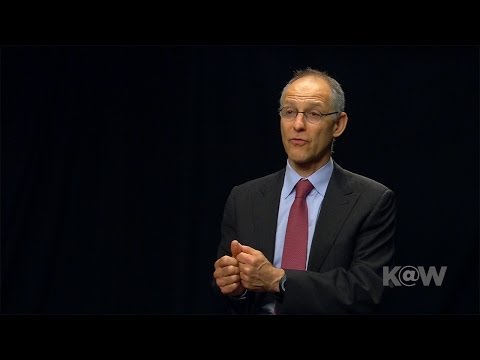
Sponsorship and Mentorship with Wharton Professor Nancy Rothbard — Ripple Effect Podcast
Ask about Knowledge at Wharton
Episode Description
EPISODE OVERVIEW There’s a difference between a professional mentor and a sponsor, but women need both if they want help moving forward in their careers, explains Wharton Deputy Dean Nancy Rothbard. This episode is part of a series on “Women & Leadership."
PODCAST OVERVIEW Every day, business scholars answer pressing questions in their research - but what do their insights mean for you? In this podcast, Wharton faculty dive into what inspired their studies and how their findings resonate with the world today. Learn how research insights translate into knowledge you can use, with host Dan Loney.
Learn more at http://whr.tn/rippleeffect.
#leadership #womenleaders #womeninbusiness #dei ----- The Wharton School of the University of Pennsylvania is committed to sharing its intellectual capital through Knowledge at Wharton, the school’s online business analysis journal.
Launched in 1999, Knowledge at Wharton offers free access to:
- Articles, podcasts, and videos highlighting Wharton faculty research and analysis of current business trends - Interviews with book authors from Wharton School Press - In-depth series of curated content like Wharton Executive Education’s Nano Tools for Leaders - A searchable database of more than 10,000 articles covering all aspects of business - A weekly newsletter that delivers Knowledge at Wharton insights directly to your inbox
Visit the Knowledge at Wharton homepage: https://whr.tn/3qUpSBE Subscribe to the Knowledge at Wharton YouTube channel: https://whr.tn/3DEAgAU
Read the full transcriptHide the full transcript
- Nancy Rothbard: One of the things we know from a lot of research is that there is a concept called "homophily," which is, we are kind of drawn
- to people who are similar to us. It's easier for us to relate to people who are similar to us. And so because there are fewer women in
- these executive roles, that sort of trickles down in a way that people actually have to be more conscious about sponsoring people who are not
- similar to them. Dan Loney: Welcome to The Ripple Effect, the podcast that takes you
- on a journey through the minds of Wharton faculty. I'm your host, Dan Loney, and in each episode, we'll be diving deep into the inspiration
- behind the groundbreaking research that Wharton professors have conducted and exploring how their findings resonate
- with the world today. Well, the importance of mentors in a career has been well documented,
- but there is also quite a bit of discussion about how a sponsor can play a vital role, as well, especially for women.
- Pleasure to be joined here in studio by Nancy Rothbard, Deputy Dean here at the Wharton School and also Professor of Management.
- Nancy, great to see you. Thanks for your time today. It's great to see you. I guess we need to start out first, though, by distinguishing
- the differences between a mentor and a sponsor. Yeah. No, it's a really important distinction, so I'm really glad you
- started there. The difference between a mentor and a sponsor is a mentor is someone who can give you help, who has expertise and skill
- and can teach you things that are really useful. A sponsor is somebody who can help you gain access and opportunity.
- And so sometimes you can have a person who can be both a mentor and a sponsor, and sometimes those roles are separate.
- So you've talked, as well, about the importance of sponsors for women. Well, I think that what we see in a lot of organizations
- is as you go up the leadership ranks, there are fewer women in those positions. And what that means is that the access and the
- opportunity for women in these leadership roles is less salient, right? People don't necessarily think of women for these roles.
- - Right. - And so one of the things that sponsors can do is to really help get your name out there,
- make sure that you're a viable candidate - Right. - for a position, so that you are known and recognized and considered
- when people are thinking about taking on a new person in a new leadership role.
- Is there a recognition of kind of the importance of sponsors when you're thinking about this dynamic between the two, between mentors
- and sponsors and how important they can be, and a recognition by the people themselves that maybe being a sponsor can be very beneficial?
- There is a lot to unpack there. Thank you for asking, because I think that those are two really critical pieces. So firstly,
- when we think about the recognition by people, by individuals, that it's important to have a mentor or to have a sponsor,
- the research does show that people say that they want mentors and sponsors. I think they recognize
- that that is an important way to get to develop your leadership potential, right, to learn more from a mentor
- and to be put forward by a sponsor. - Right. Right? So I think people do know that they want that.
- From the other perspective, from the sponsor or the mentor's perspective, I think sometimes people do recognize
- that that's actually a really important role that they should be playing in their own leadership capacities. - Right.
- So for example, in my leadership roles, I recognize that one of my key jobs is spotting talent and developing talent and make—
- and nurturing that talent. So to make sure that there are— that we're bringing people up
- for filling future leadership opportunities, right? Some people are more aware of that than others. - Right.
- Right. So— so I think that the best sponsors that you have are the people who really are aware of how
- important that role is. For you, then, specifically, what was that process like for you? Was
- there a recognition that you had along the way of the capabilities or the elements that you may be able to bring to some of those
- other individuals, in terms of being a sponsor, and the benefit that you could provide?
- The light bulb for me was when I realized that my job depended on me being able to develop future leaders,
- people who could fill the roles that were going to be really critical for the organization's
- success. - Right. - And so that light bulb went off, and I realized, "Wow, this is actually a big part of my job." And so I started being much
- more active and proactive about scouting the landscape, about thinking and getting to know people
- so that I knew what they were capable of, but also getting to know what kinds of things and
- places where they could thrive because you have all sorts of people out there who are going to be able to thrive more in one
- situation than another. And the better I am at spotting that and matching those people to jobs,
- the better I'm going to be in my role as a sponsor. So for the employee who is looking to find that person to be the
- sponsor, especially if it is a woman, is there any additional benefit of that sponsor being a woman and maybe understanding
- the process more and what that person has been going through? - Yeah. I mean, it's a great question. I think that the answer is sort of yes and no.
- Right? So on the one hand, it can be really beneficial as a woman to have a woman as a sponsor.
- On the other hand, it's much more important to have a sponsor. - Right. Right? And so for me, when I was kind of coming up—
- and— look, and I'm still, you know, we still have sponsors at whatever - Sure. - level we're at. But at different
- levels in my career, some of my sponsors were women, and some of them were men. And the key piece was having the right person
- sponsor me. - Right. - So I think that's still the most important piece, and we have to recognize that as you go up
- the hierarchy in organizations, there are not as many women in some of those roles. So I think
- having a sponsor is more important than insisting to yourself that that person be a woman.
- - I read that women tend to be over-mentored and under-sponsored. - Yeah. - Explain why that is,
- and maybe there's even a component in you just said, in terms of - Yeah. - the numbers of women
- that are kind of in a lot of these roles, or maybe not in a lot of these roles, to be able to
- provide this opportunity. And that's part of the answer, absolutely. Right. So the relative, right, comparison
- between being over-mentored and under-sponsored is such that there are fewer people in these roles who recognize women
- often as having the leadership potential that is going to be of value in the organization, right? And so that's where the—
- the under-sponsorship can come from, because one of the things we know from a lot of research is that there is a concept called
- "homophily," which is, we are kind of drawn to people who are similar to us. It's easier for us to relate to people who are similar to us. And
- so because there are fewer women in these executive roles, that trickles down in a way that people actually have to be more conscious
- about sponsoring people who are not similar to them. The mentor and the sponsor both have benefits to themselves.
- Absolutely. - But are there characteristics that maybe the sponsor holds that are maybe more unique to the development process than,
- than say, a mentor would have? I think that they both play a role, but in different parts of the
- process. Is how I would put it. So a mentor can help you really develop skills, can give you information, can give you guidance
- that can be invaluable as you develop as a leader, as a professional in any way in organizations.
- What the sponsor does is the sponsor is able to be the person who is in the room saying,
- "You know, I see a huge amount of potential in Dan. - Right. - He is going to be the next—
- you know, breakthrough - Right. - for this organization, and we really need to take a
- chance on him." - Right. And having somebody who is willing to say, "We need to take a chance on this person,"
- that's often what makes the difference - Right. - between people who are recognized, and who are not,
- and put into critical leadership opportunities, right, that allow them to advance in organizations.
- - So then I guess when you talk about the structure and the buildup of an organization, having somebody, or multiple people, like that
- - Yes. - is an incredible benefit to the growth of the organization, probably both
- within kind of the walls of the offices, but also probably at times for the bottom line of the company, as well.
- - Of course, right. So this is about, how do we build our capacity in the organization, having the right people in the roles to—
- to really make sure that we are succeeding and are rising to levels of excellence
- in our organization? Right? And so we want to choose people who are excellent and
- who can be excellent. And so having somebody who is willing to go out on a limb for you— and put their own reputation—
- so when I'm a sponsor, and I'm, you know, promoting somebody, I'm also putting my - Sure.
- - reputation on the line as a good spotter of talent and somebody who's trusted,
- so that the next time around, somebody is going to listen to me. Right? And so as somebody who wants to be sponsored,
- making sure that you earn the trust of the sponsor is a really critical characteristic
- that allows that sponsor to go out on the limb for you. Right? Somebody who is dependable,
- somebody who hits their marks, who is, you know, able to show excellence in terms of their performance and their skills, but
- also trustworthiness. - Right. Those are really critical qualities that sponsors look for in sponsees.
- And so I guess the hope is, in terms of the conversation around women in the workplace, the more women you have moving up to the executive
- roles or leadership roles within companies, then the more opportunities you have
- for women to connect and be able to develop that relationship, that sponsor relationship with that person,
- and can continue to move them up the ladder within the corporation. Absolutely, but also to recognize that women could sponsor men.
- Men could sponsor women. All of that can happen. The key is having women in these roles. What I think the difference that makes is it creates
- an accessibility, right, a stereotype, if you will, or a role model that creates the potential for other people to see those women
- as having the leadership potential, if you will. Right? So that matching process becomes easier
- when you have women in the C-suite or the executive ranks because other people say, "Oh, yeah, that's a possibility." - Sure.
- And we can see how that works and how it's effective. So what do you think are some of the recommendations
- that we need to consider when we're thinking about mentors versus sponsors in the workplace?
- I have two key recommendations, Dan, one from the perspective of the mentee or sponsee, right? The employee
- who is potentially needing mentorship or sponsorship. That recommendation is you need to be
- intentional and proactive. It doesn't just come to you. You need to actually enact that. You need to seek out mentors, you need to seek out
- sponsors, and you need to show that you are worthy of their trust. From the sponsor perspective, my recommendation is that you need to
- recognize that this is an active part of your job. You need to source talent from people in the organization,
- and you need to be really intentional about learning about who is in the organization,
- what their skill sets are, what might be a good fit for them, and be intentional about trying to not just recommend the
- same people all the time. Nancy, great to talk with you. Thanks very much today. All the best.
- Thanks, Dan. - Nancy Rothbard, Deputy Dean here at the Wharton School, and also Management Professor.
- Thank you for listening to The Ripple Effect. We hope you found this episode informative and engaging.
- Don't forget to subscribe and leave us a review so that we can continue to bring you the best insight from the Wharton School.
Brief Summary
Nancy Rothbard discusses the critical roles of mentors and sponsors for women in leadership, emphasizing proactive engagement and the importance of diversity in sponsorship.
Key points
- The Ripple Effect Podcast Introduction. Dan Loney introduces the podcast and its focus on Wharton faculty's groundbreaking research.
- Mentors vs. Sponsors. Nancy Rothbard distinguishes between mentors and sponsors, highlighting their unique roles in career development.
- The Importance of Sponsorship for Women. Nancy discusses the critical role sponsors play in advancing women's leadership opportunities.
Episode highlights
- The Ripple Effect Podcast IntroductionDan Loney introduces the podcast and its focus on Wharton faculty's groundbreaking research.“Welcome to The Ripple Effect, the podcast that takes you on a journey through the minds of Wharton faculty.”0:25Mar 5, 2024
- Mentors vs. SponsorsNancy Rothbard distinguishes between mentors and sponsors, highlighting their unique roles in career development.“A mentor is someone who can give you help, who has expertise and skill.”1:04Mar 5, 2024
- The Importance of Sponsorship for WomenNancy discusses the critical role sponsors play in advancing women's leadership opportunities.“Women tend to be over-mentored and under-sponsored.”6:25Mar 5, 2024