Stablecoins, USDC, and the Future of Digital Money
Ask about Knowledge at Wharton
Episode Description
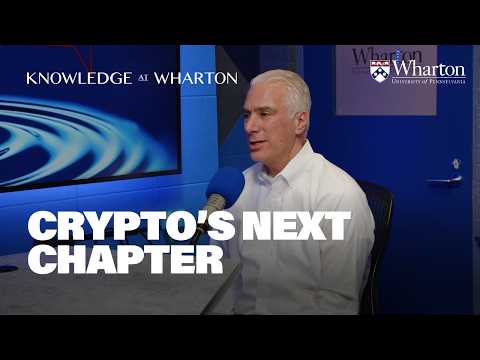
EPISODE OVERVIEW The Wharton School Professor Itay Goldstein speaks with Heath Tarbert, President of Circle and former CFTC Chair, about the rise of stablecoins in the era of digital assets. They examine how USDC functions as a tokenized U.S. dollar, distinct from volatile cryptocurrencies like Bitcoin and Ethereum, and why trust, transparency, and crypto regulation are essential for long-term stability. The discussion reflects on lessons from the Silicon Valley Bank collapse, the risk of stablecoin runs, and the push for uniform federal standards. Looking ahead, they consider how stablecoins, CBDCs, and DeFi innovation could transform payments, cross-border transfers, and financial inclusion in a blockchain-based financial system.
SERIES OVERVIEW Hosted by Wharton finance professor Itay Goldstein, this limited series takes a deep dive into the cutting-edge insights and pioneering perspectives of innovation experts in the finance industry. Discover the dynamic landscape of financial thought leadership as we explore concepts, groundbreaking research, and predictions that are shaping the future of finance.
PODCAST OVERVIEW Every day, business scholars answer pressing questions in their research - but what do their insights mean for you? In this podcast, Wharton faculty dive into what inspired their studies and how their findings resonate with the world today. Learn how research insights translate into knowledge you can use, with host Dan Loney.
Learn more at http://whr.tn/rippleeffect.
#Stablecoins #DigitalAssets #CryptoRegulation #CBDC #Blockchain #DeFi ----- The Wharton School of the University of Pennsylvania is committed to sharing its intellectual capital through Knowledge at Wharton, the school’s online business analysis journal.
Launched in 1999, Knowledge at Wharton offers free access to:
- Articles, podcasts, and videos highlighting Wharton faculty research and analysis of current business trends - Interviews with book authors from Wharton School Press - In-depth series of curated content like Wharton Executive Education’s Nano Tools for Leaders - A searchable database of more than 10,000 articles covering all aspects of business - A weekly newsletter that delivers Knowledge at Wharton insights directly to your inbox
Visit the Knowledge at Wharton homepage: https://whr.tn/3qUpSBE Subscribe to the Knowledge at Wharton YouTube channel: https://whr.tn/3DEAgAU
Read the full transcriptHide the full transcript
- - Welcome, everyone. I am Itay Goldstein, Professor of Finance at the Wharton School at the University of Pennsylvania.
- I'm also the chair of the Finance Department. And this is <i>The Future of Finance</i> podcast. This is our second season. In
- the first season, we talked about general directions of the future of finance, and fintech was one of these directions. In
- this second season, we are focusing on cryptocurrencies and digital assets. And in this episode, we're going to talk
- about stablecoins, and also the relation of stablecoins to Central Bank digital currencies, or CBDCs.
- For those of you who are not familiar with the term, stablecoins are a type of cryptocurrency. But unlike other
- cryptocurrencies, which are fluctuating a lot up and down in value, looking sometimes like a roller coaster, the point of a
- stablecoin is to maintain stability, as the name suggests. And the idea is really to have something that can replace
- money. And in order to do that, stablecoins are going to tie their value to a stable asset, stable currency, like a fiat
- currency. For our conversation today, I'm very excited. We have the ideal guest. We have Heath Talbert, who is now the
- president of Circle. As you know, Circle has its flagship product, which is the USDC, the US dollar coin, which is one of the leading stablecoins
- pegged to the US dollar. Heath has a long history in financial regulation in the financial industry, and he was also the
- former chair of the Commodity Futures Trading Commission. He's also a lecturer here at the University of Pennsylvania
- Kerry Law School. Heath, welcome. My pleasure. Great to be here at <i>The Future of Finance</i>. - Thank you. It's great
- to have you. So we have a lot to discuss, so let's dive right in. First of all, we are recording this just a few weeks after the
- successful IPO of Circle earlier this summer, so I think it's appropriate to start from that and ask you, how do you feel
- about this IPO? Well, thank you. The IPO was something that Circle had long been planning.
- And the reason is is, you know, one of the things that Circle stands behind is our focus on trust and transparency. So we do
- that, and we'll talk a little bit about that with our stable- coin that you mentioned, USDC. But we have always strongly
- believed that sort of the marquee level of that transparency is to be a publicly listed company that has the
- disclosures, has the controls, has the governance. So it was a long process to get through to become a public company, and we
- are, of course, delighted that it occurred a little more than a month ago. And so we are very pleased. We've gotten a little
- bit of rest, but ultimately we have pivoted almost entirely now on execution, making sure that we are focused on building the
- world's largest and most widely used stablecoin network. Yes, I think it was a big success, and certainly drew a lot of
- attention to Circle and to the key product, and we're going to talk more about that. Just to think about, how did you end up
- with Circle and with stablecoin? You had an inspiring career at the intersection of law and finance and regulation, public
- policy, including, of course, the appointment as the chair of the CFTC. How did you end up working with digital assets and
- stablecoins? Yeah, so it's a great question. I certainly didn't plan my career when I graduated from the University of
- Pennsylvania in— 25 years ago, about that time, 24 years ago— to get into this field. Because,
- of course, it wasn't invented. The internet was around. But the third generation of the internet that has blockchain technology,
- of course, hadn't been invented yet. And I'm not even sure people were even— even discussing its possibility.
- But I would say about a decade ago, I started hearing about Bitcoin. And about eight years ago or so, seven, eight years
- ago, I went into the United States government, as you mentioned, first as Assistant Secretary of the Treasury and
- later as CFTC chair. And we had to confront, well, what is this technology? What does it do,
- and how does it intersect with traditional finance and its regulation? And it was there that I discovered how important
- and how potentially transformational this entire field is. And it's essentially the fact that this is the next
- generation of the internet. A generation of the internet that can actually not just simply move packets of information and data,
- but can actually move value. And so just like the Internet has— has sort of had confluence with other industries that we're very
- familiar with, the finance industry, in some ways, was sort of the last industry that the internet could could merge and
- connect with. But it's blockchain technology and the underlying cryptography that actually makes that possible.
- And so when I sort of figured out that big "aha" moment, it became something that I became very interested in, at a
- somewhat technical level, but also really at a policy level. That this really is, I think, a large part,
- as the show is called, of "the future of finance." So it intrigued me. I was interested in it, and then a few years
- later, I was out in the private sector. I had an opportunity to make a career change. And I thought about, wow, this is an
- area— and this was in the midst of the— and we could talk about that a little later— this was actually in the midst of the
- crypto winter. So, crypto was not doing well. And I had to make a decision, you know, do I sort of go into this field,
- given the fact that in some ways it was at its nadir, at least at the time. And my view was, ultimately, this stuff is not
- going away. The technology is not going away. We may have bad actors, just like we had bad actors with the railroads, with
- the initial version of the internet, and we had bubbles and all sorts of things. But ultimately, that underlying—
- anytime there's a technological transformation of this magnitude, it's going to have an impact if the right people are
- at the table and the right business plan is put in place. So I got to know Circle, because I asked myself the question,
- who's actually going to make this possible? And more importantly, in some ways, who's going to do it the right way?
- Who is going to do it in an ethical, law abiding manner? Apart from the fact that sometimes the laws are not
- entirely clear. And Circle answered those questions for me, so that's how I ended up there.
- So let's take a step back and try to understand exactly what stablecoin is, how it is
- generating value to consumers, to investors. What is different between stablecoin and other cryptocurrencies? Everyone heard
- about Bitcoin and I believe Ethereum. So where is stablecoin— and your particular stablecoin, USDC— where is it
- different from other cryptocurrencies? Where is the value coming from? Yeah, and I think you explained it really
- well in the beginning. A stablecoin, in many ways, is just a tokenized real world asset. The vast majority of them are fiat
- currencies, and the vast majority of those are the US dollar. And so it's essentially taking the dollar— in our case,
- with USDC— and putting it into an internet-native form so it can be sent as easily as an email or a text message. So it's
- essentially digitizing or tokenizing, if you will, the dollar, so you can send that dollar across blockchains. In
- some ways, it's just taking something we already know, in this case, the US dollar, and figuring out, how do we get that
- dollar value onto blockchain? That differs from other digital assets, or so called cryptocurrencies, which in some
- ways are native to this new economy, this new world. So for example, there's Ethereum, which is the blockchain, and Ether is
- the native token that's on that chain. And so you need Ether to pay gas fees and to do other things, to be able to move
- transit, to conduct transactions on the particular blockchain. And so the value of that particular token is in some ways
- tied to, obviously, just general supply and demand, but also kind of the view on Ethereum and its growth, etc.
- But it sufficiently decentralized the exchange that there is— there's fundamental changes in supply and demand
- each and every day. But it is a new concept, a new source of value, that is native to the internet. Whereas what USDC does
- is it just sort of takes the US dollar and puts it in this new internet financial system. So there's not any— there's not the
- sort of volatility that there is when you're dealing with these other assets. So the way I look at it is, stablecoins are essentially,
- in most cases, fiat currencies that are put onto the blockchain, whereas these other digital assets are new asset
- classes entirely. I see. And obviously, when we think about the stability that stablecoins is supposed to bring to the
- system, we think about traditional vehicles like banks and money market funds. And investors were always drawn to
- them because of the stability. Investors like to know that when they put money in, they can take the same amount of money out
- with some return. And the question then is, what is the difference? Where is stablecoin going to depart from the traditional vehicles like banks
- and money market funds? Yeah. So first of all, it's really important to draw a distinction that a stablecoin is meant to,
- as you said, represent the underlying money. It is a new form factor of, in our case with USDC, the dollar itself. So it
- is not meant to, like a money market fund, or like a bank account, be any kind of investment. Or, as the SEC says,
- or the Supreme Court said in the Howey Test, which defines what's a security for purposes of the SEC, it's not meant to have an
- expectation of a return. So it is not an investment product. Now that said, you can create tokenized versions of money
- market funds and tokenized, perhaps even at some point, tokenized versions of bank accounts. But the stablecoin is
- meant inherently to be more conservative in that it doesn't pay any kind of yield. So that is a major difference.
- And so that alone, I think, makes it— and we'll talk perhaps about regulation and some of the other major safeguards, but that
- alone is a major distinction. It's not paying off any kind of yield. It's for you to use as effectively digital cash.
- Right. And, you know, I spent a large part of my academic career and research thinking about financial fragility.
- And what we all know from banks and money market funds, maybe more recently, is that they give you this promise of stability,
- but then in the way that they're trying to maintain stability, there is a lot of trust. And you need to trust that it's going to
- be stable, and you need to trust that everyone else thinks it's going to be stable. But then the problem is that this trust can
- be broken, depending on how the process works and what is the underlying asset, what is the triggering shock, potentially.
- But we do find ourselves in episodes where all of a sudden there is no stability anymore and everyone is running to take
- the money out as quickly as possible. We have seen some episodes like that in the short history of stablecoin already,
- but we have seen a lot, obviously, with banks and money market funds. So how worried are you about the prospect of a run,
- and how worried do you think investors should be about that? Yeah. So I think, given the fact that there are no uniform laws
- and standards out there governing stablecoins, and there's not even rules as to what can back a stablecoin, I
- think there is a chance of runs on various stablecoins, and we've seen that. So for example, we've seen Terra Luna, which was
- an algorithmic stablecoin. It was an experiment about algorithms. And ultimately that experiment clearly failed, and
- you're 100% right— and you've done tremendous research in this field, which everyone should read. Which is,
- you know, ultimately, the quality and liquidity of the assets backing it is a key part. The transparency of the
- assets backing a particular— you know, in our case, stable- coins, is important. And also some degree of regulatory
- certainty. And we don't really have that uniformly in the United States and throughout the world. Circle is regulated
- by the New York DFS, the New York Department of Financial Services. And so all of those things are addressed in a pretty
- fundamental way. They're— USDC is backed one-for-one with very, very high quality liquid assets. Essentially treasuries or
- short term treasuries like T- bills, within— you know, within three months. Essentially cash and cash-like equivalents,
- really. But not all stablecoins are backed by those assets. And when you have that maturity mismatch— and you even have this
- with money market funds, where they can invest in a lot less conservative things— I think your chances of run risk
- are much higher. Transparency is absolutely critical as well. Circle has always published, or at least— at least recently, has
- published an audited financial attestations that show you exactly what's in our reserves. And also, you want to make sure
- that there's a degree of regulation, so you know that they're supervised. So in our case, we're supervised by New
- York DFS. But the Genius Act is potentially becoming law. And my hope is by the time this airs, it will be law. And that even
- requires a federal regulatory regime for those that are over 10 billion or more in issuance. So I think all those factors
- need to be there to reduce the possibility of runs, which is very important. And my view is it's absolutely critically
- important that this be done, because otherwise the new internet financial system, this third generation of the
- internet, where the financial system and the internet are sort of— become intertwined and merged— is not going to take off
- if we have this massive loss of confidence, not to mention the fact that consumers and all sorts of other folks are going
- to be hurt. Yes. And of course, one episode that we had just over two years ago, with the collapse of Silicon Valley Bank—
- you had some exposure to that, because you held deposits in Silicon Valley Bank. And there was a moment where it looked
- like trust is going to be broken in your currency. And the question is, are there lessons learned from that? Was that just
- an episode in the past, and going forward, we're not going to be exposed to this?
- Yeah, it's a terrific question. So as you said, we had some of our reserves in the time at Silicon
- Valley Bank. And people have often said, "Well, we're worried about crypto hurting the banks." This was the exact opposite.
- This was a situation where the traditional banking system threatened the digital asset market space, because we had a
- pocket of our reserves in that bank. Very important lessons were, I think, ensuring that that there are uniform
- regulations and that banks can accept cash from stablecoin issuers. Now, of course, the vast
- majority of our cash is held at globally systemically important banks, as disclosed in our financial statements. But
- back in that time, a few years ago, banks were told not to take stablecoin issuer money, not to take any crypto money, and so
- you had this situation where stablecoin issuers like ourselves had to put, responsibly, our cash somewhere, and the only
- banks where you could potentially place it were these— were these sort of banks that catered to the industry. So I
- think having digital assets become mainstream, allowing the larger banks to do it, and having a federal regulation will
- make this a lot more important. The other thing to realize, of course, is that during that period, there was dislocation in
- the secondary markets. In other words, people out there were saying, "Hmm, I want to make— you know, I'm a little worried about
- USDC, because some of the reserves were in Silicon Valley Bank." At no point did Circle say they were worth anything
- less than $1. In fact, we— we made very clear at the time— I wasn't at the company, but the company made very clear, they remain
- redeemable one-for-one. So what ended up happening was a lot of these trading firms went out there. They scooped up USDC, and
- they brought it to Circle because they had Circle accounts to redeem it one-for-one. So they— they made out quite well.
- But in the future, we want to make sure that situation doesn't occur and we don't have secondary market dislocations,
- even if a company like Circle continues to stand by its peg. So when you're thinking about the future of the stablecoin
- industry, do you see uniformity in that all the stablecoins are going to adopt the same practices? Or do you see some
- taking more risk and having potentially more exposure to runs, and others are taking less risk and having less exposure to run?
- We have advocated for uniform federal standards, just like they've done in the European Union under MiCA, where
- stablecoins are held to very conservative standards that are implemented uniformly. Because, again, the
- risk— stablecoins should not be risky. Stablecoins should be the equivalent of a digital cash. So when you want to send
- money as easily as you send an email, you have to depend that that dollar continues to be $1. So our position has always been
- to have a pretty conservative standard that the US Congress now appears to be adopting, that is applied to everyone, and that
- if you do want to have assets that maybe take a little bit more risk, that maybe pay the
- holder of that asset a yield, they are different kinds of instruments, and some of those may be securities, and
- they should be regulated accordingly. So, for example, Circle has a tokenized money market fund, which, at the time
- we took it over, was the world's largest, and that does pay a yield. That does have assets that that may be somewhat different
- in kind, or at least they're not held to the same standards as our stablecoin reserves, but that offers investors an
- opportunity to get some yield. But I would make a distinction between that kind of product and a stablecoin, a
- tokenized dollar, if you will, that should be held to those— those pretty stringent, conservative standards.
- So, you talked a lot about regulation. Maybe we should confront it a little more head on. Going
- forward. How optimistic are you that we will have proper regulation to support the growth of stablecoins and, maybe more
- broadly, the support of de-fi and cryptocurrencies more generally? So I am optimistic. I am optimistic. This
- administration currently in office has made it a priority, and the President has said he wants the legislation, all the
- legislation, on his desk by the end of this summer. I think we're certainly going to see safe stablecoin legislation
- happen sooner. And again, my goal is by the time this podcast is released, that we will have a stablecoin bill signed into
- law. So I'm very optimistic. I'm also optimistic on market structure, but it's a bit more complicated, because the issues
- are a bit more novel. But the House has been steadily working on this. There is a bill that's about to be passed in the House
- of Representatives, and I think a companion piece will be introduced in the Senate relatively soon, that will
- address things like digital assets that are not stable- coins, that may be securities, that may be commodities. They're
- trading on centralized exchanges, the custody of digital assets, as well as blockchains and blockchain
- tokens, how they are treated, and all of these other issues I do see coming and even potentially de-fi as well. And of
- course, the other thing we haven't talked about, which is really important, alongside prudential standards and making
- sure that there's customer protections, is the anti-money-laundering, counterterrorism finance element
- to all of this as well. We have long advocated for standards in that. We are registered under FinCEN, under the Patriot Act,
- and we do AML, CTF, KYC, all those sorts of things on our customers. And that's also something that I think we want
- to get right in this industry. So we're able to take a step forward, use this innovative technology— because we haven't
- talked about all the benefits, but the benefits are many. But we also don't want to introduce new risk, whether they're
- financial risk or national security type risk. So, fast-forward 5, 10, years from now.
- You see a financial system, a monetary system, that is fundamentally different than
- what we have today. Who are the main people who are going to benefit from that, and how are they
- going to notice it? If you're thinking about, you know, households, they don't have much interaction with the financial
- system, they don't make speculative investments. They just need to save and pay. How are they going to see the
- tangible difference in their day to day life? Yeah. So I think any family that has waited, you know, two days for money to
- clear, that has friends— for example, you probably have lots of friends overseas, and you want to send them money. And
- you've paid exorbitant fees. All of these things are going to potentially change if we have the new internet financial
- system. And so— as well as folks who maybe don't have access for traditional bank accounts. In the United States, most Americans
- do, but many people in the Wharton community are outside the United States. Even in a country to our south like
- Mexico, only 50% of Mexican adults have access to a bank account. But if they have their phone, then they can download a
- wallet and they can store value there. There's other folks as well, in countries where the local currency, let's say, is
- highly volatile. I remember when I was there at Penn, we had some poor fellow students at Wharton and at the law school who were
- from Asia, and the Southeast Asian financial crisis occurred, and their tuition rate quadrupled overnight because
- they weren't able to store value in dollars. Very difficult. So all those sorts of things could be potentially addressed
- by— again, the other way to think about it is, when you and I were going through university, to call— to call Philadelphia, to
- make a call from Philadelphia to New York, we needed a phone card. It was long distance, right? And so to some extent,
- the current system of moving money is back in the 1980s, when— and 90s— when we were using telephonic communication. And so
- all of this will get a major uplift. So there will be a ton of benefits that I think, what I would call— are skew—
- skeuomorphic. You know, in other words, all the stuff we're doing today, we can probably do a lot better with stablecoins and
- with blockchains. And then there's a whole host of stuff that we haven't even imagined that are native to this new
- system. For example, AI agents buying and selling things. Anytime they use— for example, AI
- goes and sweeps the Wharton website for all of the great research that you and your colleagues are doing. Right now,
- they're not charging any— you're not charging anything for it. But maybe in the future, you could get a slice of every time
- that is used in an AI agent. And the most likely way that value transfer would occur would be by automatic payments in stable-
- coins or other value over blockchain. So there's a whole bunch of use cases that entrepreneurs, many of whom may
- be watching this very podcast— Wharton students and graduates— may come up with on their own.
- So we talked a lot about the government as a regulator. The other part that the government
- takes in this overall story is through its own product, its own currency. And here there is a lot of talk about central bank
- digital currency, or CBDC. How do you look at that in terms of the future landscape of the monetary system? Is there going
- to be— is that going to happen, first? And then if yes, what will be the relationship with stablecoin? Is that going
- to be a competition or happy coexistence? Or how do you see it? So some countries are experimenting and have central
- bank digital currencies. China is one of them, and there are other countries as well. The United States does not appear to
- be interested in adopting a CBDC— a Fed dollar, if you will— anytime soon. And the reasons for that are pretty clear, based
- on sort of, I would say, Western democratic values as well as what we've seen with some of the other nations that have imposed
- CBDC experiments. First and foremost is sort of civil liberties and privacy. There's an innate sense, at least in
- Western-style democracies, but I think most places in the world, that we don't necessarily want the central bank to be tracking
- every single dollar, every single unit of currency that we spend, right? So there's a— there's a sense there that
- that's very, very different from the current system by which the Fed issues Federal Reserve notes, but ultimately works
- through the banking system and doesn't have that insight into what's in America's— what's in Americans' every single wallet.
- The other reason, I think, or a couple of other reasons, are there's a concern by the banking system itself. Many Wharton
- graduates are working in finance, and their customers have accounts with them. But if, in fact, the bank issued its own
- currency directly to citizens, there's a concern that it would disintermediate the entire banking system, the entire
- private banking system, if you just had an account, for example, with the central bank, and were transacting directly.
- So that larger policy issue, I think, needs to be solved. There's also the question of monetary policy. Right now,
- there are a number of mechanisms by which the Fed can— can regulate the money supply. But many of them are traditional,
- and they take time. It's much harder than just issuing, you know, a trillion dollars of stablecoins, for example,
- right? And so there's a big concern, what will that mean for monetary policy, and what about if there's a slip up there? And
- I think closely related to that is if, in fact, the Fed can create money digitally in a way that is much broader than the
- way it does so today, that creates a major cybersecurity risk for the United States of America. Hacking, and the ability
- to sort of create money literally out of thin air. Compared to stablecoins, which must be backed one-for-one by
- traditional assets that are very conservative. And so I think the United States, to your question, is going to go the route that
- says, look, the Fed will still, obviously, play a major role in the money supply. But as— as
- digital dollars go, we actually want competition. We want a decentralized model where we have a number of stablecoin
- issuers who are highly regulated, held to high standards, supervised by federal authorities. Need to back
- everything one-for-one, be transparent, but also are on the cutting edge from a technology standpoint, who can experiment
- and make sure that the US digital dollars that are out there are the very best and continue to iterate. And so I
- see the Federal Reserve and the banking sector regulators working with stablecoin issuers to ensure that the dollar is
- exported, that it remains the reserve currency, not only in the traditional financial world, but also on the new internet
- financial system, but working together, as opposed to the Fed just taking it over and doing it itself.
- Right. And there are indeed a lot of debates in the academic community along these
- lines, and I think you hit on some very important points there. So we're running out of time. Just one final question to
- our own local audience here, Wharton students, MBAs and undergraduates. You've interacted with them in a few
- lectures, and your lectures here are always very popular. So what word of advice do you have for some of these students who are
- now picking their future career path? Should they go and work for a firm like Circle? Should they target the fintech
- industry? How do you look at that? Great question. Obviously, we're always happy to look at resumes from Wharton. It's
- a phenomenal school that— you can do no better. It is a wonderful place. My advice to students and graduates— and this
- is sort of, over the years, my own, you know, reflected learnings, I would say are a few key lessons.
- First of all, I would say, the days of traditional careers where you go to a place and you spend 10 years or 25 years— my
- own view is those days are largely over. Unless you're in academia and you're— and you're able to get a tenure at a great
- university like you have, by and large, there's a lot more movement out there. And then what I would say, too, is, if you
- look at the original Fortune 500, I think only, like, 49 of them are still in the Fortune 500.
- So the champions when you graduate from from Wharton may not be the champions 10 years later and 20 years later. And so
- that's the great thing about our system of free enterprise, is there's always new things developing. I personally believe
- FinTech and blockchain is a great area that will continue to grow. And so I would recommend looking at this as an area. But
- I would also say everybody at Wharton probably one day wants to be a CEO. And my advice to you, all of you guys, is you are a CEO. The
- moment you graduate and you're looking for your job, think about yourself as a CEO, the CEO of you. Your own professional
- services organization that you are going to sell to all these companies in your career who may technically employ you, but
- ultimately you're in control of your own set of services. So that leads to another— I think the penultimate point, I would
- say, is you're always learning. Don't stop learning. Every day, I am learning new things, and that's what excites me about
- this career. I'm reminded of the statue of Ben Franklin, where he's sitting there on the bench, right around the
- corner from the Wharton School. And one of the things that he said long ago, which still strikes me, is the doorstep to
- the temple of wisdom is knowledge of our own ignorance. And so I know some things. I've been around for a long time. But
- there's a lot I don't know, and learning is something you got to constantly do. And then the final point would be, don't be
- afraid to take risk, but be thoughtful about it, right? And so there'll be some times when you can take financial risk and
- other times that you can't, depending on your family situation. But one thing I would say, do not risk— and this goes
- back to the story of why I chose Circle, is don't risk your integrity. Go to places that you're going to be proud that
- you work for, and that ultimately want to do the right thing, because that's the only thing— you know, one of the few
- things you can take with you to the grave is your integrity. Thank you very much, Heath. A lot to draw inspiration from.
- This was a fascinating conversation. I think we learned a lot about stablecoin, and hopefully the audience benefited
- from that as well. Thank you for your your time. My pleasure. It's always great to be at Wharton.
- This is part of the second season of <i>The Future of</i> <i>Finance</i> here at the Wharton School. We are focusing the
- second season on cryptocurrencies, stablecoins, digital assets, decentralized finance, and all the exciting
- technologies and innovation that we have in this space. Today's episode was devoted to stablecoin. Thank you very much.
Brief Summary
Heath Talbert discusses stablecoins, their stability, regulation, and the future of digital finance in this episode of The Future of Finance.
Key points
- Understanding Stablecoins. Stablecoins are designed to maintain stability, unlike other cryptocurrencies. 'A stablecoin is meant to represent the underlying money.'
- The Collapse of Silicon Valley Bank. Heath Talbert discusses the impact of the bank's collapse on the digital asset market. 'This was a situation where the traditional banking system threatened the digital asset market space.'
- The Future of Regulation. Heath Talbert shares his optimism about upcoming regulations for stablecoins and digital assets. 'I am optimistic. This administration has made it a priority.'
- Advice for Wharton Students. Key insights on career paths and the importance of integrity.
- The Future of Finance. Exploring the evolution of financial systems and the impact of stablecoins.
Episode highlights
- Understanding StablecoinsStablecoins are designed to maintain stability, unlike other cryptocurrencies. 'A stablecoin is meant to represent the underlying money.'“A stablecoin is meant to represent the underlying money.”10:52Aug 19, 2025
- The Collapse of Silicon Valley BankHeath Talbert discusses the impact of the bank's collapse on the digital asset market. 'This was a situation where the traditional banking system threatened the digital asset market space.'“This was a situation where the traditional banking system threatened the digital asset market space.”17:02Aug 19, 2025
- The Future of RegulationHeath Talbert shares his optimism about upcoming regulations for stablecoins and digital assets. 'I am optimistic. This administration has made it a priority.'“I am optimistic. This administration has made it a priority.”21:08Aug 19, 2025
- Advice for Wharton StudentsKey insights on career paths and the importance of integrity.“Don't risk your integrity; work for places that do the right thing.”34:31Aug 19, 2025
- The Future of FinanceExploring the evolution of financial systems and the impact of stablecoins.“We are focusing on cryptocurrencies, stablecoins, and all the exciting technologies.”35:07Aug 19, 2025