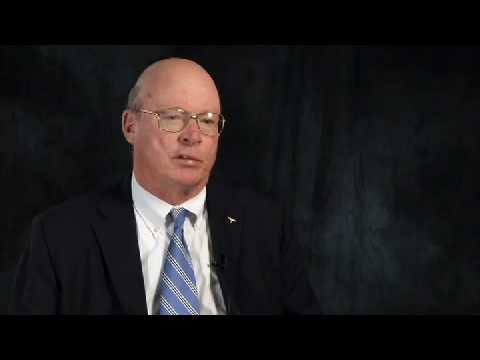
A View from Above: Justin Ryan, VP, Strategic Planning and Marketing, Honeywell Aerospace
Ask about Knowledge at Wharton
Episode Description
Justin Ryan, vice president of strategic planning and marketing at Honeywell Aerospace, discusses the impact of the financial crisis on the industry and on Honeywell, how his company is controlling costs during the economic downturn, industry changes likely to come as a result of a new administration in Washington, how his company differentiates itself from the competition, and how he manages across a global organization. Ryan offered his comments in an interview during the sixth annual Wharton Aerospace Conference held recently in Philadelphia. Visit the site: http://executiveeducation.wharton.upenn.edu/wharton-aerospace-defense-report/index.cfm
Read the full transcriptHide the full transcript
- this podcast is brought to you by knowledge at Wharton for more information please visit knowledge
- Horton upenn edu honeywell is a 35 billion dollar company in the multi industry space so we have a
- number of different businesses i work in honeywell aerospace or about 13 billion
- in size we have probably the most diverse aerospace portfolio out there we serve air transport and regional
- customers we have business and general aviation customers as well as a large defense in space business and our
- products range from gas turbine engines turbofans turbo props and auxiliary power units that power everything from
- tanks to airplanes business jets and helicopters we also have cockpit avionics surveillance systems inertial
- navigation systems so we're very diverse and it makes it a very exciting business
- to work on strategy one of the benefits of that wide range of products and services we sell as long
- as well as the number of customers we have both domestically and globally is that diversification really does help us
- the diversification helps in a couple ways one is there's a 50 year history of defense in commercial markets running
- counter cyclical so that helps us quite a bit because if some businesses are going up others are coming down and we
- can balance that the benefit of that is that we get to move our people around so
- we can shift them back and forth so we get more efficient resource use especially for folks like engineers it
- also means that our manufacturing and supply chain can be a bit more stable than if we were in only one of those
- areas so the good thing about that diversification is when you run into cycles like the one we're about to go
- through or starting to go through you know are the amount that we're going to move is going to be less and we can
- shift resources back and forth and grow the still you know experience growth and
- key businesses I think what we're trying to do is not take anything that's a drastic or
- short-term oriented really continue to think about the long run but be very prudent and that the trick in this kind
- of market is to make sure that you have accurate forecasts of what's going on you stay extremely close to the customer
- to know what's actually happening to their demand that you understand not just what your customer is saying but
- what the underlying trends are driving the demand in the market and as long as you can track your supply chain to
- what's happening in the market pretty accurately then you don't have to take huge drastic changes typically the big
- ones you read about or when someone's reacting as opposed to trying to stay ahead of it so for us it's mostly about
- staying ahead of it really understanding it it's a very long cycle business we're
- in and that helps quite a bit and so within aerospace I think we're just trying to stay ahead of what's going on
- in the aftermarket which is where the airplane flight hours are in the OEM side which is where they're building
- aircraft or platforms as well as all the programs that we have in the defense and
- space world it'll be interesting to see what happens with the new administration I think one
- of the things is they are definitely taken a hard look at the defense budget figuring out where they're going to
- spend money what programs are going to do well our mantra is pretty straightforward there one is we're
- trying to make sure that we've got programs that offer very high value to the warfighter soldier centric as we
- call it means the things that are going to support the soldier and our closest to the soldier are the things they're
- going to stay funded and we need to continue there's also a global aspect to this too that so programs like Joint
- Strike Fighter which are nine countries involved it replaces a lot of aircraft it offers tremendous value to all the
- services you may see some changes in that but will be harder for that kind of a program to see huge impacts so again
- diversification really helps us quite a bit being as global as we are helps but a bit so that it's not a business that's
- a hundred percent dependent on the u.s. we're actually quite global in a number of our markets so it will have an effect
- on our defense business i'm sure it's probably a little bit further out there also and timing because you know it's it
- like i said it's a long cycle industry it takes a while to kind of move the direction so for us it's making sure
- we're on the right programs making sure we execute the programs that we're on so
- that they don't run over budget and over cost those are the programs that are going to see the most pressure
- one of the things that's important to do is make sure that you're not making all
- your decisions in individual stovepipes because if you do it that way what tends
- to happen is a business that isn't going to have a lot of growth opportunities or
- because of the competitive nature or because it's older declining technology might actually be where a lot of the
- profit is generated right typically things that have been in the market for a while and that we're servicing over
- the long run have very high aftermarket revenues if you took all of that profit and plowed it back into that business
- then and so if you're organized in a way that causes that to happen what can happen is that you're actually not able
- to fund the higher growth more innovative opportunities and in aerospace I would say we have a
- tremendous number of innovation opportunities our challenge is not thinking up new ideas we have tons of
- great ideas we actually have thirty to fifty percent more ideas and opportunities than we actually have
- capacity or willingness to fund so the trick for us is making sure that we actually look across the whole business
- and make sure we're funding those things that are truly innovative truly differentiable and create the most value
- for our customers and not just letting you know a business that's generating a lot of cash fund itself but have to
- think about overall so we have a large process where we actually go through currently doing this right now there's
- about 750 individual opportunities that we're evaluating for what we're going to
- fund and how we're going to take it forward so you have champions for each one of those that present their ideas
- and and what it would cost and what the benefits are and what kind of value they're creating and we have a process
- of going through and evaluating which ones we want to fund I think you have to start with the
- customer and you have to start with the concept of value and so we spend a lot of time forcing our teams to not just
- explain you know well here's how much it's going to cost if I add some you know margin to it here's what it you
- know what I should charge the market for to think about incremental improvements
- but to rather start with what are the customers needs what are problems that you're trying to solve for that customer
- what's their nest best alternative to what you're offering them and how do you create value and value to us is not a
- nebulous concept it's three things it's one it's it's a for a specific customer segment so it's not just general for the
- market but you're talking about specific customers to its measured in currency and we don't that doesn't have to be
- dollars but it has to be currency so it's it's not something nebulous but truly measured in currency and three
- it's always relative to the next best alternative sometimes that next best alternative is do nothing keep what they
- have sometimes it's a competitor with their offer and sometimes it's a future competitor that might be emerging so you
- have to be very careful to make sure you're not just creating value but only to find out that you know the next best
- alternative is just as good so we really try to hone that concept and make sure that we're thinking that way when we
- develop our new products and services managing global organization is truly a challenge and if you think about many
- aerospace companies are organized in some kind of matrix right you have to pick customer or product or geography or
- function or some combination and generally you end up with a bit of a matrix where you have one or two primary
- and the others have to work across that so we've recently set up a global structure where we have a president in
- asia-pacific who sits in Shanghai and a president of our what we call amia which
- is Europe Middle East Africa and India and so we've created a virtual organization there I actually have
- people who report to me who are in in our Switzerland office as well as in Prague I've got people in Shanghai but
- also in Mexico and a couple locations as well as folks around the u.s. so it is me it is difficult to manage across that
- I think that the key is to make sure that people's roles and responsibilities are clear and that people know each
- other I mean the simplest thing is our CEO likes to say that if you don't know somebody if you haven't met them you
- probably have a bit of distrust if you know them and you've met them and you've talked to them you tended to have a bias
- towards trusting them so part of what you got to do is connect people get them to know folks and in a matrix as
- complicated as we've created it's it's important that you know who to pick the phone up to and who to call how do you
- create a virtual team that crosses those boundaries and actually works together and I think we've got some great success
- stories in in Europe as well as in Asia that are working very well across those boundaries
- for more business news and analysis from knowledge awarding please visit knowledge Horton Jupe NBD you
Brief Summary
Honeywell's aerospace strategies focus on diversification, innovation, and understanding customer needs in a global market.
Key points
- Honeywell's Diverse Aerospace Portfolio. Honeywell boasts a diverse aerospace portfolio, serving various customers across air transport, defense, and space.
- The Importance of Diversification. Diversification helps Honeywell balance resources and navigate market cycles effectively.
- Innovation Opportunities in Aerospace. Honeywell faces a challenge in funding innovative ideas despite having many opportunities.
Episode highlights
- Honeywell's Diverse Aerospace PortfolioHoneywell boasts a diverse aerospace portfolio, serving various customers across air transport, defense, and space.“We have probably the most diverse aerospace portfolio out there.”0:24Apr 24, 2009
- The Importance of DiversificationDiversification helps Honeywell balance resources and navigate market cycles effectively.“Diversification really does help us quite a bit.”1:19Apr 24, 2009
- Innovation Opportunities in AerospaceHoneywell faces a challenge in funding innovative ideas despite having many opportunities.“We have thirty to fifty percent more ideas than we actually have capacity to fund.”5:51Apr 24, 2009