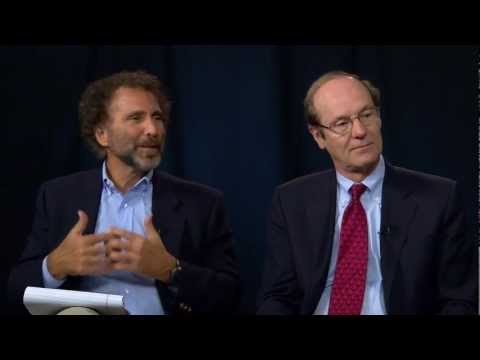
A View From Above: Marc Paganini, American Eurocopter
Ask about Knowledge at Wharton
Episode Description
An interview from the recent Wharton Aerospace Conference.
Read the full transcriptHide the full transcript
- [Music] we are we are a subsidiary of one of the largest Aerospace group in Europe
- Eads and we do uh our Market is mainly uh helicopters we uh we do uh manufacturing and support of commercial
- and military helicopters from the small one to to the large one we have two facilities one in Grand Prairie Texas
- and one in Mississippi the Columbus Mississippi is our manufacturing production plant and
- in Texas we have all the support and headquarter function it's a company which is uh growing has been growing
- over the last 10 years we have currently about 800 employees and revenues of $750
- million and we have been number one on the commercial market for helicopters for the last seven
- years we have been uh we have been just recently in the uh military business in the US we we got our first contract 3
- years ago and uh since the contract is uh is progressing well that we have delivered all the aircraft on on Time on
- cost I would say on budget and on quality uh we have not seen any changes in uh in the environment for us the
- contract is ongoing and uh we have uh this contract is going to go over 7 years and we're going to produce about
- 350 helic so there is no change for us as long as uh the customer is is happy we don't we
- don't forecast any any change and and the need for uh rotor craft is uh is going to remain very high because of the
- um the mission that uh the US Army or the National Guard have to fulfill there is a constant need in helicopters and
- there is also a need to replace quite quite an aged fle of helicopters the main challenge is uh is
- continuing to grow the company find uh the people to to help us grow the company and I would say uh uh since the
- crisis that we we faced in the end of8 and in 2009 the main challenge is to see how the market is going to come back
- over the next uh few years well we we have uh we have done a lot of uh action in terms of trying to adapt the
- uh the production uh to to the to the New Market uh requirement in the in the commercial business uh on the military
- side we're still in a in a ramping ramping up phase so we we are still looking at uh hiring uh young technician
- and Engineers to help us to to grow this business so it's it's kind of a adaptation to uh to the current
- environment but keeping always keeping in uh in perspective what the what is the long long-term plan we don't want to
- U uh we don't want to overreact today in a difficult Market environment and put at risk our long-term strategy so there
- is a balance between what you need to do to to protect yourself on the on a reduction of the market and what you
- need to do ultimately to to grow to grow the business so it's a and we we always
- continue to uh in in that difficult environment the key uh is to continue to invest in development of new product
- which are going to uh to meet better the the need of the customers to remain and
- to remain very present uh with the customer even when they are not buying But continuing to uh to ensure that we
- continue a dialogue talk to them trying to understand what what are going to be their future requirement and to and to
- work on these future requirements so that's that's a would say normal business but it's an industry which is
- longterm uh the the product cycle is very long it's not like in the automotive industry where the life of a
- car is about 5 years we are in an industry where the the lifespan of a product is more 15 20 years so there is
- a long time to develop the product which is between five and seven years then after there's a a long life
- of the product which is between uh 15 and 20 years but you you Contin continuously work on adapting the the
- product the platform remain the same but you continue to adapt it to the changing
- needs of the of the customer the business is a it's not a monolithic Market it's it's made of very different
- Market with a very different environment uh we are today working on five market so the uh the evolution of this Market
- are not always the same they are not always dependent on the economical cycle we are working on tour utility or
- corporate or EMS and offshore uh Homeland Security so it depends a little bit of the environment
- some of these Market are are very much linked to the overall economic activity so if if the
- economy uh starts to recover we will do uh more sales in to utility corporate uh business if the price of
- oil uh increase uh we will do uh more business on the offshore side where we sell
- helicopters to go to the platform and for example in the Gulf of Mexico if uh Homeland Security remains a concern uh
- we will do more business into with custom and Border Protection with the National Guard so it's a very different
- uh different market so the grow today on the commercial Market evidently the growth in the next two to three years is
- linked to the economic recovery but it's not only linked to that well I think what I would like to
- to say that uh we uh we are uh we have been investing in the US for for 40 years we' have been
- present in the US for 40 years and uh what I would like to say that our company is a very International Company
- it's based in newor but we have been uh investing and opening plants all over the world we
- have uh over 20 uh subsidiaries all over the world so we can uh be closer to the
- customer understand better their needs and produce locally so it help us to get market and the US one is of course the
- largest single Market in the world for Aerospace so it help us to to be POS on the market also to to fine tune the
- product on the on the market needs and it's also help us to u to get bright people from all over the world and to
- have this diversity of mixing European and us and we do a lot of exchange between Europe and and the US for
- engineers for for manager and it also help us to uh to um offset some uh issues with the fluctu
- fluctuation of exchange rate because between the Euro and the dollar the more we produce in in the dollar zone the
- less we are impacted by the uh the Euro strength against the dollar uh it also help us to to get some source for raw
- material so it's a way it's a it's a very much it's a strategy of being very much International and I think it fits
- well with it has helped us to to be very successful on at least on the helicopter
- Market
Brief Summary
The episode covers helicopter manufacturing, market challenges, and the importance of adapting to customer needs in the aerospace industry.
Key points
- Leading the Helicopter Market. For seven consecutive years, we've dominated the commercial helicopter market.
- Commitment to Growth. Despite challenges, the company is focused on long-term growth and adaptation.
Episode highlights
- Leading the Helicopter MarketFor seven consecutive years, we've dominated the commercial helicopter market.“We have been number one on the commercial market for helicopters for the last seven years.”1:12Apr 6, 2010
- Commitment to GrowthDespite challenges, the company is focused on long-term growth and adaptation.“The main challenge is continuing to grow the company.”2:36Apr 6, 2010
Tension
30/ 100Low tension