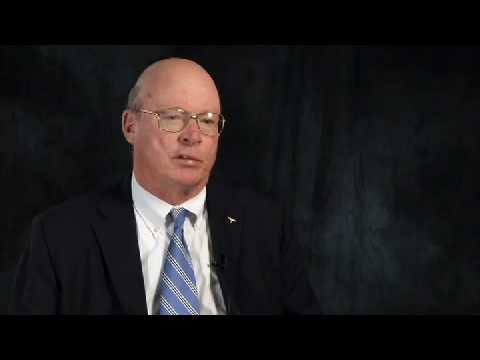
A View From Above: Michael Baughn B/E Aerospace
Ask about Knowledge at Wharton
Episode Description
An interview from the recent 7th Annual Wharton Aerospace Conference.
Read the full transcriptHide the full transcript
- [Music] BE Aerospace is the largest cabin interior supplier to commercial airliners and to business jet aircraft.
- We're also the largest global distributor of aerospace fasteners and consumables. Primarily a commercial
- presence, but about 10% of our sales involve uh the military space. Well, let me speak more specifically to
- commercial aerospace, which is our space. It was a particularly challenging year. Uh traffic was down an
- unprecedented level. Yields were down 20% and uh most of the industry or at least the customer base experienced
- devastating losses. For be aerospace, I think we responded to that challenge. Although we had uh declining sales, we
- were able to uh maintain our operating margins through uh integration synergies of our consumables business and uh uh
- continued efforts in our supply chain and our lean initiatives and efficiencies in our business. And so
- while we have not uh yet reported our 2009 results, uh our our results through uh 9 months ended September 2009 were
- were quite encouraging. Our products are bought by industry because they either increase airline
- traffic or yields or reduce operating costs. And our consumables business is about logistics. We uh for OEMs or
- airframe manufacturers or MRO's uh manage their parts logistics. We supply for instance many of our customers uh
- bin management programs where we're stocking their consumables. Uh we're doing value added kitting services that
- reduce those customers costs and allow them to focus on the key aspects of their business. Uh in our commercial
- interiors businesses uh we continue to uh introduce new products that improve the airlines topline because of
- increased yields or or load factors or reduce operating expenses for instance with reduced weight or or reduced uh
- cost of ownership. With oil having hit $150 a barrel last year and being a high level of concern
- throughout the industry, weight savings are uh particularly uh front burner at the moment. So in in all of our product
- segments, we are focusing on reducing weight and there's uh strong uh customer interest for for weight efficiencies.
- Well, the industry is changing. uh we have strong and leading market shares in all of our maj major product lines and
- our challenge is to maintain those and in fact to try to grow those. We're doing that by a continued commitment to
- strong product development, maintaining high levels of customer intimacy through
- our account management strategies, field service commitment, uh execution of our
- existing programs, and as new airframes are introduced such as the 787 or the A350, uh we are expanding our commitment
- and our emphasis on SF uh contracts and systems work. And so, uh, recently we've
- been, uh, won major awards for the A350 and 787 and for many of the new business
- jet platforms that that we think will position us very favorably, uh, longer term on those growth platforms.
- Well, I think it's difficult to be precise when you're talking a short-term period like that. We're coming off of an
- unprecedented downturn and I think uh our expectation is that we'll start to see a gradual recovery in traffic and
- capacity over the next couple of years. But I think longer term the outlook for our industry is particularly strong. Uh
- air traffic has a close correlation with economic growth. So as long as you believe that long-term there's going to
- be economic growth, there will certainly be an increase in air traffic. We believe that we're very well positioned
- at B Aerospace to participate uh in that traffic growth and in the growth of the
- industry. I think what's unique about our country, our our our our company, what's unique
- about B aerospace is our product leadership, our market share leadership in in the product segments that we
- operate with consumables. We are the largest global uh man distributor of aerospace fasteners and hardware.
- uh working with virtually all of the the MRO's uh airframers and many of the subcontractors that use distribution in
- their in their business model within the interiors business. We are the leading seat supplier for all classes of
- aircraft seating. A leading supplier of interior systems products such as ovens and beverage makers, galley equipment
- and oxygen systems, lighting systems, all sorts of products that that go into the interior. Our job is to customize
- aircraft. Airlines come to us to configure those aircraft to customize them to make them work for their unique
- purposes. So it's really the interiors that we produce that align an airplane for a particular root structure, for a
- particular service, for a particular brand. And the airlines use those interiors to differentiate themselves
- from each other and to establish their brand identity. That's what we help them do.
- Well, sure. Let's just look at trip 7s. Boeing makes trip 7s and at the start of
- the production line essentially they're identical to each other. They don't really change until they get into the
- interiors installation. Let's look at Continental. It's a twoclass carrier that's recently now introducing liflat
- business class seats replacing older seats that were not li flat. So, uh, the service strategy for Continental is to
- put liflat business class beds in, but to do it in a way that doesn't have a density disadvantage. What we've done
- with Continental is to align the seats and to nest them on an angled V-shape arrangement that allows Continental to
- offer its passengers complete liflat horizontal beds, but with a density configuration that's affordable both to
- Continental and to the passenger. Perhaps the next plane coming down the line might be Air France. Air France has
- a different strategy. Air France is a three-class provider and it's not the traditional threeclass. It's not coach
- and business class in first. With Air France, it's coach and premium economy and business class. So Air France might
- have a similar kind of business class seat that Continental would, but they've decided to segment their coach market
- differently. And so whereas Continental would have a nine a breast coach in trip
- 7, Air France would have a 10 a breast coach designed for the the tourist market. Perhaps it's the family member
- going on vacation. Um and in premium economy an eight breast seat that's designed for a traveler who will pay a
- little bit more at at and and then still for business classes. Six of breast business class seats. two different
- airplanes start off identical but very different service strategies and branded strategies and I think that dynamic
- plays through uh the industry
Brief Summary
BE Aerospace discusses challenges and strategies in the aerospace industry amid economic downturns and highlights their product innovations and market positioning.
Key points
- Aerospace Industry Challenges. The aerospace industry faced unprecedented challenges with traffic and yields down significantly.
- Gradual Recovery Expected. Expectations for a gradual recovery in air traffic and capacity over the next couple of years.
- Market Leadership in Aerospace. B Aerospace is the largest global distributor of aerospace fasteners and hardware.
- Differentiation Through Interiors. Airlines customize aircraft interiors to establish their brand identity.
- Innovative Seating Solutions. Continental Airlines introduces liflat business class seats with a unique arrangement.
Episode highlights
- Aerospace Industry ChallengesThe aerospace industry faced unprecedented challenges with traffic and yields down significantly.“Traffic was down an unprecedented level.”0:47Apr 6, 2010
- Gradual Recovery ExpectedExpectations for a gradual recovery in air traffic and capacity over the next couple of years.“Our expectation is that we’ll start to see a gradual recovery in traffic.”3:50Apr 6, 2010
- Market Leadership in AerospaceB Aerospace is the largest global distributor of aerospace fasteners and hardware.“We are the largest global distributor of aerospace fasteners and hardware.”4:33Apr 6, 2010
- Differentiation Through InteriorsAirlines customize aircraft interiors to establish their brand identity.“Airlines use those interiors to differentiate themselves from each other.”5:27Apr 6, 2010
- Innovative Seating SolutionsContinental Airlines introduces liflat business class seats with a unique arrangement.“What we’ve done with Continental is to align the seats.”6:08Apr 6, 2010
Tension
40/ 100Low tension