Jeremy Siegel Explains Need for Fed Rate Cut as Stock Market Drops
Ask about Knowledge at Wharton
Episode Description
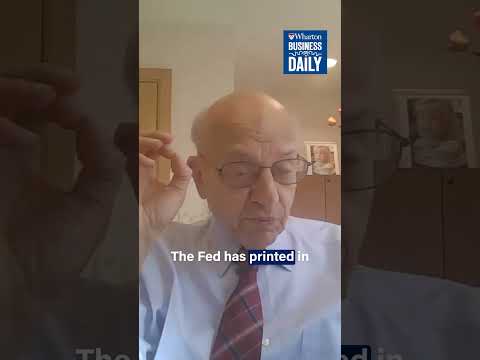
How should the Federal Reserve approach its decisions in light of most recent jobs report and the global market selloff, including the Dow Jones' drop? Wharton professor emeritus of finance Jeremy Siegel joined Wharton Business Daily to discuss the labor market, interest rates and the need for an emergency Fed rate cut, the stock market, and more the will affect the U.S. economy and global economy.
Wharton Business Daily airs Monday-Friday from 10 AM - 12 PM ET on SiriusXM Channel 132, featuring emerging trends, top business leaders & Wharton’s renowned professors.
Learn more: http://whr.tn/businessdaily
----- The Wharton School of the University of Pennsylvania is committed to sharing its intellectual capital through Knowledge at Wharton, the school’s online business analysis journal.
Launched in 1999, Knowledge at Wharton offers free access to:
- Articles, podcasts, and videos highlighting Wharton faculty research and analysis of current business trends - Interviews with book authors from Wharton School Press - In-depth series of curated content like Wharton Executive Education’s Nano Tools for Leaders - A searchable database of more than 10,000 articles covering all aspects of business - A weekly newsletter that delivers Knowledge at Wharton insights directly to your inbox
Visit the Knowledge at Wharton homepage: https://whr.tn/3qUpSBE Subscribe to the Knowledge at Wharton YouTube channel: https://whr.tn/3DEAgAU
Read the full transcriptHide the full transcript
- Dan Loney: Well, as we mentioned at the top of the show, we are seeing a pretty big sell off today, to a degree worse than what we saw
- late last week. But this has been a pattern that's gone on for a few days. Great to be joined by Jeremy Siegel,
- Emeritus Professor of Finance here at the Wharton School. Jeremy, great to talk to you. And let me get your thoughts in
- general on what we've been seeing the last couple of sessions. Well, it is a big deterioration in the jobs picture. And a fear
- that the Fed is moving way too slow. They should have cut at the last meeting. They have overshot their target on the
- labor market. In other words, they said the normal labor market should be 4.2% unemployment. We crossed to 4.3
- on Friday. We've reached— we've gotten down to two and a half percent inflation, so still at 90% towards our inflation
- target. But we've changed nothing on federal funds. They say— don't— the Fed has printed, in their last meeting,
- that the normal Fed funds rate should be 2.8%. So given that they've overshot on one of their two targets, almost there on the
- other, why have they not moved on the Fed funds rate? Right. - And I think that is what the market is really concerned about,
- that they are going to be as slow and tardy going down as we all know they were three years ago on the way up.
- So does this mean we're going to have to see a larger cut than maybe we thought we would see? I mean, a lot of the— the
- expectation was for a quarter point here. It feels like we're gonna have to go maybe beyond that?
- Way beyond that. I mean, I was— I was extreme when I was on, you know, CNBC. I said 75 basis points, immediately, and another 75
- basis points in the September meeting. And by the way, that only, you know, gets us down to 4%, which is, you know, still
- way over the normal Fed funds rate. If you take a look at all rules, like the famous Taylor rule, and you can go on and on
- about how you set the Fed funds rate. They are all 100 to 150 basis points below where we are today.
- So you're talking about, in terms of the timing, having a cut even between meetings at this point. - Yes, absolutely. And—
- and I bring you back. I mean, I remember, I was in my office at Wharton in January of 2000, when everyone said they should
- have cut in the December meeting and they didn't. And all of a sudden bad data came, they made an inter-meeting cut,
- and the NASDAQ— at that moment, the futures prices jumped 20% in saying "Oh my goodness, the Fed gets it." The Fed needs to
- tell the market, "We get it. Things are not over and we need to reduce the degree of restrictiveness." You know, I
- mean, I saw Austan Goolsbee also, and he was very careful in head. He didn't want to speak for anything. But he basically
- said, "Why are we increasing the level of restrictiveness as we're moving towards our target?" Which, of course, a lower
- inflation means that the real rate is going up at the time that everything else is going down.
- We're joined here by Wharton Emeritus Professor Jeremy Siegel. And you— obviously a lot of the conversation we've had
- over the years really started around being slow to the dance when inflation was actually hitting. And now we've kind of
- come full circle to a degree, haven't we? Yeah, that's what the market is. We're exactly that, too slow on the way
- up, and they're worried about too slow on the way down. He— Jay Powell has to learn the lesson. It's not wrong to do an
- emergency cut. The market will welcome it. Get back on track. That— that— I'm not saying we can avoid a correction in the
- market. I'm not saying we can avoid a slowdown in the economy. I would say we could avoid a recession if they reacted
- quickly. But it would make things better if they move closer to their own stated neutral rate at this time.
- And so you believe that if they did make a move of, like, 75 basis points immediately, that we would see a positive momentum on the
- markets and not a negative where you know, some people would potentially view it as, okay what's wrong with the economy?
- Maybe even more than— than maybe we're thinking. I mean, No. Because— well, there's two things. First of all, the Fed
- hasn't been very good at predicting about the economy, like they have special knowledge. So in a way, I think
- the market has much more knowledge of what's going on in the economy. And second, I'm just taking from historical
- experience. As I said, when they missed cutting in the December 1999 meeting and did an emergency cut in January, it
- helped the market. Now, it is true that the market, because of recession, continued to go down. But it was a very mild
- recession. I argued it would have been worse had the Fed not lowered rates. I'm not saying that it could prevent the market
- from going down further. I can say it can prevent it from going down much worse. - Right.
- And so at least at this point, we may be getting closer to a correction, but at least we're not falling off the cliff.
- Yeah. I mean, it would welcome, they will say, the Fed is is able to react more quickly. Jay Powell is just far too deliberate. He has
- to tee it up at one meeting, and then go a quarter point and then— this is not the way the economy works. It goes much
- faster. He has to learn to move faster. Would even a quarter of a point at the last meeting had
- been effective, even with the the labor numbers that came out? Or would it have just kind of, you know, been a little bit of a
- bump on the road? - Well, it would have— if he would have gone a quarter point, which was against
- expectations, it would have shown he's very flexible. And I was very disturbed at the meeting when someone asked him,
- "Are you thinking of 25 basis points in September?" And he said, "Oh, no, that's off the table." I don't know why he said that.
- Not only is it not off the table, the market is predicting at least 25 basis points right now. - Yeah.
- So I mean, again, it's the overdeliberateness of Powell, and just going slow, slow, slow, that they're worried about. By going
- 25, that's not much. It would have shown flexibility. By not going— taking 50 off the table, the— unfortunately, the market is
- worried about the worst. So let me finish up with this. And it's something you just kind of
- alluded to, is kind of that connection between the markets and what we're seeing there, and the reaction to the Fed, and how
- really, the markets can provide even a little bit of the economic information that the Fed is really going off of,
- to understand the path that they should take. Yeah. You know, absolutely. I mean, I'm just not— you know, people say, "Oh,
- the market has overreacted. It's had bear markets without recession. That's true. But I'm also looking at the real data. And I
- don't like the real data. - Right. So I mean, we got more than just, you know, a— you know, a sudden bear market. This is not
- a 1987, where, you know, we cut where we didn't have a recession. No, it was a very different circumstance like
- that. And I'm looking at that real data. And I was pretty shocked at the deterioration that I saw both on Thursday with
- the ISM data and on Friday with the employment data. All right, Jeremy. Great to talk with you. Thanks
- very much. - Thank you. Jeremy Siegel, Wharton Emeritus Professor of Finance.
Brief Summary
Jeremy Siegel critiques the Fed's slow response to rising unemployment and inflation, advocating for immediate interest rate cuts.
Key points
- Market Concerns Over Fed's Slow Response. Jeremy Siegel discusses the Fed's slow reaction to economic changes and its implications.
- Potential Rate Cuts Ahead. Siegel predicts larger cuts than expected, suggesting immediate action is necessary.
- Connection Between Markets and Fed. Siegel highlights the importance of market signals in guiding Fed decisions.
Episode highlights
- Market Concerns Over Fed's Slow ResponseJeremy Siegel discusses the Fed's slow reaction to economic changes and its implications.“The market is really concerned about the Fed being slow and tardy.”1:30Aug 5, 2024
- Potential Rate Cuts AheadSiegel predicts larger cuts than expected, suggesting immediate action is necessary.“Way beyond that. I mean, I was extreme... 75 basis points, immediately.”1:59Aug 5, 2024
- Connection Between Markets and FedSiegel highlights the importance of market signals in guiding Fed decisions.“The markets can provide economic information that the Fed should consider.”7:29Aug 5, 2024