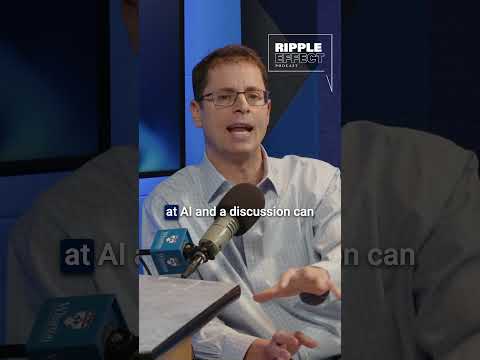
How a Philly Financial Literacy Course Is Helping Underserved High School Students
Ask about Knowledge at Wharton
Episode Description
EPISODE OVERVIEW Wharton’s David Musto talks about Penn’s financial literacy course, which is being taught to high school students across the country. It’s just one of the programs at the Stevens Center to help younger people understand money and make better financial decisions.
Wharton’s David Musto talks about programs Penn has developed to teach high school students about financial literacy, a process he says should start when people are young.
PODCAST OVERVIEW Every day, business scholars answer pressing questions in their research - but what do their insights mean for you? In this podcast, Wharton faculty dive into what inspired their studies and how their findings resonate with the world today. Learn how research insights translate into knowledge you can use, with host Dan Loney.
Learn more at http://whr.tn/rippleeffect.
#financialliteracymonth #financialliteracy #financialeducation ----- The Wharton School of the University of Pennsylvania is committed to sharing its intellectual capital through Knowledge at Wharton, the school’s online business analysis journal.
Launched in 1999, Knowledge at Wharton offers free access to:
- Articles, podcasts, and videos highlighting Wharton faculty research and analysis of current business trends - Interviews with book authors from Wharton School Press - In-depth series of curated content like Wharton Executive Education’s Nano Tools for Leaders - A searchable database of more than 10,000 articles covering all aspects of business - A weekly newsletter that delivers Knowledge at Wharton insights directly to your inbox
Visit the Knowledge at Wharton homepage: https://whr.tn/3qUpSBE Subscribe to the Knowledge at Wharton YouTube channel: https://whr.tn/3DEAgAU
Read the full transcriptHide the full transcript
- They've come from countries where they speak Spanish, they're adults, they do not know very much about our
- financial system because they just got here. And a lot of them have had negative experiences with the financial systems in
- the countries where they came from. And so material that is aimed at that community, helping them plug in to our financial system
- as soon as possible and not get ripped off and be able to send money back to their own countries, to remit money with—
- once again, without getting ripped off— this is a community that has very specific needs,
- and we want to address those needs. Welcome to The Ripple Effect, the podcast that takes you on a
- journey through the minds of Wharton faculty. I'm your host, Dan Loney. And in each episode, we'll be diving deep into the
- inspiration behind the groundbreaking research that Wharton professors have conducted, and exploring how
- their findings resonate with the world today. Well, financial literacy is receiving greater attention these days, as
- educators look at new and innovative ways to improve the knowledge, especially for younger individuals, as we move
- forward. Pleasure to be joined here in studio by David Musto, Professor of Finance here at the Wharton School, who is involved
- in a lot of these areas right now. David, great to see you again. Thanks for your time.
- Nice to be back. Nice to be back. Let's start with just, I guess, your general thoughts about
- where financial literacy stands at the moment, kind of in our culture, what it's missing, where we need to go moving forward.
- When you think about today's high school student—which is what we're focusing on a lot, and we can talk about that— they
- haven't had a lot of opportunities to make financial decisions. And they haven't had to think, to some extent, about
- things that you and I had to think about a lot when we were kids, like inflation, until recently. Right? It didn't even come
- up. And yet they have so many big financial decisions ahead of them. Not just student loans that loom very soon in their
- lives, but also responsibility for their own retirement, election campaigns that hinge on financial issues that are hard
- to understand. The demands on them to understand finance are greater than ever, so maybe literacy might not be lower than
- it was 40, 50, 100 years ago. But the demands to be adept are much higher than they used to be.
- And it seems like in many cases, the resources to be able to provide that information are not there as much as they probably
- should be. Hopefully, they will increase in the years ahead, but still a ways to go.
- I've been involved in developing a financial literacy course for high school students, and it has been an education to see how
- little they've already seen, and how little is already out there. So it's been a great opportunity for us to go in and— and really
- be helpful and add some value to their lives at a key moment, too, when— when all these decisions are just
- about to come up in their lives. So tell us about what the course entails and— and at what—
- how you've been able to develop the relationships with a lot of these schools in order to provide this information.
- Okay, so the course that I'm talking about is Essentials of Personal Finance. Penn calls it Finance 2, and that's
- important. It's actually a Penn class. These students are taking it. 500 students are taking this class right now, at schools all
- around the country. And they are getting Penn course credit. They get a transcript from Penn showing this course on it. It
- covers the whole range of financial issues that are relevant in their lives right now. Like if you are working at
- checkout at a store, what's coming out of your paycheck and why? What does that get you? Where's that going? And then
- student loans, which are coming up for a lot of these students right away. Well, how do those work? And it also covers some
- topics that really are about being an educated voter. So when people say the Social Security Trust Fund is running out. Well,
- what is that? What exactly is that? It's not a stack of dollars somewhere that's running out. But it— but it does mean
- something, and it is running out soon. So what does— what does that mean? And the different candidates say different things
- about that. Well, what do you like? What— what does that mean for you? A lot of low hanging fruit there that we are going
- out there and providing. And the kids not only get a chance to learn this material, they get Penn course credit. And I should add
- that what's really made this work for us is a partnership between my center, the Stevens Center, our global youth program
- that— that reaches out to high school students, and a nonprofit in New York called the National Education Equity Lab, which has
- a lot of that last mile outreach to these Title 1 high schools around the country. So that teamwork between my— the two centers
- here at Wharton, and this New York nonprofit is what's made this work. So we have students thousands of miles away from each
- other taking the same course. - Now it feels like maybe in the past, maybe we've underestimated the
- importance and the value of having this type of education, and the understanding and having all of this kind of in their
- lives at a younger age, so they can be better prepared when they leave high school.
- Oh, for sure, yeah. And I— we noticed that specifically, in the case of student loans. Kids are 17 years old, having made
- almost no financial decision in their lives. And here's this enormous financial decision to make, borrowing tens of thousands of
- dollars, when they've never borrowed anything, and having to deal with all the different nuts and bolts of that. They're at a
- perilous moment there and ripe for being taken advantage of too. And so just to make them astute and adept is very
- rewarding. I should say, also, for our Wharton students, who are the synchronous instructors for this class, too— I made the
- videos, but we have our Wharton students who are actually the in- class, over— you know, over the internet— instructors to these
- students all the way from California to Florida. So I understand one of the other areas that you focused on is
- the development of an app that can help this process out as well. Yes. When we started the Center five years ago, and were
- looking around for, what's a way we can reach out to the Penn community that's grounded in finance, and that would mean a
- lot to the Penn community? And we thought: student loans. For the same reasons I just gave. Huge decision, very early age. And so
- we thought, what people could use is an app to help them think about taking out a student loan. And not only that, what would be
- really terrific is to bring high school students here to Wharton and have them build the app. So they not only learn the finance
- involved in student loans by building the app, but they'd learn everything else having to do with essentially a little
- startup company. We have a very clear goal of what we want to deliver, and different pieces of the project. And different teams
- of students are working on different elements. And it's all coming together. In fact, we're having a launch on April 19, of
- this app, trying to get it into the hands of students as soon as possible. So the students are learning finance, and they're
- also learning about entrepreneurship, building a company, getting it done. It's just been a great experience.
- Larger scale, how important can technology be, do you think, to enhancing the level of financial literacy that we have in our kids?
- I think it's a huge impact. And specifically— and this is what's come up in the student loan app— financial decisions are decisions
- you're making under uncertainty. Right? You're taking out a loan, you're gonna have to pay it back. You don't know what your
- circumstances are going to be in the future. You have a hope, you have an aspiration for what you're doing with this money and
- how it's going to pay off, but you don't know for sure. And so then trying to visualize, "I'm taking out this loan, the
- consequences include" — you know, think of a bell curve. A left tail, where things have not worked out, and now what? And a
- right tail where my aspirations have come true. And everything did work out. That kind of scenario analysis is what you
- have to do in your mind somehow, when you take out the loan in the first place. And I think technology can have a great
- effect in helping people do that scenario analysis, think about the diversity of consequences that could follow from a
- decision, and then make the decision that's best for them. Longer term, what do you hope is the impact that the app has on
- these kids in their lives? Well, I think there are several moments where the app could add
- a lot of value. Naturally, the number one scenario we picture is you've gotten into a college, you get a letter just spelling out
- your financial aid, where they say, "Well, here's our sticker price for the college, here's what we're actually going to
- charge you. And here's what you— what we expect you to borrow and your parents to pay," and all that. And you look at that.
- You get that from one school, and then you get that from another school. And you think about "Well, I could go to this
- school and finance it that way, I can go to this school, finance it this way, what should I do?" And we would help you think
- through, you know, the consequences of those different paths, at least the diversity of consequences that could come out of either
- decision and help you think about that and make the decision that's best for yourself. So that's one scenario. Another
- scenario is, you're applying to college in the first place, you haven't even applied yet. And you're thinking about where
- should I apply? And if you know more about the actual net cost of colleges— and sitting here at Penn, I should say that Penn has
- a very high sticker price. But for many students, an extremely low net price to many students. And a lot of them don't even
- know that when they're applying. And Penn is not the only school like that. And the more you know about that, the more you
- understand where would be a good place to apply. And then once you've gotten in, then— and this is something we talk about in
- our financial literacy class— you are in a position to bargain between these schools. When you've gotten into several
- schools. And we have some students we've worked with who have bargained very successfully with a terrific outcome.
- I understand you're also looking at the issue of financial literacy from the perspective of other cultures as well, for
- people that are here in the United States thinking about things like the Spanish-speaking community as well.
- Yes. Well, this is something that was inspired actually by a financial services provider who contacted the Center, saying, "Well, I see you
- have English language material, but I have potential clients, they've come from countries where they speak Spanish,
- they're adults, they do not know very much about our financial system, because they just got here. And a lot of them have had
- negative experiences with the financial systems in the countries where they came from. And so material that is aimed at
- that community, helping them plug in to our financial system as soon as possible and not get ripped off, and be able to send
- money back to their own countries, to remit money— once again, without getting ripped off— this could be
- tremendously valuable." And at first, we thought, "Oh, well, we could just put captions on the material we already have." I
- thought, "No, that's not right. This is a community that has very specific needs. And we want to address those needs." And so
- we are now working with our Wharton Latin American Students Association, to develop the courses that we're going to
- offer. And then they can be the onscreen talent. They can be— it's a joint project with them. And, you know, hopefully, by the
- end of this calendar year, we can roll it out and then make this available to new arrivals in our country.
- Safe to say that it also potentially opens the door to looking at the banking industry, and the changes that it may need
- to be to be more inclusive and more— more well-rounded in terms of the information and how they present it to all types of
- individuals? - Yeah, well, certainly there are some— if you just look across the big
- banks in the country, some of them make a big effort to reach out to immigrant communities and other underserved communities
- and others don't. But it would certainly help to have material they could provide that would just be— you know, it's not
- marketing for their bank. It's just, this is what it's like in the US. Here are the opportunities. Here are the
- risks. Here are the safeguards. And sort of introduce them to our financial system. And then they can make financial
- decisions, which once again, are both astute and adept. We can bring people to that point, then hopefully, you know, every bank
- would feel comfortable doing business with them. We're obviously— it feels like we're in a better situation
- right now around financial literacy than maybe we were a decade, two decades ago. But are we at a point where we have
- reached the level of recognition where we understand how important having these elements of education are going to be for
- kids, as they continue on down the line? Not just this generation of kids in high school now, but the next several
- generations as well? - Yeah, well, I think that we look at our own lives and see how much
- responsibility we have for our own financial well-being. Far more responsibility than people had many years ago. And even
- though there's so much to learn in high school— so much that you need to boot up on to enter society— finance just has to be
- part of that. You know, it's how you save up what you've produced at one time in your life, to be able to spend at another time of
- your life. Or to borrow against your future production to get something you need now. It's just fundamental to life to make
- financial decisions. And, you know, the sooner you can do that with a clear mind and understanding the consequences
- and own your financial decisions, the better for everybody. David, great to see you again. Thanks very much.
- Great to be back. Thank you. David Musto, Finance Professor here at the Wharton School.
- Thank you for listening to The Ripple Effect. We hope you found this episode informative and engaging. Don't
- forget to subscribe and leave us a review so that we can continue to bring you the best insight from the Wharton School.
Brief Summary
David Musto discusses financial literacy initiatives for high school students and outreach to Spanish-speaking communities in this episode.
Key points
- The Ripple Effect Podcast Introduction. Welcome to The Ripple Effect, where we explore the groundbreaking research of Wharton faculty.
- Financial Literacy for High School Students. David Musto discusses the importance of financial literacy education for today's youth.
- Developing a Financial Literacy Course. Musto shares insights on a course designed to help high school students navigate financial decisions.
- Creating a Student Loan App. Musto explains the development of an app aimed at helping students understand student loans.
- Addressing Financial Literacy in Immigrant Communities. Musto discusses efforts to create financial education resources for Spanish-speaking immigrants.
Episode highlights
- The Ripple Effect Podcast IntroductionWelcome to The Ripple Effect, where we explore the groundbreaking research of Wharton faculty.“Join us on a journey through the minds of Wharton faculty.”0:34Apr 2, 2024
- Financial Literacy for High School StudentsDavid Musto discusses the importance of financial literacy education for today's youth.“The demands to understand finance are greater than ever.”2:04Apr 2, 2024
- Developing a Financial Literacy CourseMusto shares insights on a course designed to help high school students navigate financial decisions.“It's been a great opportunity for us to really be helpful.”2:27Apr 2, 2024
- Creating a Student Loan AppMusto explains the development of an app aimed at helping students understand student loans.“We thought, what people could use is an app to help them think about taking out a student loan.”6:02Apr 2, 2024
- Addressing Financial Literacy in Immigrant CommunitiesMusto discusses efforts to create financial education resources for Spanish-speaking immigrants.“This is a community that has very specific needs.”10:56Apr 2, 2024