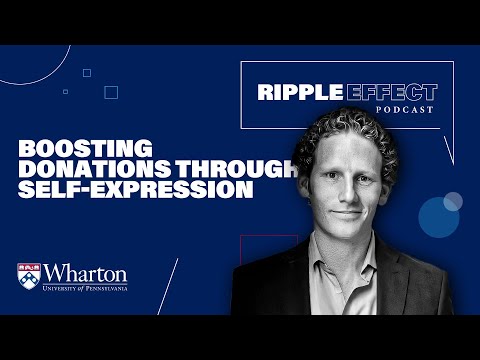
How Do People Decide to Donate to Political Campaigns or Charitable Foundations?
Ask about Knowledge at Wharton
Episode Description
EPISODE OVERVIEW Wharton’s Pinar Yildirim untangles the relationship between charitable and political giving, which are both on the rise. This episode is part of a series on “Charitable Giving.”
PODCAST OVERVIEW Every day, business scholars answer pressing questions in their research - but what do their insights mean for you? In this podcast, Wharton faculty dive into what inspired their studies and how their findings resonate with the world today. Learn how research insights translate into knowledge you can use, with host Dan Loney.
Learn more at http://whr.tn/rippleeffect
----- The Wharton School of the University of Pennsylvania is committed to sharing its intellectual capital through Knowledge at Wharton, the school’s online business analysis journal.
Launched in 1999, Knowledge at Wharton offers free access to:
- Articles, podcasts, and videos highlighting Wharton faculty research and analysis of current business trends - Interviews with book authors from Wharton School Press - In-depth series of curated content like Wharton Executive Education’s Nano Tools for Leaders - A searchable database of more than 10,000 articles covering all aspects of business - A weekly newsletter that delivers Knowledge at Wharton insights directly to your inbox
Visit the Knowledge at Wharton homepage: https://whr.tn/3qUpSBE Subscribe to the Knowledge at Wharton YouTube channel: https://whr.tn/3DEAgAU
Read the full transcriptHide the full transcript
- Pinar Yildirim: But we did look at donations to other organizations as well. So let me tell you what we did, and then we can jump
- into the conclusion. So the first thing we wanted to do, of course, is to understand how the two types of donations move
- relative to each other. So we wanted to be able to, of course— in an ideal scenario, you would like to be able to randomly just
- move donations going into one cause, and then see the impact on the other. - Welcome to <i>The Ripple Effect</i>, the podcast that takes you on a
- journey through the minds of Wharton faculty. I'm your host, Dan Loney, and in each episode, we'll be diving deep into the
- inspiration behind the groundbreaking research that Wharton professors have conducted and exploring how
- their findings resonate with the world today. - Well, certainly the fall of 2024
- will be remembered as a unique time in and around the area of charitable and political giving. Certainly we
- are seeing a high level of political giving right now with it being a presidential election year, but you also now have the
- impact of Hurricane Helene, which will also lead to giving to various organizations looking to help out those impacted by
- the storm. But the question which has been asked in the past, and that was being asked again, is, does one impact the
- other? Pleasure to be joined here in studio by Pinar Yildirim, who is an Associate Professor of Marketing here at the Wharton
- School. She's been part of research looking at the correlation between these two types of giving. Great to see
- you again. How are you? I'm wonderful. Thank you for having me. So the research that you did shows that there is an impact. Take us
- through what you did and what you found out. Well, we see significant amounts of money go into political
- donations. And naturally, we ask this question. Why are we seeing so much money going into politics? What motivates people
- to give to politics? And can we explain that in any way, maybe in relationship to charitable giving, which we know a lot more
- about? And those are the type of questions that we wanted to answer. It's an important year. When we look at the numbers, we
- see these numbers going up compared to the previous years. For example, if you were to just look at the 2016 election year,
- the presidential candidates were collectively able to collect about $440 million in the first 12 months of the campaign. That
- number more than doubled in the 2020 election, going over $1.1 billion. So in general, we are seeing this trend. This is for
- political giving. We also see similar trends if you look at charitable donations. In— last year, 2023, there were about
- $550 billion going into charitable giving. And that number is a significant hike compared to what we used to see
- ten, 15, years ago. For example, in 2010, we used to see about $300 billion going into charitable giving. So we asked this
- question again. What motivates people to donate? So we wanted to understand again, the motivations to giving. At the
- same time, also, wanted to understand, if we start seeing potentially an increase in one type of giving, what might be
- the impact on the other form of giving as well? So that's what we wanted to study.
- And so then what did you find out in— and part of the research you looked at was focused on
- giving to the American Red Cross, correct? Yes. Our focus, or at least our primary data
- was coming from the American Red Cross. But we did look at donations to other organizations as well. So let me tell you what we did, and then
- we can jump into the conclusion. So the first thing we wanted to do, of course, is to understand how the two types of donations
- move relative to each other. So we wanted to be able to, of course— in an ideal scenario, you would like to be able to
- randomly, just move donations going into one cause and then see the impact on the other. But in real world, of course, being
- able to see these effects in random ways is almost impossible. So we looked at events that happen in the world
- that almost randomly or random- like fashion, increase the motivations to give to one type of cause. And then we can look
- at the effects on the other. So for natural disasters, right? If you think about it, these events typically happen in very
- unexpected ways. They happen and their devastation is usually not calculable in advance, especially foreign disasters
- that take place in far away lands. They can act as reminders to give to charity, or how important donations to
- charitable organizations might be at the time of giving. These events get plenty of, or ample amounts of coverage on media,
- and therefore could increase the motivations they give in giving to charity, at least in temporary ways. So we took
- advantage of foreign natural disasters, large disasters, and we looked at the increase in the American Red Cross donations
- around the time of or in the weeks that follow these natural events. And then at the same time, looking at the Federal
- Elections Commission data on politics— on political donations, we looked at the response in political giving as
- well. So what we have seen was in the weeks— the six weeks, roughly, that follow a large foreign natural disaster,
- you see about a 34 to 35% increase in the American Red Cross donations, and the corresponding decline in the
- political donations is about 18 to 19%. - Right. - So just to summarize that, again, we see an increase in charitable giving or
- disaster response giving, and then we see a decline in the political donations.
- Does it happen to go the reverse way in a situation where you have a political event going on, and maybe you don't necessarily have
- the natural disaster that occurs? - Yeah. So exactly the same way of you framing that question, we also
- wanted to understand the flip side of the coin. If we start seeing, for example, events that motivate giving to politics, do
- we see a response in charitable giving as well? And again, finding events that will randomly increase the
- motivations to political giving is somewhat hard, but we can look at events that impact individuals or voters in ways
- that are almost random. For example, we can look at political advertising. We took advantage of some of the
- characteristics or institutional futures of political giving or the media markets. In general, in the United States, if you want to
- buy advertising, you typically buy them, especially TV advertising, by focusing on geographic areas that are called
- as "designated media market" areas. Designated market areas, DMAs, these are areas that are defined by the company Nielsen.
- And the boundaries of these markets are typically independent of the administrative boundaries. So
- what that means is you could be living— or two individuals could be living on two opposite sides of a designated market area
- boundary, and they could receive very different amounts and very different types of political ads. And we take advantage of
- those boundaries. We simply do a comparison of the individuals who fall— again, somewhat randomly— who fall on two sides
- of that boundary, and compare how someone who might have been exposed to higher levels of political advertising might be
- increasing or changing their giving to politics, and at the same time, how that person responds in charitable giving.
- And what we see is— just to quantify that— about a 10% increase in the political ad spending. So political ad
- spending typically determines what you can buy in, essentially, a market area. A 10% increase roughly corresponds to about a
- 0.2% increase in giving to politics, and at the same time, a 0.4% decline in giving to charity. So the amounts look
- slightly maybe different in terms of the magnitudes. But if you actually do a calculation, a comparison of how charitable
- giving responds to increase in political events, and do the opposite— how political giving responds to to these charitable
- or disaster events— we see somewhat comparable responses. Do people— you mentioned the historical numbers in terms of
- total giving. Do people feel like their money has more of an impact now than maybe they did 20, 30 years ago? Or is it, you
- know, just kind of the natural course of— of the funds that we have available to us, that we're willing to give to either
- case? Whether it be political, whether it be a charitable donation as well. - Yes.
- - Do people feel like there— it has more of an impact these days? Yeah. So if we reframe your question, I think we should ask
- what might be the motivation to giving, or what might be explaining, potentially, the substitution that we observe.
- And one sort of simple explanation could be that people have limited budget. And as they start giving to one cause, they
- start decreasing the amount for another cause. That, of course, is an explanation that we cannot rule out for everyone, right?
- There could be some individuals who, indeed, just because of budgetary considerations, start giving to one cause and
- start taking away from the other one. But we did look at spending or the response in other items. For example, we looked at how
- retail spending, or spending on on groceries, or spending on lottery items, lottery tickets, etc, which tend to be a lot
- more, you know, hedonic type of spending— we looked at how people's other spending response to the— both the political
- giving, as well as the charitable giving. So while we cannot rule out, of course, individuals giving because of budgetary
- considerations, one thing we have done is we looked at also spending in other categories. For example, we looked at retail
- spending. We looked at grocery spending, we looked at buying lottery tickets— which, of course, is not something that
- you have to do, right? It's something that you can— you can decide to buy. We did not see the same response. When we look
- at, for example, the increase in charitable giving, you do not see a decline in the spending items of these sorts. So we
- therefore think that it should not— or the substitution that you observe— should not be solely explainable by the budget
- considerations. But there could be other motivations that are potentially driving the pattern that we observe. Now, one
- potential explanation is something that relates to charitable giving. When you look at motivations for charitable
- giving, typically, the literature will put those motivations in two very broad buckets. One is the idea that,
- "I'm very altruistic. I really want the betterment of others. I care about the welfare of welfare of others, and therefore
- I give, right? I give because I want you to be better." - Right. - The other set of motivations typically fall under impure—
- impure altruism, or what the economists and the academics like to call "warm glow". "I give because it makes me feel good."
- - Sure. - "I give because I get some kind of status out of giving. Maybe I'm recognized as a donor somewhere, or I feel good about
- myself because I do something good for others." So for the individuals who are giving primarily because of the impure
- altruism or "warm glow" motivations, you don't really care if, ultimately, the money that you're giving is helping
- others to recover from a disaster, or doing something. So if the motivations for giving to the two types of charities, or
- if the primary motivations of giving is "warm glow" or feeling better about yourself, you could feel better about yourself from
- giving to to charity, and you might get a similar enjoyment, similar utility, out of giving to politics as well. So if
- motivations are "warm glow", we could potentially explain why people give to one cause versus the other.
- So the political cycle is unique in this process, because obviously it's not just the day or the week before the election. It's
- obviously a long run-up process in order to get to that point. And as you mentioned before, there's a lot of political
- advertising that will be on different platforms. That, I would assume, has then an impact, kind of in a longer framework, on how
- people think about their giving at that particular time. Whether they're giving to a political campaign versus a charitable
- giving. And I'm wondering if it has a longer impact, potentially to the detriment of the charitable organization, that
- they lose out on funds from individuals over a longer period of time, because that election cycle is such a longer cycle.
- Yeah. So I hear, I think, three sort of separate questions in what you just asked. One is, of course, the idea of, is there
- any difference across the time period? For instance, going into getting closer to the elections, do we see a different level of
- impact? Because of the aggregation in our study of the time periods, we wanted to look at donation response over a
- number of weeks. We don't necessarily observe— we were not able to observe these type of differences. But certainly, I
- could speculate that if somehow we are sending more reminders about the importance of donating to politics to individuals, or
- if we are elongating the periods over which people are constantly reminded of the need to give to politics, that could have a
- negative impact on the nonprofits that are trying to raise money for charitable causes, as well as the victims
- of these disasters. Because they're not going to be able to receive the same level of funds
- that they could have received otherwise. What do you think were your most important takeaways in looking
- at these components of giving from the outside? So I think a couple of important takeaways. First, we want to
- understand the motivations to giving to politics. Because, as I mentioned earlier, this is not entirely clear. It's relatively
- understudied compared to charitable giving. We understand the motivations to give to charitable giving, but we don't
- know what political donations are really for, or if it— some— some academics, some researchers, suggest that people
- give because they expect something in return, right? This is an instrumental motivation. You're donating because maybe
- you think that the politician will return that favor. - Sure. In the future. Or some others
- suggested that people give because they think it's their civic duty. Others suggested that people
- give because they get some consumption value out of that. So there could be different explanations, of course, or
- different suggestions as to why people give. But it's important to underline the common elements with charitable giving. And I
- think that's one of the first things that we do. We see that these forms of giving are substitutes. The second, I
- think, important takeaway for us is the relative negative impact of these two forms of giving on the other. Right? So we are
- observing that if there is an event that drives charitable giving, disaster giving in particular, we will see a
- negative impact on political donations. And that's not just coming from the budget effect. That seems to come from other
- factors as well, just like the "warm glow" effects that motivate people for giving. To quantify that, we see that if there is an
- increase of $1 that goes to charitable giving, that results in about a 42 cent decline in the political donations.
- Now looking at the other side, we also see that political events that drive political giving could have a negative
- impact on charitable donations. And that could be potentially a negative outcome for both nonprofits as well as disaster
- victims. To quantify that effect, we see that if there is a $1 increase, or events that drive political donations result
- in a $1 increase in political giving, that corresponds to about a 33 cent decline that's going to their charitable giving. So it's
- a sizable amount, and I think we need to be aware of these potential responses that come from the other causes of giving.
- And a third thing that we discuss at the end of our study which we care about is this question about the effect of
- money in politics. Right? As we were starting, I mentioned that the political donations are increasing. A non-significant— non-
- trivial amount of those donations come from individual donors, and that seemed to— seems to have increased over the last
- election cycles as well. So the question comes down to, should we think about— rethink— about the policies that restrict
- giving to politics? Is this too much money? And if there's too much money or too many political donations, does that really
- change the electoral dynamics in some way. Right? Could it be potentially benefiting some politicians more than others?
- And in discussing this topic, typically, we care about a concept called incumbency advantage. I think for our
- listeners, it might be potentially a familiar concept, but in brief, it just simply describes this idea that
- politicians who have access to resources, who have been in an office before, who have been elected before, who essentially
- are an incumbent, they tend to get re-elected again and again when you look at the United States elections, as well as in
- other countries as well. We don't like the idea of incumbency advantage too much unless the incumbent gets
- elected again and again because they are the better candidate. We don't like it if it's coming from some resource advantage,
- because that means we have less competitive elections, and some of the really good candidates, potentially high quality
- politicians, they may not be able to to get ground. They may not be able to get elected, and they may not eventually be able
- to benefit the public with their policies. So looking at the question of money, right, small and large amounts of money that
- go into donations, and how that potentially influences incumbency advantage, that's also something that we do in
- this study. And here, charitable donations are really useful, or disaster events are really useful because they create an
- exogenous or unexpected change in the money that goes to politics. Therefore, we can look at the response in terms of the
- electoral chances of incumbents and challengers. And perhaps surprisingly, or at least differently from some of the
- earlier studies in the literature, we find that actually more money in politics is not necessarily bad. When we
- look at the chances of getting elected by an incumbent as well as a challenger, we see that if we can increase the total pot of
- money— that is, if we can have more donations, more money going into politics, we actually are able to increase the chances of
- a challenger getting elected. So about a 10% increase in donations results in about a 3.6 percentage point, if I recall
- correctly, increase in the chances of a challenger getting elected. Which, again, if we believe in more competitive
- elections, where everybody has the chance to go and run and get elected, which should be a positive outcome for the society.
- Pinar, great to have you with us, and to go over all of this. Thank you very much.
- Thank you so much for having me. You got it. Pinar Yildirim, Associate Professor of Marketing
- here at the Wharton School. Thank you for listening to <i>The Ripple Effect</i>. We hope you found this episode informative and
- engaging. Don't forget to subscribe and leave us a review so that we can continue to bring you the best insight from the
- Wharton School.
Brief Summary
Pinar Yildirim discusses how political and charitable donations influence each other, especially during disasters and election cycles.
Key points
- Charitable Giving vs Political Donations. A $1 increase in charitable giving leads to a 42 cent decline in political donations, highlighting the competition for donor dollars.
- The Ripple Effect of Donations. Pinar Yildirim explores the relationship between political and charitable giving, revealing a significant impact of one on the other.
- Money in Politics and Election Outcomes. Surprisingly, increased political donations can enhance the chances of challengers winning elections, promoting competitiveness.
Episode highlights
- Charitable Giving vs Political DonationsA $1 increase in charitable giving leads to a 42 cent decline in political donations, highlighting the competition for donor dollars.“If there is an increase of $1 to charitable giving, it results in a 42 cent decline in political donations.”1:34Nov 12, 2024
- The Ripple Effect of DonationsPinar Yildirim explores the relationship between political and charitable giving, revealing a significant impact of one on the other.“What motivates people to give to politics?”1:46Nov 12, 2024
- Money in Politics and Election OutcomesSurprisingly, increased political donations can enhance the chances of challengers winning elections, promoting competitiveness.“More money in politics is not necessarily bad.”19:02Nov 12, 2024