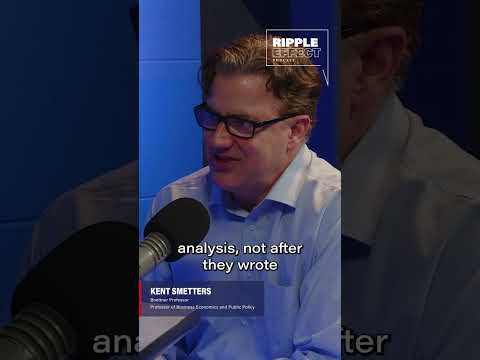
How Economic Modeling Can Identify Trends with Wharton Prof. Kent Smetters — Ripple Effect Podcast
Ask about Knowledge at Wharton
Episode Description
EPISODE OVERVIEW Wharton’s Kent Smetters talks about the Penn Wharton Budget Model, a nonpartisan, research-based initiative that analyzes the fiscal impact of federal public policy. This episode is part of a series on “The Economy & You.”
Topics and questions covered: 0:00 - Introductions 1:10 - Growing public interest on the economy 1:52 - Origins of Penn Wharton Budget Model 2:51 - What are the benefits of Penn Wharton Budget Model? 4:27 - Evaluating bias in policymaking 6:20 - How is Penn Wharton Budget Model funded? 7:39 - Is there public interest in the Budget Model? 10:17 - How does the Budget Model address U.S. debt?
PODCAST OVERVIEW Every day, business scholars answer pressing questions in their research — but what do their insights mean for you? In this podcast, Wharton faculty dive into what inspired their studies and how their findings resonate with the world today. Learn how research insights translate into knowledge you can use, with host Dan Loney.
Learn more at http://whr.tn/rippleeffect.
----- The Wharton School of the University of Pennsylvania is committed to sharing its intellectual capital through Knowledge at Wharton, the school’s online business analysis journal.
Launched in 1999, Knowledge at Wharton offers free access to:
- Articles, podcasts, and videos highlighting Wharton faculty research and analysis of current business trends - Interviews with book authors from Wharton School Press - In-depth series of curated content like Wharton Executive Education’s Nano Tools for Leaders - A searchable database of more than 10,000 articles covering all aspects of business - A weekly newsletter that delivers Knowledge at Wharton insights directly to your inbox
Visit the Knowledge at Wharton homepage: https://whr.tn/3qUpSBE Subscribe to the Knowledge at Wharton YouTube channel: https://whr.tn/3DEAgAU
Read the full transcriptHide the full transcript
- so pen Wharton budget model started about 7 years ago that's right how did it get started and what was the Genesis
- of the idea behind it yeah it was really members of Congress who I already was having conversations with they they were
- they really wanted a analysis not after they wrote the legislation not after it went to a chairperson maybe what went
- over to like the CBO or some of the other scoring agencies they wanted analysis at the very beginning while
- they're actually writing legislation so they wanted to know what was the effects
- before they put their reputation on the line what's the effect on the budget what's the effect on the economy what's
- the effect on people welcome to the ripple effect the podcast that takes you on a journey through the minds of wart
- and faculty I'm your host Dan Loney and in each episode we'll be diving deep into the inspiration behind the
- groundbreaking research that Wharton professors have conducted and exploring how their findings resonate with the
- world today well a pleasure to be joined right now by Ken Mets who is a professor
- of business economics and public policy here at the Wharton School as well as faculty director of the Penn Wharton
- budget model Kent great to see you again great to be back fair to say when we're
- talking about economy and economics right now that we're in a period of time where there is more interest on what's
- occurring and how it's occurring than maybe we've seen in in times past yeah it definitely true it's the last time
- we've really had this type of focus especially given the focus on inflation it's been over 40 years you have to go
- back to the early 1980s Ronald Reagan first term to really see this level of interest and also that people are
- understanding that you know inflation is this real phenomenon it's not just you know a textbook issue that the Federal
- Reserve has to worry about it really has a big pocketbook issue as well so pen Wharton budget model started about seven
- years ago that's right how did it get started and what was the Genesis of the idea behind it yeah it was really
- members of Congress who I already was having conversations with they they were they really wanted uh analysis not after
- they wrote the legislation not after it went to a chairperson maybe what went over to like the CBO or some of the
- other scoring agencies they wanted analysis at the very beginning while they're actually writing legislation so
- they wanted to know what was the effects before they put their reputation on the
- line what's the effect on the budget what's the effect on the economy what's an effect on people and um that's really
- how we operate very differently we do a lot of analysis it's not even on our website directly with policy makers on
- both sides of the aisle who just are looking for an understanding of the impact of their legislation and before
- they put pen to paper before they put the reputation on the line so then in the landscape of what's going on in
- Washington right now what do you think the benefit has been of having a resource like that to be able to bring
- this type of information forward it's ultimately about credibility we become known very much as the honest broker at
- any point in time one side May really dislike us for our analysis honest in Washington DC sometimes that's a
- challenge it is because there's a lot of groups in uh DC that call themselves nonpartisan they're really for tax
- purposes because you can give to a nonpartisan deduct the uh amount that you're giving um even though they're
- doing a lot of advocacy in terms of issues and things like that we are not just nonpartisan we go one step further
- we're nonnormative what that simply means is that we'll never advocate for a policy we'll simply do the analysis as
- what we think is the best as possible and let the numbers just be what they are CH let the chips fall where they may
- and um at any point in time one party May love that number and uh another party May hate that number but if you
- look at at who asks us for numbers it's coming from both sides of the aisle now if you look at our free certificate
- program that we do in Washington DC that is available to anybody interest in policy but not surprisingly a lot of
- capital staff it's basically evenly split between both parties and so even yes uh people on both sides have said
- that they find our our numbers often scary when they're writing legislation they still respect it how much then do
- you also think that it it has while maybe it wasn't the intentional goal right from the outset of also focusing
- on the issue of bias that we see play out in and around Washington DC as well yeah there's a lot of problems with the
- metrics that are traditionally used in Washington DC so Republicans typically focus on just a macro outcome Democrats
- on distributional outcome economists have never believed that either measure is the right one to look at a policy and
- in particular we want to have things are much more integrated uh so something that may look bad for a low-income
- person simply because they happen to be young may actually be good for them over
- a lifetime if it happens to grow the economy and so it we have a much more integrated approach that actually
- combines uh everything and also we don't truncate uh like under current rules a lot of analysis under current law is
- done on their fiveyear or 10year budget so anything that is like a preas spending program is always going to look
- bad under 10 budget because you spend all the money up front and those you know four-year-olds are not going into
- the workforce until decades later and so whenever you truncate you're creating this bias and so we really uh work hard
- to remove biases and really focus on good economics and and Analysis I mean it's true in many ways what economists
- have focused on have been clever insights and so forth they've never built their models to actually do real
- policy work uh and the policy work that's often done is really from an advocacy perspective we're trying to
- bring the actually make economics useful in many ways and bring bring the rigor of analysis tie our hands in a way that
- the the the process has to be rigorous and um let the chips swall where they make May and let economics be really
- useful where where does the funding component come from for pen Warton budget model sure wa it's partly alumni
- and partly that we get grants from different uh large organizations and so uh what we do is really make it clear to
- everybody that our analysis is our analysis and if you uh look at what we have done in the last you know five
- years with for example the tax cuts and jobs Act was largely liked by Wall Street but in fact we came out and said
- it's going to have very little effect on the economy and on top of that it will um cost a lot more than what the
- government's official numbers were and after it got passed the government official numbers then came right up to
- ours they did a technical revision and came right up to our numbers and so it then if you look at the uh
- infrastructure bill that was uh passed a couple years ago and then last year the
- inflation reduction act our analysis really played a key role in those legislation both sides of the Isis said
- are analysis was pivotal for for their members in both cases you know highly cited by both by Advocates of those
- policies hand we also showed neither policy was going to energ ISAC ony like you know The Advocates were trying to
- say and so um not not terribly surprising there's lots of overstepping that happens in the political process do
- you see even interest from outside the political realm like uh even the public in general because as I said there's
- such more of an interest in seeing what has been going on and trying to understand it a little better that the
- public is diving more into something like ped Mor budget model to have a better understanding of what what's
- going on right you I would say just because of our size we're uh around 30 people with two offices philadelph in DC
- we have to be somewhat focused and our main policy audience has been policy makers them them themselves having said
- that we have definitely tried to write briefs and articles that on public legislation so this is the legislation
- that's actually been introduced um either as a bill or signing the law um that's accessible on our website but
- even there I will admit that sometimes uh things can get a little little Advanced when you're trying to explain
- hard to understand Concepts and and so we certainly are trying to do a better job of that over time and give people
- tools like simulators that they can try to understand things with I I will say that you know our modeling is often
- takes hours to run across 75,000 threads in many T cases running paralyzed Computing very detailed calculations
- trying to break that down and make it really understandable it's it's a it's always been at chore and we we continue
- make improvements but we're not there yet but that under that element of understanding uh becomes that more
- important even for those members uh on Capitol Hill or their aids to have a better framework of understanding of
- what x might have an impact instead of Y as we move forward with some of this legislation right I mean I think it's
- really important a couple things one is that we're as transparent as possible possible with the mechanisms that were
- including and not including um that were credible that we are not an advocacy um
- organization but immediately um it's still going to be hard for staff to on the Capital Hill even trained staff to
- really understand everything that's kind of going on because there's a lot so we're working hard to really document
- things first for the experts who could validate and understand what's going on and making sure that uh for everybody
- else that work communicating in a way that is as straightforward as possible knowing that we're never going to get
- that completely right and so uh we live in a country where just basic financial literacy is often very challenging and
- um we're not going to solve all those problems we're going to try to do best we can with our limited headcount so
- obviously one of the big stories right now involves the debt uh which has been talked about a lot how then does pen
- Warton budget model look to try and address some of the issues that are out there in around uh the level of debt
- that we have in this country yeah the debt is it continues to increase relative to the size of the economy
- there's no end in sight on that and um right now neither side is proposing really anything that will address that
- and so that's a very scary Outlook in the sense that um that's happened at the same time a large carbon debt is
- accumulating and it you know if you think things are a little bit kind of crazy now in the politics and the world
- and so forth um this is is actually the good time because we actually are very Capital flush right now in the United
- States and the world as a lot of people are going into retirement they have a lot of retirement Savings in a a decade
- from now we're going to see a lot of that saving um have uh disappeared and as a result of that or continue to
- disappear and um as a result we're really have this convergence between a debt that's spiraling out of control
- carbon's still going to keep on going to where it's going and then um the resources of the uh the capital
- deepening that we have right now is going to go away and so it is one of those things we're really trying to get
- people to look down the the the road a lot more than they currently are you know both sides have taken strict
- positions or what they're willing and not willing to do you know the fact of matter is if you're not willing to raise
- taxes on those making less than $400,000 a year which the Democrats have said um
- there's not enough money left over and the high income the high wealth and so forth every everybody thinks that
- there's tons of money up there they they're not understanding the size of the imbalance rate now there's just not
- enough money up there there has to be broad-based uh either increase in revenue or decrease in spending and then
- on the other side of the aisle the Republicans are also taking you know positions about no new tax increases but
- we're not going to touch int tellement programs either well that doesn't add up either so both sides really need to come
- to grips with the situation and what we're going to do is we're really in the past what we done is we've created these
- policy uh these different policy options but they typically were things like uh before the 2017 tax cuts and jobs act or
- the infrastructure bill or IRA or before that um build back better or some of the
- cash payments and we lay out the options and the policy makers a lot of times are
- picking one of those options that's what they form in the law what we're going to
- be doing going forward is also uh creting these policy bundles because there's lots of interactions between
- things like what you do social security and the rest of the economy and the rest of the tax bases and we're
- going to be looking at those um big bundles and trying to show people first the path that we're on this is not
- sustainable it literally will collapse the economy if we don't do something but secondly then layout here is different
- options uh for dealing with this and they all have different trade-offs and just let's be super transparent um about
- that is that the the concept that the belief that the idea of the bundle is going to be something that we're going
- to be talking about more and more you're bringing some of these elements together
- kind of under one package as we move forward I think so I mean usually the politics is you know you try to be
- incremental make small changes the problem with incrementalism is first of all it's too late for that in the United
- States um we've uh we're really too far along in the debt path uh so we need um to make bigger changes sooner but the
- second is some people feel like actually what happens with those incremental changes is that you've had too many
- people who benefit from that particular tax provision or spending provision they
- Lobby intensely and maybe now is the day for the Big B for the big bundles uh that worked our way in where you know
- everybody's a loser in some ways today but we're making these Investments for the future
- Generations Kent always great to talk with you and get your Insight on all of these things thanks very much and all
- the best with the pen Warton budget model and for people that do want to follow it the website is you can simply
- Google pen Warton budget model and that will be actually the easiest to fine all
- right great thanks Kent all the best to you thank you thank you Wharton school's
- Kent smetters thank you for listening to the ripple effect we hope you found this
- episode informative and engaging don't forget to subscribe and leave us a review so that we can continue to bring
- you the best Insight from the warten school
Brief Summary
Ken Mets discusses the Penn Wharton Budget Model's role in providing early economic analysis for Congress amidst rising national debt and inflation concerns.
Key points
- The Genesis of the Penn Wharton Budget Model. Learn how the Penn Wharton budget model was created to provide early analysis for legislation.
- Understanding Inflation's Impact. A deep dive into how inflation affects the economy and people's lives today.
- The Challenge of Political Bias. Exploring the biases in economic metrics used in Washington and how they affect policy.
- The Unsustainable Debt Path. A stark warning about the increasing national debt and its implications for the economy.
Episode highlights
- The Genesis of the Penn Wharton Budget ModelLearn how the Penn Wharton budget model was created to provide early analysis for legislation.“They wanted analysis at the very beginning while they're actually writing legislation.”0:26Oct 10, 2023
- Understanding Inflation's ImpactA deep dive into how inflation affects the economy and people's lives today.“Inflation is a real phenomenon; it's not just a textbook issue.”1:46Oct 10, 2023
- The Challenge of Political BiasExploring the biases in economic metrics used in Washington and how they affect policy.“We’re not just nonpartisan; we’re nonnormative.”3:37Oct 10, 2023
- The Unsustainable Debt PathA stark warning about the increasing national debt and its implications for the economy.“This is not sustainable; it literally will collapse the economy if we don't do something.”13:11Oct 10, 2023