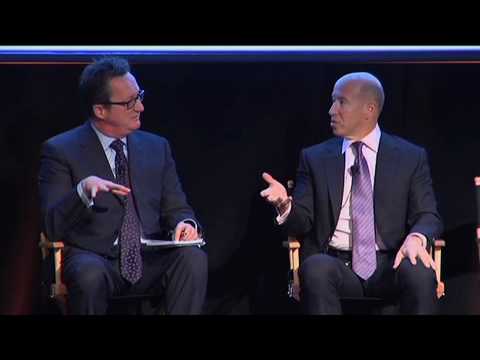
Market Update with Wharton's Jeremy Siegel and Scott Richard
Ask about Knowledge at Wharton
Episode Description
The Dow has hit its highest level in years, loan rates are at record lows and the U.S. economy appears to be gaining momentum. Even the housing market is starting to look inviting. But is this a real recovery -- or a false start like last year's? Wharton finance professor Jeremy Siegel and Scott Richard, a Wharton practice professor of finance, think the economy is showing signs of a true rebound, and predict that stocks should do well in the next 12 months. But bonds, they warn, are in dangerous waters, and economic growth will be in jeopardy if oil prices keep rising and the European credit crisis worsens. 📂 Finance & Accounting
Read the full transcriptHide the full transcript
- Hello, I'm Jeff Brown for Knowledge at Wharton. The stock market is up, not up as high as it once was. The economy
- seems to be improving a little bit, but maybe not as much as we'd like. We're trying to make sense of it all and today
- we have two Wharton professors with us, Jeremy Siegel and Scott Richard. Thank you very much.
- And I'd like to start with each of you. I'll start with you, Professor Siegel. Uh
- we look at these signs of the economy. It does seem like things are improving. On the other hand, we had kind of a
- false start a year ago and I think a lot of people were burned by that. So, should we believe it or should we not
- believe it? a head fake. Things were going up in April and through March. I think things are far more real now. I
- The employment numbers are much better. The private payroll expansion is much better. Remember, just at this time we
- had you know, we just had the anniversary of the tsunami and earthquake in Japan.
- And then Europe got much worse. Now, no one can can talk about Europe later. No one can say that that couldn't flare up
- again, but there's been a lot of measures that have taken. Those stifled, I thought, the recovery that was
- proceeding at the beginning of of this year. We take a look at even the home building cuz that's been the most
- depressed area. National Association of Home Builders suddenly moving up. That was dead last year. Did not move up in
- March and April. I mean, today at Wall Street Journal I saw an article about a revival of of real estate in Phoenix.
- How could you believe that? Yeah, I mean, it was one of the worst and all of a sudden they they see
- a recovery there. So, the think these green shoots are much stronger now than what we had a year ago.
- I completely agree with that. We are in the beginning of a serious recovery. Uh both in jobs and in output.
- Mhm. And um I expect stock prices and bond prices will react accordingly. With the bond market going up in yield
- and down in price. Finally, we've been saying that for ages. All right. Well, the forward rates all show uh
- significant rises Uh-huh. uh in bond yields built in. So, you lose money, if you will, if they
- don't go up that much. Okay. Okay. But, you think it's more solid this time than it was a year ago.
- That's your your bottom line on that. All right. Well, let let's uh zero in on the stock market for starters, then
- we'll talk about the bond market. So, uh Professor Siegel, the we've talked over the years a number
- of times about what are kind of the the the the the the gears and levers inside the market that you look at to to to see
- what's going on. Things like P/E ratios and that sort of thing. What are you looking at now and what are they telling
- you? Well, I I think, you know, when you take stock price, actually you can take asset
- prices. I mean, the the the two things that are important are cash flows and the discount rate, which for stocks are
- earnings, basically, and the interest rate environment in which you find those earnings.
- Uh uh it was very favorable last year, actually. It is more favorable to me this year because interest rates are a
- lot lower now, especially those long-term interest rates, uh than they were a year ago. So, uh the
- P/E ratio is about the same as a year ago, 12 13, as we had last year. That's what we're looking
- Yeah, that's the forward-looking on the next 12 months. Uh 12 13 on that. Lower than the
- long-run average is 15. And in an even almost well, in some ways a record low interest rate environment. Uh
- So, you know, the the question is is those alternatives that you have out there are
- you know, not attractive at all. You know, a lot of people tell me nowadays, well Jeremy, there's
- not just you know, bonds out there. There's there's you know, all these other assets that they talk about and
- commodities and private equity and and you know, venture capital and all the rest, but you shouldn't be fooled. I'm
- sure that Scott will agree. I mean, fixed income is still the biggest asset class. I mean, that that you have to
- compare it to. You can't you know, they're not on all equal footing in terms of size. Fixed income is is the
- big comparison there and there there the comparison is just I think extraordinarily favorable.
- So, with PE ratios low, the risk level of stocks looks relatively low and you can make nothing in bonds or anywhere
- else. But what I think risk level on stocks, you know, I mean, they could go lower.
- The bears are you know, they they they like to point well, Jeremy, you know, we had PE ratios of seven and eight back in
- the in this late 70s and 80s and I say, yeah, and that's when interest rates were 15 and 20% and there was a lot of
- competition there. There isn't any competition. So, to see a a PE ratio of 13 in an extraordinarily low interest rate
- environment is is really extraordinary. I mean, again, And that's good. That's a positive sign.
- extraordinarily positive going forward and I think people are beginning to you know, to to
- put their toes in the water and and buy a little. All right. Um We've looked when you look at the stock
- market, of course, anyone who's in the market for a mutual fund is experienced in this. They say, we were the best
- performing fund in some you know, period that they've selected and you can always
- argue what period should use the entire 20th century, the last 10 years, the last two days. You You what what today
- given what the market has done over the last few years, would be sort of a a good period to look back and say how
- well are stocks doing or how poorly are they doing? Well, I actually think that this period
- is not that unlike the 1950s. Mid-1950s, we had very low interest rates and low valuation of stocks.
- People were very frightened then. They still had memories of the Great Depression and the the tremendous stocks
- collapse that had there. They didn't believe the post-war recovery was real because so many economists were talking
- about a relapse into another depression. The fear was there and if you remember,
- that was one of the best times to start accumulating stocks and one of the worst
- times to start buying bonds at that time. And I'm wondering whether, you know, 10-15 years from now we'll
- look back on that and say exactly, I think, the same thing. So, it would be risky to be sitting on
- the sidelines now. I think I think you're missing out on great values in stocks,
- you know, even in terms of the dividend yield. Uh This is the first time since the 1950s
- that the dividend yield on the S&P 500 has been higher than the 10-year government bond. So, and stocks have
- growth and inflation hedge properties that the bonds don't have. And if you want the inflation hedge properties in
- the bonds and you go to TIPS, their yields are negative, incredibly so, in my opinion.
- So, there's really no yield there at all. So, again, I mean stocks are really, I think, the only real game in
- town for for yield going forward. So, so a person who's, say, in or near retirement should really consider
- dividends as a as a source. you know, good blue chip dividend paying stocks, low PE dividend paying stocks. I
- think that that's going to be your best best answer. of the some of the telephone stocks are
- paying over 5% these days, so. I wouldn't stay with any one or two. I mean, I would try to be as diversified
- as possible. I mean, I don't pick sectors or stocks, but you know, if you go and I diversify towards
- a a value portfolio that that is dividend tilted and dividend weighted, I think that will be very good performing
- going forward. So, people who look back or read the stories about sort of the lost decade,
- which now not referring to Japan, but referring to the US stock market, that would be too short a perspective for
- Well, we remember we started that quote lost decade in 2000 with a PE ratio of 30 on the market.
- Right. In March of 2000. And you know what? When you start with 30, you're not going
- to have a good decade. I mean, Japan started in in 1989 with a 90 PE and they did not have a good 30 years
- after that. You know, I mean, when you start from high valuation, but that's why people
- say, "Well, can't this next decade be lost?" And I say, "Not starting from these PE ratios."
- is one of the class you might want to look at, which is real estate. Uh-huh. Okay. Clearly, cash is absurd
- with single-digit yields. I mean, in basis points, 10, 12 basis points. And then bonds, I don't
- understand why anybody in their right mind wants to lend the US government money for 10 years at under 2%. It makes
- no sense to me at all. So, if you rule out cash, you rule out bonds, stocks are very attractive as Jeremy said. But real
- estate also has a lot of attractive attributes this you're referring to real estate
- investment trusts or actually going out and buying of investment property? Either one. Especially if you're if you
- have the nerve in some of the sand states where things have really been crushed. Now, the rental markets already
- are reflecting this. Rents are up nationwide. But we've never seen more affordable
- prices on single-family housing since the records have been kept. It's between the low mortgage rates and the low
- prices, this is the best opportunity that anybody have seen in 40 years of records.
- Now talking about real estate, I mean when people are considering their own home, they've historically been told
- well you you've got to stick around for four or five years to break even given the cost of buying and selling title
- insurance things like that. If one were considering an investment property, how long a holding period would they
- have to commit to do you think at minimum? Depends on the market of course, sure.
- If But is it in the six It's not a six-month flip buy and flip kind of market? housing for the one you occupy is a
- consumption good. It's not an investment. If you're not collecting rent, it's not an investment. You're
- consuming the house property. And and rental properties, that's just a straightforward present value
- calculation. How much is the rent I can collect versus the cost of carrying the house, the P&I, and the insurance, and
- the taxes. And I think that you'd have to be fairly foolish to as we've all learned to invest on the on the come, on
- the capital gain that you're planning to get out of that house. I I'd like to mention supple and I I do
- agree with Scott here, but the REITs itself, the REIT index has really totally bounced back. I mean, it's
- within I think 10 or 15% of its high that it reached pre-crisis. But so is the stock So is the stock
- market. market is also within that. In some of these individual properties you're talking about, and I do agree
- that like the affordability index is at a record high. And if even if you look internationally, US real estate is
- unbelievably cheap on an international basis as well. So again, the REITs the REITs themselves
- I think have gotten a good bounce. I still think they're probably okay as investment, but if you can if you can
- get into the rentals in in particular places, I think you might you might score very well.
- But but again, that's a multi-year problem. requires a little bit more specialty in
- terms of being able to do that. And no liquidity. There's no liquidity there as opposed to stocks which are
- among most ultimately liquid. short. Okay. And and retail and that's one reason they're back up.
- Now Professor Siegel, yeah. You mentioned the foreign markets in real estate and there are also of course
- foreign markets in stock and and in the past you've been quite a strong advocate
- of people having a pretty substantial holding in international stocks. How have things changed? Is that still a
- good idea? an an excellent idea. There is more growth, you know, well, abroad and I'm
- excluding You know, you have basically the United States, you have the other world developed countries such as, you
- know, Japan and Europe and those have moved into a slow growth period to be to be sure, but the emerging markets
- have bounced back and not only have they bounced back, but their valuations for rapid growing
- countries and firms are still extremely reasonable. I mean, I was just looking at the Shanghai composite
- selling 10 to 11 times this year's projected earnings and even with the come down of the squeeze in in the in
- the Chinese market Hong Kong is like at 12, Singapore is you know, at at 15. They're all 15, 16 which I think are
- very good valuations. You know, one of the things that I've mentioned this before, people say are
- these emerging markets for real? And I think I think we definitely know the answer is
- yes because we had the biggest economic shock in 2008-2009 since the Great Depression of the '30s.
- If it was going to knock anyone out, it would have been the emerging markets. They've come back much stronger than any
- of the developed markets in terms of the economies themselves. Some of their stock markets are not quite back to
- that, but their economies are now over, well over the peak of what they were in 2007.
- If you look at I have data since 1972 to look at corporate values. That is both the stocks plus the corporate bonds.
- That's grown about 1% faster than nominal GDP. So, why? Well, two things have been
- going on. One is labor's share of the economy has been falling. And the other one is we are participating in a global
- expansion. The US companies themselves without diversifying globally give you global diversification. Clearly, they
- can't keep growing 1% faster than the economy or they become the economy. So, sooner or later they're going to have to
- level off and grow at the rate of the economy. But I don't see that happening in myself in the short run because of
- the increasing and continuing globalization. Okay. I don't know what you think. Uh no, well, I I definitely agree and
- that's why some of these comparisons people look at ratio of stock market value to GDP is not appropriate anymore.
- I mean, 45% of the profits of the S&P 500 are now coming from abroad. So, you know, you need to look at world GDP
- which is growing faster than US GDP. You know, I mean, that's that's I think the
- most important criteria and and why I think that that divergence can go on for an awfully long time.
- Before we switch from stocks to bonds, I just want one last question which is what worries you the most if if
- something were to derail all of this? What what would it What would it be? Well, you know, I I
- I always have in the back of I'm not happy about rising oil prices. Um We're learning
- War in Iraq. Well, war Any sort of war in the Gulf that closes that and sends oil up to 250. Um and is
- in some scenarios is is obviously a threat out there. Um A longer term threat is if and I
- don't see this happening, but if this if if if the emerging market stop growing.
- I mean, China and India political things happen and uh you know, because I think the growth of
- the emerging markets are very important uh for us economically. They're the new middle class that are going to be buying
- so many of the goods as we retire as the baby boom population retires over the next 20 years and and and they're
- going to be the demanders of goods and grow much bigger than the middle classes that now exist in Europe and the United
- States. So, and that's a longer term issue. Uh you know, if if something disrupts their growth, I don't see that
- happening. Short run, it is probably the the oil question and uh war or attacks in Iran.
- I agree with Jeremy that um we're I think this is going to be the century of wealth
- creation. You've got 2 billion people in the last 20 years who have come out of abject poverty
- into the cash economy and a huge growth in the middle class in India and China. And that's nothing but good news.
- And I don't see anything that will cause that to derail if unless their governments adopt very bad policies. The
- government can always do that and there's nothing you can do about it, but both the Indian and the Chinese
- government seems seem to have shed it their socialist policies and have embraced market economies and
- we should see quite a bit of growth continuing out of those countries. Let's talk about bonds a little bit and
- the and the interest rates. It does seems like it's been years that we've been saying
- we and other people, well, you know, interest rates are more likely to go up than down.
- And I'm not blaming you. Eventually we're going to be right. I'm not blaming you guys.
- I say the same Everybody says this. So, you know, Except for tips. Tips are negative.
- Have we ever seen negative? Just give Put this in perspective. Professor, have we Have we ever seen a
- period where rates have been so low persistently for so long? Not since the Great Depression.
- Uh-huh. This is a post-war new. And uh we've seen low rates uh at the 10-year point
- and the like, but never cash this low, the Fed funds this low for this long. Um and uh
- Chairman Bernanke has announced that he intends to keep it there uh through 2014, and the markets seem to
- be buying this. Yeah, that that that was quite a remarkable announcement, very unprecedented. And I I'm just curious
- how do the markets react? I mean, so much of the coverage of the bond markets is, you know, the speculation, well,
- what are they going to do? What are rates going to be like in the future? Has this changed that element? Has it
- calmed them down? Uh is it Are they just ignoring it? What's the reaction? No, I think they've Nobody in the
- markets ignores the Fed. Okay. Okay. Uh they are the 800-lb gorilla. Mhm. And long rates are just averages of
- short rates. So, you have to figure out you have to be looking at the Fed. Of course, the Fed has much, much more
- control over the front end of the yield curve than they do over the long end. So, the reaction in the market is we've
- seen a very We have very steep yield curves. The rates are not all that high, but the curve is very steep. And
- the forward rates are even steeper. So, the market its reaction is that as the as I read it, as the economy strengthens
- in the coming year, the Fed is going to be holding down the front end of the curve.
- And so, the only way the curve has to go is to move up. It's to steepen. And that's what the forward rates look like,
- and that's what I expect will happen. And whether the Fed changes its mind and then eases before the end of 2014, I
- think will be very endogenous. It depends on what happens to the unemployment rate and inflation.
- Inflation right now is more abundant, but they may have printed a lot of money. And I don't know whether they're
- going to be able to reel it back in in time to keep the inflation from coming out. Uh in past years, if when the
- economy was stronger, they had printed anything like this amount of money, this huge uh easing they've gone through in
- the last few years, uh people would be very worried about inflation. So, it does look like rates will come up
- in the next couple of years, few years. yeah. And they that's what's the market's forecasting as well. That's
- what the forward And I'd like to just remind people that it's always difficult for for laymen to
- remember this relationship between interest rates and bond prices and how a rising rate can cost you money if you've
- bought a bond earlier that pays less. That's correct, and that's a danger for people who are looking at bond mutual
- funds and think they're safe. How how would you gauge that danger these days? can buy a mod bond mutual funds in all
- sorts of flavors. You can go everything from a money market fund, which probably
- is safe, okay, to But yields zero. Yields zero, right. Well, no free lunch. Okay, on out to There are short-term
- bond funds, which are yielding something like 1% and are relatively exempt, relatively immune to interest rate
- movements. And then you can go on out to longer bond funds, 5 years, where what you say is very true. When yields go up,
- eventually these funds are going to suffer. Uh Offsetting it will be some spread
- tightening as the economy recovers. The corporate spreads are not all that wide right now, nor are they nor are
- mortgages. So, should the investor who wants a portion of the portfolio in bonds assume
- that this is going to even out over time? That the turnover in the fund will get new higher yielding bonds and it
- won't matter, or should they be worried about it? I would expect to earn your yield.
- Mhm. Right now. Okay. I don't think you're going to get some coupon and I expect capital losses to
- come in against the coupon. So, if that's what I mean by earn your yield. If you hold it to maturity, that's
- about the best you're going to do. But the bond funds I mean, if they're a long-term bond fund, they'll always be
- selling a bond that gets too short and buying the long and you will get that capital gain. You'll never recover it.
- Right, you'll get the capital loss. The loss. Right. Or yeah. I misinterpreted your question.
- I thought you were talking about buying bonds, With a fund you can't hold to maturity
- the way you can hold to maturity like you can with an individual bond. Right. Okay. So, people should be aware of the
- bond market right now. be very wary of it. Okay. And I would not be a bond buyer at these
- yields. Like I said, why do you want to lend the US government money for 10 years at 1.75%
- when they're running trillion dollar deficits? All right. Now, of course, we're constantly hearing about the situation
- in Europe, the debt crisis in Europe, and it's a little bit mystifying to many of us how that affects us. We know
- vaguely everything's interconnected, but how does it affect us? What's sort of the mechanism in which troubles in
- Europe affect markets in the United States? They're a huge trading partner. Mhm.
- And if they go through these serial defaults, like I liken it to a bank run, okay?
- Greece has defaulted. I imagine the market's going to turn its attention to Portugal next.
- Okay? And Portuguese spreads are already very wide and have been widening. Um these are less worrisome because
- they're small. They're small amounts of GDP. But if they start to fall and then the next one is Italy or Spain. Those
- are big and real. The joke about Italy is it's too big to save. Okay? And uh if their economy becomes
- compromised, these are people who buy a lot of goods and services from the United States and that's going to hurt.
- That's going to hurt everybody who exports. Okay? From farmers through manufacturers.
- So, that's the mechanism is trade is really the mechanism I think. And And do you feel that that that
- they're getting a grip on this situation in Europe or not? Truthfully, no. Okay? I think that um they're getting
- they're moving in the right direction. But for a currency union to work, you need several things. That's what they've
- got. We've got a currency union in the United States. We've got 50 states and one currency. We have a lot of labor
- mobility. Okay? And that's what makes our currency union work. They have very little labor
- mobility in Europe. Not on the laws. There you're allowed to move, but in fact, there's very little
- labor mobility. So, they don't really have a mechanism that's going to allow huge differences in labor productivity
- across Europe to equilibrate. The normal way of doing that was, for example, with
- Greece, they would have had a drachma. And the drachma would have fallen in value.
- Okay? And then everybody's labor productivity per unit of currency would have worked
- out. So, the euro would have stayed strong, the drachma would have weakened, and the Greeks would have been
- competitive in the in the European market. Same thing's true now of Portugal, Spain, and Italy. They have
- real problems in unit labor costs. Their unit labor costs are very high compared
- to Germany's and they don't have a mechanism for adjusting. And that's what worries me.
- Well, do you think that going to the euro was a mistake? Is that what all this is pointing to?
- Going to the euro was perhaps not a mistake. What was a mistake was going to the Euro without having a mechanism in
- place to make sure that unit labor costs across the Eurozone were going to remain
- competitive. And they had no such mechanism in place. Now, you mentioned that nobody would
- make no sense to lend the US government money for earning nothing. Well, I wouldn't lend them to them.
- But there are other opportunities in the bond market. There are corporates, there
- are municipals, and there are junk bonds or high yield as they like to say. What
- what do you see sort of looking across that spectrum uh what looks appealing or unappealing or
- more dangerous or less so? Yeah, I don't see anything awfully appealing in the bond market uh
- at all across the the whole sector. Um and that's because of I'm worried about rates going up. Now, if you hedge out
- the rates, then the question becomes are any of the spreads attractive? Mortgage
- spreads are a little bit wide, not tremendously wide. Corporate spreads are a little bit wide, not tremendously
- wide. A lot of the value in corporations, if you had the nerve, was available a year ago. But they've
- tightened into a lot. So, I don't see any real great values across the whole bond market. I don't know about you.
- No, I I I I tend to agree. Um interest rates are going to go up. Um again, they're at zero on on the short
- term. I personally do not think that Bernanke is going to be able to hold rates uh until 2014.
- I think the economy's going to improve and uh or inflation is going to increase enough that he's going to have to pull
- the trigger uh and then Now, a lot of people ask me, "Well, Jeremy, what's going to happen to
- stock market?" I say it'll be a shock when that happens, but if you go through history, the early phases of Fed
- tightening are not bad for the stock market. Stock rallies continue. It's only at the end when they really
- squeeze, you know, tight to you know, slow the economy that's getting out of control in terms of inflation and and
- and resource utilization, that you really begin to see the the bear market beginning. So, yeah, I'm not I'm not
- saying on the day when Bernanke you know, says, "We're we're now thinking of, you know, withdrawing the
- accommodation." There will be a short-term shock there, and I consider that a buying opportunity because
- history shows us that often times stocks uh recover very quickly from that and continue on to the new highs as long as
- earnings are growing. Because remember, there's two things that affect the stock
- market. Uh it's interest rates and earnings. The bond market's only the interest rate. So, they don't have if
- the if the economy's going to be stronger, you're going to do really well on the earning side, and that's going to
- be able to bring the the the stock market up where bonds can't go. Now, you know what I thought of was
- some sectors of the bond market, like the banks, I think are very attractive right now. But that's a view that the
- financial sector is healing and not uh going down the tubes. All right. There's one other sector I want to ask
- you about because of your background in the mortgage securities market, and that
- is uh am I correct that that that the private securitization market is still pretty much dead?
- More abundant. Uh and does that matter? I mean, is there something else uh I mean, I guess it's
- Freddy and Fran- Fannie have stepped in to fill that breach. Um is it important that we have a private
- securitization market? And if it is, what will it take to get it going again? Yeah, those are great questions. Um
- Fannie and Freddy can only securitize a loan up to a congressionally set ceiling, which under special
- circumstances it's now up to about 625, but the actual ceiling's about $200,000 lower than that, and there's a lot of
- political pressure to return it to the actual ceiling, to not make it a uh a jumbo loan securitizer. There's
- essentially no jumbo loan market. How important is that? Well, if you're the average person who's
- buying the average home price in the United States is a couple hundred thousand dollars, it's not important at
- all. Because there are lots and lots of conforming Fannie and Freddie conforming
- loan money available. If you're buying a jumbo loan or if you live in an expensive market like California or New
- York, it's very important. Because you can't buy a house, which means that the person trying to sell you
- the house can't sell it to you even though quote rates are low, people can't get the loans.
- Um, so what's it going to take to get that going? I think you're going to have to see house prices turn to some
- strength so that the underlying collateral, house price, uh, looks good enough for people to be
- willing to lend against it. Nobody in in Wall Street days there's an expression,
- don't catch a falling knife. Okay? And that's what people look at the housing market as, a falling knife.
- Uh, now we have some signs like Jeremy mentioned about Phoenix turning and we may see other cities turning, but I
- believe that the mortgage lenders in the bond market are going to take a wait-and-see attitude. They're not going
- to get in front of this. All right. Let's just finish up. I want to ask each of you to just sort of look forward to
- say a year from now. What do you think things are going to look like uh, in in the the economy and
- and the markets that you're following? Well, since I I believe this recovery is real, we're going to see a stronger
- economy. I I think the stock market's going to be higher. Um, you know, I I I wouldn't be surprised 15% could even be
- more. Um, we know one year projections are so so uncertain. I think the interest rates on Treasuries will be
- substantially higher. I think within a year Bernanke is going to have to bring forward the tightening date and that
- announcement could very well well be made next 12 months. Um, and the rising economy and as Scott said, I think we'll
- stabilize the home price situation, which is not such a very very attractive and and start lending on
- in that market. And you know, we will be healing in an economic sense in the next 12 months.
- The big unknown is the elections. Okay. We have a very very big tax hike built in at the
- beginning of next year at the end of 12/31 of this year. The rates return to the pre-Bush tax cut rates.
- If the House and Senate or White House if we're split among Democrats and Republicans, it could be
- that it's impossible to do anything about that. Uh and I think that will not help. That will slow the
- recovery to hit the recovery with a big tax hike right in the middle of of the recovery.
- know, I've always been saying you're not going to get an agreement until the elections and I'm not saying that you
- know, it could be a Republican Congress and a Democratic president, but at least
- they'll know that's the way it is for next 4 years. I mean in a way, all right, this is my two years straight.
- Well, two years for the house. Okay. But I mean this is the way that you know, it's it's
- it's going to be. This is and they're going to have to make it because as as Scott said, if we go back
- to those old that would be a fiscal hit that any even a strong recovery will be totally derailed. Uh so my feeling is at
- that particular point or this is our strength, these are our negotiating points and they're going to come to a
- deal. Okay. So we're optimistic, but there are a lot of big ifs out there. That's the
- bottom line. Whenever there's an election year, there's a big if. All right. Well, we'll hope to come back
- again and talk about it as things evolve. Thank you very much. Thank you. Thank you, Jeff.
- Mhm.
Brief Summary
Wharton professors discuss economic recovery, stock market trends, and bond market risks amid political uncertainties.
Key points
- Economic Recovery: Real or Illusion?. Professor Siegel discusses signs of economic improvement and past false starts.
- Real Estate Opportunities. Experts discuss the current state of the real estate market and investment potential.
- Century of Wealth Creation. Discussion on the growth of the middle class in emerging markets and its implications.
- The Bond Market Dilemma. Investors are cautioned against buying bonds at current yields due to rising rates.
- Economic Recovery Predictions. Experts predict a stronger economy and higher stock market in the next year.
Episode highlights
- Economic Recovery: Real or Illusion?Professor Siegel discusses signs of economic improvement and past false starts.“Should we believe it or should we not believe it?”0:53Mar 14, 2012
- Real Estate OpportunitiesExperts discuss the current state of the real estate market and investment potential.“This is the best opportunity that anybody has seen in 40 years of records.”9:46Mar 14, 2012
- Century of Wealth CreationDiscussion on the growth of the middle class in emerging markets and its implications.“I think this is going to be the century of wealth creation.”16:36Mar 14, 2012
- The Bond Market DilemmaInvestors are cautioned against buying bonds at current yields due to rising rates.“I would not be a bond buyer at these yields.”22:06Mar 14, 2012
- Economic Recovery PredictionsExperts predict a stronger economy and higher stock market in the next year.“I think the stock market's going to be higher.”30:17Mar 14, 2012