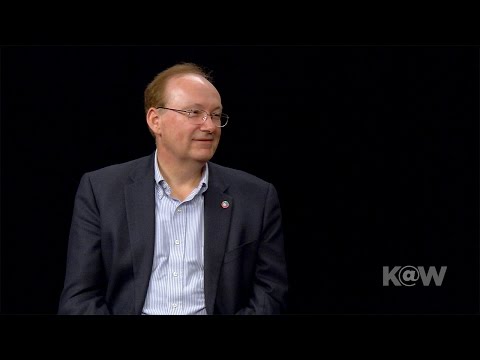
Profits, Globalization and Leadership -- Muhammad Yunus: Banker to the Poor
Ask about Knowledge at Wharton
Episode Description
Part 2- The effects of Globalization on the Microfinance industry, leadership and the qualities of those leaders, and how they factor into the future success of the industry and the social good it brings.
Read the full transcriptHide the full transcript
- [Music] you have spoken about the downside of a global globalized economy referring to
- it during the Nobel Peace Prize ceremony in Oslo as quote a dangerous free-for-all Highway whose Lanes will be
- taken over by the giant trucks from powerful economies even as Bangladeshi Rick Shaws will be thrown off the
- highway end quote I'm assuming you're referring to the onedimensional profit motive of these giant trucks that focus
- more on money than on social good but how do you think how do you think a a a scenario could could realistically be
- averted a global scenario and in fact isn't that somewhat desirable uh I was giving an image that
- uh globalization is like a multi-lane Highway all the products are moving back and forth in many directions and
- everybody on the road carrying their merchandise and giving the idea that uh big countries big economies Rich
- economies will have more merchandise to carry big trucks to carry and a very powerful and take over the lanes the
- small countries don't have space for themselves because it's all taken over by the big trucks and the big companies
- uh so I said if it if it that image fits into the picture then we should have uh
- traffic rules so that uh little company and the Little Country little economy have their safe Lanes where they're slow
- moving they carry little things and very fragile but they move safely uh so that
- they the big trucks don't take over everything so and I'm saying that if we accept the traffic rules idea then we'll
- need traffic police so that these rules are obeyed and the idea is to have a traffic Authority so that somebody has
- to say this is the rules of globalization that if you are a big company you cannot come to a weak
- economy and say I take over the whole economy they can because they have the money power uh so that will be wrong
- globalization in globalization both sides must be the winner and the whatever gain in the trade takes place
- it should be shared equitably just because I have the power I take out out of 100 I take 99.9 and give you 0.1% and
- say this is globalization I don't think that will be tenable that will be sustainable so we have to agree how much
- you should get and how much I should get although I could have taken over everything but by agreed principles we
- don't do that we give you some and we keep some and what that participation would be how division would be that
- would be the traffic police or the traffic Authority will decide that this is how we should do that otherwise
- globalization will become I suggested that will be an economic imperialism that uh big economies taken over the
- small economies well one effect we see of globalization right now is what's happening happening in the world banking
- industry and why I find that very interesting is because if you were to look at grin's own borrowers they are
- not just the subprime what are considered subprime but even the sub subprime uh in spite of that Grine
- repayment rates are 99% or so and you uh have never required a bailout uh from that perspective I wonder how you see
- this global banking crisis and what advice would you give to the CEOs of Institutions like City Bank or Bank of
- America about what they could do to salvage their operations it's a it's a paradoxical situation right now because
- uh back uh 33 years back when I was trying to start this program in a tiny village with a few people and arguing
- with the bankers that this would be a good idea to give loans to the poor people their argument was that poor
- people are not credit worthy they will never pay back and so on so today 33 years later you can ask the same
- question who is credit worthy the answer obviously will be very different because
- it's the poor who turned out to be the better credit worthy than the other category of people because uh the
- programs microcredit programs all over the world still function very well still their repayment is very high
- uh whereas uh the big Banks and their big uh Landing operations are in situation of collapse it's falling down
- uh so uh with this experience uh kind of contradictory experience that we have uh
- now we have to uh we have no other way but to redesign the whole system recognizing the fact the strength
- in this non-collateralized loans for the poor people and the weakness in the cat
- has loan for the rich people so we have to find find a ground where we can have a an inclusive Financial system where
- nobody will be thrown out of the system uh not the poorest person not the homeless person or a beggar person
- nobody should be thrown out uh they can handle they have already shown examples shown and created a long-term credit I
- mean record that what they have done uh so this is one lesson from this uh to redesign the financial syst system uh
- the another point I would like to make that uh This Global crisis financial crisis uh is worst In Our Lifetime when
- whole world is going through it while we look at the crisis part of it we forget
- this is also the greatest opportunity when the system is not working that's the time you unpack it
- and redesign it so that not only it uh works it works better than ever before uh unless we do that we'll be committing
- a big mistake uh so I I emphasize on the opportunity part of it uh while the crisis will take its time it take its
- course to get get through it but we should be focusing attention and then start redesigning uh piece by piece
- where it needs to be fixed so that we don't have the same old system that we had before what qualities does one need
- to lead a micro Finance institution and how are these different from the qualities needed for another type of
- organization uh one idea I was just mentioning that we came from the Direction Where We wanted to bring
- Financial Services to the poor people to help them generate income for themselves
- and gradually move out of poverty by doing that build confidence build experience and step by step uh take care
- of themselves and see that they can move on uh and get out of poverty uh so we would like to keep microcredit in that
- fashion in that mood not profit maximization mode because then you are not looking at people's condition you're
- looking at your own condition uh so you want to take out as much Poss as possible to improve your uh Financial
- strength and so on so that is I think Number One requirement for microc credit that you have the right kind of attitude
- and right kind of mood when you get involved with it that here I have come to use my talent my creativity my
- management skills to help people get out of poverty uh without losing money losing money pushes
- you into another Direction it becomes a uh to it pushes in itself into the charitable uh kind of programs
- microcredit is not a charity program microc credit is a business program but business with a social purpose and uh in
- a c separate way have called it a social business and defined it in a very clear
- terms what a social business like so ideally I would like microc credit to be a social business where profit is zero
- for the person who has invested but the company can make profit profit stays with the company with a social objective
- in this case the social objective will be to help people get out of poverty but but in terms of individual leadership
- skills or or organizational skills how do you nurture these within individuals in say gine
- Bank uh within gramine Bank uh we just recruit people and uh let them learn by doing as apprentices with other older
- persons in the branches so it's not a classroom training which makes all the difference classroom training is a very
- small part of our training we simply introduce what we do and then let them figure out what how it is done and so on
- when they join gramine bank for them it's just a job they're looking for job not many jobs are available they got the
- job they're very happy they got the job they think now on uh I get I work can I get my salary so the intention of
- helping poor and all those things was not part of that job but once you start working with the poor people and get to
- know the system get to know the objectives of the system and gradually you are taken by it and more and more
- you feel um inspired by it and all these ideas that yes my work helps people excites them uh it's a wonderful
- experience uh to be able to touch other people's life it's almost intoxicating experience once you have it uh you
- cannot get away from it you want to have it more because you see things are happening in people's life their
- children going to school the kid you saw a little kid running around in the village uh now you see he or she is in
- school and doing very well and talking about what she wants to be what he wants to be and you remember your own
- childhood that how you went through and how difficult it was for you now these kids
- lucky kids uh they could have been they they are in a school and some of their older students are now going to higher
- education and gramine Bank gives them Education Loans and you say nobody gave me an education loan and my education
- finished After High School I couldn't proceed any further only job I could get is this one but I'm happy through my job
- I'm helping other kids to go to higher education becoming doctors engineers and University professors and so on so forth
- and that excites him that yes uh my service is useful [Music]
Brief Summary
Muhammad Yunus discusses globalization, microfinance, and the banking crisis, advocating for equitable trade and social business models.
Key points
- The Dangers of Globalization. Globalization can lead to economic imperialism where powerful economies dominate weaker ones.
- Redesigning Financial Systems. The global financial crisis presents an opportunity to redesign the system for inclusivity.
- Microcredit's True Purpose. Microcredit should focus on helping the poor rather than profit maximization.
Episode highlights
- The Dangers of GlobalizationGlobalization can lead to economic imperialism where powerful economies dominate weaker ones.“Globalization will become economic imperialism.”2:58May 29, 2009
- Redesigning Financial SystemsThe global financial crisis presents an opportunity to redesign the system for inclusivity.“This is also the greatest opportunity when the system is not working.”5:47May 29, 2009
- Microcredit's True PurposeMicrocredit should focus on helping the poor rather than profit maximization.“Microcredit is not a charity program; it's a business program with a social purpose.”7:46May 29, 2009
Episode quotes
Tension
55/ 100Some tension