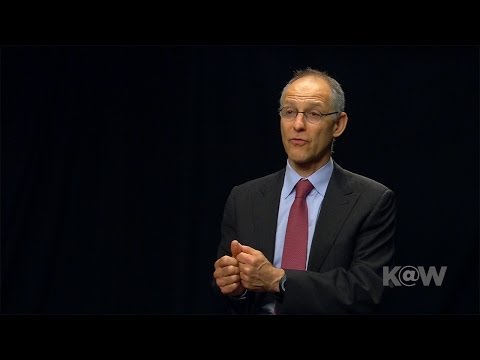
The Future of AI at Wharton – Vice Dean Eric Bradlow on New AI & Analytics Initiative
Ask about Knowledge at Wharton
Episode Description
Vice Dean of AI & Analytics at Wharton Eric Bradlow joined the Knowledge at Wharton podcast to talk about Wharton's goals to serve as a thought leader in AI, "to democratize business and AI education," and to use AI to address pressing social issues. He talks about AI's complementary role to faculty and risks of disinformation and misinformation and job replacement, especially for people who struggle to adapt to new technologies.
The Knowledge at Wharton podcast features interviews with Wharton faculty and industry leaders about the business landscape and the impact of their work. Conversations range from the latest research and books by faculty authors, to Leading Diversity at Work with professor Stephanie Creary, and Dollars and Change with professor Katherine Klein.
#AI #artificialintelligence #generativeai #chatgpt ----- The Wharton School of the University of Pennsylvania is committed to sharing its intellectual capital through Knowledge at Wharton, the school’s online business analysis journal.
Launched in 1999, Knowledge at Wharton offers free access to:
- Articles, podcasts, and videos highlighting Wharton faculty research and analysis of current business trends - Interviews with book authors from Wharton School Press - In-depth series of curated content like Wharton Executive Education’s Nano Tools for Leaders - A searchable database of more than 10,000 articles covering all aspects of business - A weekly newsletter that delivers Knowledge at Wharton insights directly to your inbox
Visit the Knowledge at Wharton homepage: https://whr.tn/3qUpSBE Subscribe to the Knowledge at Wharton YouTube channel: https://whr.tn/3DEAgAU
Read the full transcriptHide the full transcript
- this podcast is brought to you by knowled of [Music] warten the Wharton School is leveling up
- its teaching and its research in the areas of artificial intelligence and data science the school has launched the
- warden Ai and analytics initiative it's an interdisiplinary collaborative effort
- to shape how generative AI will be used for business Innovation and Beyond welcome to knowledge at Wharton I'm
- Angie basuni with me today is Eric bradow he's a longtime faculty member in our marketing department and he's an
- applied statistician and many of you probably know him from his Moneyball podcast on
- SiriusXM Eric thanks for being with me oh it's great to be here Angie and always happy to talk about our new
- acronym w a AI oh goodness well you've been named as the new Vice Dean for this initiative so you're giving us a little
- bit of time today to pick your brain about it I want to start with ask asking you to explain just a quick overview of
- the initiative and why the school is launching it right now yeah I mean it's really as our Dean Erica James says it's
- really one of those meet the- moment types of opportunities for the Wharton School um actually we've been in the
- analytics business if you'd like for 20 years uh a colleague of mine Pete fader and I started the first ever data
- science center if you'd like at any business school in the world 20 years ago now and so we always believe that
- data science basically using empiricism using high-powered statistical models was going to be a big part of the future
- of business because of technology and new data streams that emerge but what's happened of course in the last almost
- two years now is generative AI now fortunately at Wharton we've had a center called AI at Wharton for almost
- seven years now we knew this future was coming we didn't know how fast and how if you like ubiquitous it was going to
- be but the goals of our Center are actually quite simple there are four major goals first we want to be thought
- of as the number one knowledge creators of Business Schools in the world number two we want to impact students now
- broadly defined not just students at the Wharton School or even the University of
- Pennsylvania but we want to democratize Ai and business education throughout the
- world third we want to have an impact on the SE Suite we're a business school and
- so what I always say is we're training people to be the leaders in Ai and data science but not data scientists we're
- training people ble to lead companies through Ai and data science and last but not least I've always called it
- analytics for good but how about we do some good in the world through data science so those are our four if you'd
- like populations of interest if you'd like researchers students companies and the community and Now's the Time to have
- that impact I love that let's talk about a couple of those buckets let's start with number two which you mentioned
- students now this initiative you've got this really unique collaboration with open AI most of us know that name by now
- because they're the makers of chat gbt so starting in the fall our MBA students are going to have these creative
- Enterprise licenses with chat PT what do those licenses do what are they going to
- create with them what's the end result yeah so first let me just say why I think this is crucially important and
- let me just say as you can imagine there's more sensitivities on younger adults meaning the undergraduate
- population but that's coming by the way there will be a time where Wharton will be able to present enter priz licenses
- to the entire population but of course the undergraduate is as part of the University of Pennsylvania so there's
- some technicalities there but we're working through them the the answer is Andrew you learn AI by doing it right so
- that's the only way to get people to do it every warden for now MBA every faculty member every PhD student will
- have access to if you'd like the newest versions as they come of chat GPT right on their desktop or pH they can actually
- experiment with it see what it can do to enhance their education we don't view it
- as replacing us as faculty we view it as enhancing their education and at the end
- of the day this is what it's going to be expected of all of our students when they go into the workforce they're going
- to be expected to know so how do I create video using artificial intelligence how do I do the proper
- prompt engineering so that I can get the right answers out of these large language model engines like chat GPT and
- the only way to do it is to experience it and that's what these licens are going to provide and the good news about
- the Enterprise version is the data is secure what I mean by that is if Eric bradow myself Professor bradow uploads
- his course materials and creates a localized version of chat GPT it's not being sucked up into the Corpus that
- they're using to train the model so people around the world do not have access to my information and let's be
- honest Angie that's the business model because chat GPT for most people is free forget the Enterprise it's free it's
- like Google Google searches free to you and me but it's not free to companies that want to advertise on it chat jpt is
- free to you and me but it's not free to Amazon that wants to create a localized version of it so that's the way it's
- going to work we Wharton have invested money and resources and an Enterprise license so we can educate our students
- on how to be leaders through using artificial intelligence I hope one of them comes up with the next big idea
- we'll stay tuned about that I do too well there's so much research that's coming out of Wharton about AI uh can
- you give us like a quick touch on some of the areas that have already been impacted by our research and then what
- you find to be the most promising yeah I think research comes in a few different
- buckets so one of the buckets are there are people even though we're business school there are people at Wharton that
- are statisticians and computer scientists like myself who we do work on the actual let's call it the
- mathematical models that underly artificial intelligence and just so all of our listeners know ai's been around
- for about 60 years so as a PhD student I learned about artificial intelligence now large language models which is
- taking a big Corpus of information training them in real time at scale and providing generative AI That's new but
- the problem of predicting the next word or token that's going to be used that's that's not a new problem but number one
- there's academics who are in my narrow slice who are what we call methodologists that will work on the
- methods the larger bucket the much larger bucket for researchers are people that are going to apply AI so for
- example how do you use P patient records I'm in the Healthcare Management Department here at the Wharton School I
- partner with pen medicine I see doctors writing handwritten notes on patient records well those used to have to be
- human coded now they don't I'm in the management department Department I want to know how AI is going to affect
- teamwork and how it's going to affect like if I can just ask a chat agent and not my colleague well what does that do
- to camaraderie and building relationships with your team and so there's researchers many of us that also
- work on applications of artificial intelligence and then of course there's the student piece which is you know how
- do I get my job done how do I get my job as a student done using artificial intelligence so I view US almost like as
- a three prong at least three prong lab laboratory which is the methods part the applications part and the how do I get
- it done part with artificial intelligence you know I have been learning so much about AI just from
- coverage at Wharton and there really is no area that it doesn't touch it really isn't and I think one of the things
- that's really um great about the school is that our professors are always trying
- to pursue relevant research research that has a business case a use case can you tell me uh what the companies are
- asking us for right now what is it that they want in terms of AI research yeah there's there's a lot of it so let me
- just give you a couple of specific use cases so obviously one big area is in customer service so for example can AI
- be used for chatbots and what's people's reaction to the use of AI generated chatbots can AI be used to coordinate or
- collect you know let's call it audio recordings and video recordings make them searchable indexable so that in
- some sense we don't need humans taking notes the AI engine can do it the third part is what most companies are
- interested in is they have data all over the company and I say data I don't mean
- just numeric data which is historically how we thought about it but I have physical reports I have online reports
- I've got Excel spreadsheets I've got PowerPoint decks I've got a SQL database I've got a big data Lake sitting
- somewhere how do I bring all of that information together so Angie sitting at her desk doesn't need to be a programmer
- to query this database can just use the English language or even a foreign language to just query this database and
- say what do we know about the following topic if we were to make an investment in X what does our data say about this
- or Angie has a data set you're not a you don't know python but you want to do some analysis well you can now do that
- analysis so I think of it as are there jobs that will be replaced absolutely are there but that's not to me the large
- part the large part is how does each person use AI in their job as my colleague Stephano ponton says and my
- colleague Ethan mik say it's Ai and the workforce not AI or the workforce right so that's what I see as the biggest most
- exciting use cases and that's something I you know I think is really important to touch on too because AI has been
- described as everything from society salvation to its Doom right it just sort of depends on where you sit on the
- Spectrum as a Communications person I think I lean more towards the Doom part tell me tell me where you said you know
- what what gives you optimism about Ai and what do you worry about yeah so um I actually given we have a political
- election here in the US in 2024 my worries are more on a personal level which is around
- disinformation and you know if you like creating fake content which is almost indistinguishable if not totally IND
- distinguishable from real content I'm worried about um I was actually at a conference just yesterday in San
- Francisco or two days ago I took a red eye back um and this was someone from one of the large security companies in
- the world and says imagine the following imagine you create a million fake articles and load them into chat GPT
- well it's going to train on those fake articles and then to anybody using chat GPT it's going to seem like the truth so
- the disinformation and the fact is sometimes as you know they call them fakes it just makes stuff
- up it will give you an answer so that concerns me in a society that's got some polarization in it and a society where
- we're relying on these engines to provide us answers and my view is relying is the wrong word we shouldn't
- be relying on them they should be decision support tools but I can promise you I'm not betting my company's future
- or my academic future or my teaching future or my research future on what an AI engine says because I know I test it
- all the time some of it stuff it says is just wrong it seems right but it's actually wrong so my concerns are around
- disinformation I've look I everybody I love action movies I've seen every Schwarzenegger Terminator movie I'm not
- worried about AI cyber whatever they called it cyber whatever the name of the thing was in in The Terminator movies
- I'm not worried about AI taking over all of that about replacement yeah I'm not I'm not worried about that but I do
- think and I'll tell you what else I'm worried about I'm worried about people I'm not worried about the young people
- today because they always get trained in the best of technology and we have to democratize that we need to do better
- job of making access available I'm worried about the 50 plus year old I'm pointing it myself same who need be
- training because of what AI can do and where do they go so I'm worried that the people whose jobs will be displaced many
- of them don't have the training or won't receive the training to make AI an asset
- for them it'll be seen as taking over their job so those if you ask me my areas of concern it's I'll call it
- disinformation and it's also that um in some sense the people that are going to benefit the most from it are the people
- that are the young people who are going to get training but what about the 40 50
- 60 70 plus year olds in the workforce that will need this type of training where are they going to go to get it
- right and they already face a certain degree of age discrimin in general so this might further set them back in the
- workforce well let's not end on a on a tough note let's end on a positive note what gives you optimism about AI for the
- future and about this initiative well I I think I hope this is what everybody does and my my colleague
- Ethan mik says this the best just go on and start using it like think about all the things you do so I'll give you an
- example I'll just take an example matter of fact our our interim president Larry
- Jameson asked me to speak on this to a group of uh if you'd like alum I maybe about two weeks ago the role of AI and
- education and I said okay so I used to need I still do I could use them but I don't need them physical Tas in the
- classroom to sit there and record class participation well I don't need that I have audio data well I needed people to
- help me do grading it's not obvious I need that anymore um well every year oh God I gotta create an exam no I don't
- chat GPT can create an exam for me oh I need to create a simulation for the class
- well actually um the generative AI lab that Ethan and his wife lck mik are starting can generate a simulation for
- me so the way I view it is Wharton should be thrilled Eric bradow gets to spend more time on Research he gets to
- spend more time teaching in a pedagogically interesting way he gets to spend more time mentoring our students
- but all this stuff that now can be his time can be alleviated because he can get the generative AI engine to do it he
- doesn't have to spend his time on anymore so to me I think this is I think everybody this is my fatherly advice to
- everybody here think about the tasks that you do and just do it before you do the tasks in the humanlike manner you've
- been doing them till now try doing them in a generative AI engine a large language mod engine see the results you
- get and step by step you'll notice in yourself like I did replacing the things that used to take me a ton of time for
- weren't what I call the heavy brain human CPU stuff I'd like to spend my time on that's what gets me excited yeah
- that's something I have heard our professors uh repeat quite often which is think of think of it as a tool that
- can free you up from the banal so that you can do the more exciting aspects of the job that you love so it sounds
- sounds good to me well it sounds good to me too and as I said as you said at the
- beginning um Morton Ai and analytics initiative you know uh were extraordinarily ambitious we want to
- impact the world we want to impact Society businesses researchers students and we're going to do it and and then
- real magic to it is through Partnerships so we partner with schools to deliver education we partner with nonprofits to
- teach nonprofits how to use them obviously we partner with Scholars around the world we partner with
- companies in the sea suite and so this as a matter of fact this is a time where the Ivory Tower better not be the Ivory
- Tower because we desperately need the application and the corporate Partners to actually bring what we're doing to
- life so again I've never been more excited and I I'm honored that our Dean asked me to lead this initiative
- congratulations to you and thank you for your time today I appreciate it Eric bradow is the new Vice dean of Wharton's
- Ai and analytics initiative you can learn more about the initiative sign up for updates insights at their website
- which is aien Analytics won. up.edu I'm G to say that one more time aien analytics won. up.edu for knowledge at
- Wharton I'm Angie Bas thanks for joining us for more insight from knowledge at Wharton please visit knowledge. won.
- up.edu [Music]
Brief Summary
Eric Bradow discusses Wharton's AI initiative, its goals, student collaboration with OpenAI, and the importance of AI in business and education.
Key points
- Wharton AI and Analytics Initiative. Wharton is launching an initiative to integrate AI into business education and research.
- Collaboration with OpenAI. Wharton MBA students will have access to ChatGPT licenses to enhance their education.
- Concerns About AI Disinformation. Disinformation is a major concern as AI technology evolves.
Episode highlights
- Wharton AI and Analytics InitiativeWharton is launching an initiative to integrate AI into business education and research.“Now's the time to have that impact!”2:49Jun 5, 2024
- Collaboration with OpenAIWharton MBA students will have access to ChatGPT licenses to enhance their education.“You learn AI by doing it!”3:40Jun 5, 2024
- Concerns About AI DisinformationDisinformation is a major concern as AI technology evolves.“Imagine creating a million fake articles and loading them into chat GPT.”10:44Jun 5, 2024