Unmasking the Mystery of the Federal Reserve
Ask about Knowledge at Wharton
Episode Description
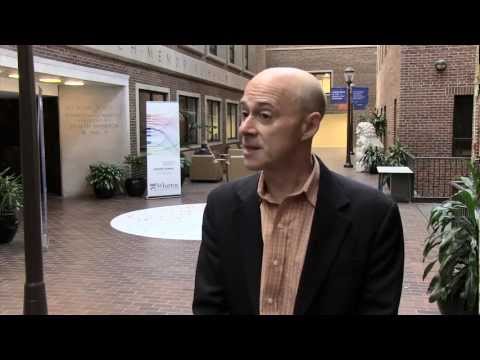
Peter Conti-Brown, a professor of legal studies and business ethics at Wharton, has an perspective that isn't always found in academic research. As a financial historian, he is keenly interested how economic institutions evolve and the forces that help them take shape. More: http://knlg.net/1NJEv1u 📂 Finance & Accounting;Public Policy 🏷️ Research
Read the full transcriptHide the full transcript
- So I look at the uh intersection of law, finance, history and politics. It's a lot of things to intersect, but the
- intersection actually is really a rich place to be. So where in in practical terms that means I'm looking at the
- institutions of banking and central banking uh the way that they overlap between government and and markets uh
- and looking at how they evolve through history. Key takeaways are that the my my primary
- research subject is the Federal Reserve, central banking generally, but especially the US Federal Reserve
- system. And the key takeaway is that the Federal Reserve is an institution that has been built by people. These people
- have desires, they have interests, they have histories, and they work sometimes strategically with a long-term vision of
- what the Fed should be and what it should become. And sometimes they are subject to the winds of history and and
- accident. And so, as uh a legal scholar and a financial historian, it's my job to look at how these subjects in history
- built institutions that changed over time. and what tools do they use including law but also force of
- personality norms traditions politics and other things like that. So it's it's a bit unusual uh to
- come at these questions from the backgrounds I'm coming at them from. So so again I'm I'm both a financial
- historian and a lawyer and lawyers are very interested in the practical and policy implications of their research.
- Historians aren't always, in fact, sometimes historians pride themselves in saying, "I am disconnected from the
- present. I'm very interested in the past." And what I do is take the past, what we know about these institutions
- and where they've come from. And then ask questions about the present. The Federal Reserve and its policies are
- some of the most uh debated and contentious issues that we see today. It wasn't always so. And to understand this
- contentious climate, we've got to understand just exactly what the Fed is, who within the Fed pulls the levers of
- power, how do they pull those levers of power, and to what end? And so in my work, again, this intersection of
- history and finance and politics and law gives us some of the answers that if you
- look at at these questions just from one lens, you just simply wouldn't get. I'm writing a book right now that
- is uh in its early stages that looks at one of the key decades in the development of central banking the world
- over which is the 1950s. This is a decade that's often overlooked when you look at the history of central banking
- and a key part of the of that decade what was happening during the in the United States and the Eisenhower and
- Truman administrations was balancing national policy against the threat of international communism. And so my work
- in on this project is to link our interests in financial security and specifically monetary stability which
- happens inside the Federal Reserve with national and international security. In other words, central banking and the
- shadow of the cold war. Uh I think that these are two areas that have a lot to say to each other again as a historian
- but also in the present. There's simply no question of national security in the United States today that doesn't have a
- financial component attached to it. And so my my project now then is to look taking again that same intersection of
- of law, history, finance and politics and see how we can put this question of financial security and national security
- in dialogue with each other. [Music]
Brief Summary
The episode discusses the Federal Reserve's history and its ties to national security and finance.
Key points
- The Intersection of Disciplines. Exploring the rich intersection of law, finance, history, and politics.
- The Role of the Federal Reserve. Understanding the Federal Reserve's evolution and its impact on today's contentious climate.
- Central Banking and the Cold War. Linking financial security with national security during the Cold War era.
Episode highlights
- The Role of the Federal ReserveUnderstanding the Federal Reserve's evolution and its impact on today's contentious climate.“The Federal Reserve and its policies are some of the most debated issues today.”1:56Nov 5, 2015
- Central Banking and the Cold WarLinking financial security with national security during the Cold War era.“Central banking and the shadow of the Cold War have a lot to say to each other.”3:18Nov 5, 2015