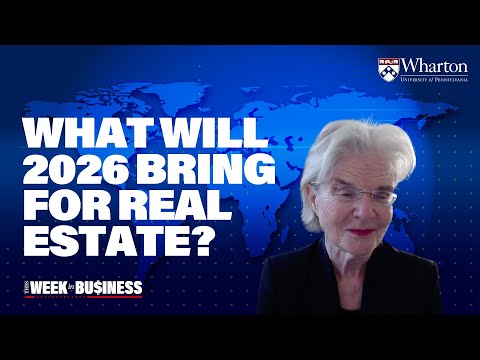
Housing Market in 2024 – Wharton Professor Susan Wachter's Real Estate Forecast
Ask about Knowledge at Wharton
Episode Description
In an interview on Wharton Business Daily, Susan Wachter – Albert Sussman Professor of Real Estate at the Wharton School – offers her forecast on where the housing market and mortgage rates are headed in 2024, particularly given trends surrounding inflation and interest rates.
Topics and questions covered: 00:00 - Introductions 00:27 - 2023 housing market trends 1:24 - Analyzing inventory (supply side) 5:34 - Predicting trends in interest rates 7:29 - Adjustments in housing prices 10:08 - Commercial real estate 11:51 - Takeaways
Wharton Business Daily airs Monday-Friday from 10 AM - 12 PM ET on SiriusXM Channel 132, featuring emerging trends, top business leaders & Wharton’s renowned professors. Learn more: http://whr.tn/businessdaily
----- The Wharton School of the University of Pennsylvania is committed to sharing its intellectual capital through Knowledge at Wharton, the school’s online business analysis journal.
Launched in 1999, Knowledge at Wharton offers free access to:
- Articles, podcasts, and videos highlighting Wharton faculty research and analysis of current business trends - Interviews with book authors from Wharton School Press - In-depth series of curated content like Wharton Executive Education’s Nano Tools for Leaders - A searchable database of more than 10,000 articles covering all aspects of business - A weekly newsletter that delivers Knowledge at Wharton insights directly to your inbox
Visit the Knowledge at Wharton homepage: https://whr.tn/3qUpSBE Subscribe to the Knowledge at Wharton YouTube channel: https://whr.tn/3DEAgAU
Read the full transcriptHide the full transcript
- Dan Loney: Well, the real estate market has had an up and down time this year. The high interest rates look to take its
- toll, lack of inventory has also done that. And all the while, home prices staying fairly elevated. And then there are the
- concerns about the future of the commercial real estate market as well. To discuss that and much more, pleasure to be joined here
- in studio by Susan Wachter, Professor of Real Estate here at the Wharton School. Great to see you again, Susan. Thanks for
- your time today. - My pleasure. How do you kind of put a framework on what we've seen in 2023?
- 2023 has been a very difficult year, and the housing market came to a screeching halt starting in late
- 2022, because of Fed action. There's no way that a 7% interest rate won't cause the market to freeze. Which it
- did. But it wasn't simply on the interest rate side, as you reflected. It is also the inventory. So the two do enough
- to kill the market. So this is a market where we haven't seen the lows in activity for decades. And at the same time, housing
- prices are so elevated, and the cost to become a homeowner makes it, for most households, simply impossible, at a time when
- the Millennials are looking to become homeowners. So a painful— a painful housing market, a housing market in recession. Not
- much good to say about 2023. So let me start with the inventory side of things. How do you try and get that turned around? Because obviously
- there are the factors of interest rates, there's the factors of cost of materials, there's the labor side. I mean,
- there are a lot of components in here that seem to me would have an impact. And realistically, this is a story we've been talking
- about for many years. This isn't just because of what we've been dealing with, with the— with the impact from interest rate.
- Well, there are two sides to the inventory issue and the supply issues is what you're going to. And one is the existing inventory,
- which is totally governed by the Lockean problem. So this is a problem that will solve itself. That's the good news going
- forward. The supply side in terms of new building— yes, of course, we're going to continue to see high costs there. We're
- going to continue to see— labor costs are a challenge and availability is a challenge. But,
- you know, construction is happening. In fact, we've seen more construction as a percentage of
- housing sales than we've seen in decades. So the construction industry is actually being part of the solution. The essence of
- the problem is the Lockean effect, the low amount of inventory, which is due to people simply saying "We're not
- gonna give up a 3% rate to get to a 7% rate. Am I crazy? I'm not going to do that." And that is only going to be solved by
- one thing, which is interest rates declining. How, then, do you solve the— because even if you see interest rates come from
- 7 to 5%, somebody that's got a three, three and a quarter percent interest rate, it's still not as enticing for them.
- I mean, maybe they feel like, "I can put up with"— - It will make a difference. - that extra point and a half, point and three quarters, to be able to go
- get that that next house? - It will make a difference. Because we do have people who are there at 4%, and four and a half
- percent. So if we hit 5%, that will be a remarkable turnaround. And what's interesting is you see that two things go together.
- Not only does the interest mortgage rate go down— and that, of course, has caused the cost of mortgage to go up by a third—
- and— but also, the price of housing will go down. So the two points of pain will transfer— translate to points of gain. So
- I see— while 2023 has been extremely painful and 2024 will be a continuation, by the end of 2024, I see considerable relief
- ahead, mostly because inflation is considerably under control. This is a story that hasn't been
- well covered. But actually, over the last six months, we've solved inflation. Inflation's gone— is— for annually, if you look
- at it, it's 4%. But over the last six months, annualized, it's 2.5%. And that's before we have this current slowdown, eventual
- we see slow, no-recession landing. Whatever it is, it's coming down. So we have solved the inflation problem. It's— yet
- we have three to four months, whatever, to see it, and six months for to hit the mortgage market. But once it does affect long-
- term interest rates, it will also affect this huge gap between mortgage rates and 10- years, which is very unusual.
- That is going to— that gap is also going to deflate. So we'll have a very good potential decline in mortgage rates for
- the sake of the housing market, which will go a long way to solving the problem. Because at the same time that the cost of a
- mortgage goes down, housing prices are likely to ease, simply because we will have more housing on the market. We will
- have people who have, today, five and a half percent, 5% mortgages, four and a half percent mortgages— as mortgages start
- going down to the 5%, then, you know, buying down, which is happening right now— buying down from 5% to four and a half
- percent is a lot easier than buying down from 7% to 5%, which is what we're seeing. And that, of course, is rare and difficult
- to achieve. Not so difficult to get to a four and a half percent rate when the markets are saying 5%. And I see that. That's the
- good news for 2024. - So it's interesting, then, with that buy- down, I guess you're seeing it a little bit now. - Yes. - As we're,
- you know, in the month of December, as we're taping this from, you know, seven to 5%. - Yes. Yes. - By a lot of
- builders. - Yes. - Because they have some of these properties out there. - Yes. - And they want to move them.
- - Yes, yes. So buy-downs are happening because they have to happen. But it's only a limited capacity to get that
- done. But of course, if the market's on your side, if the interest rate, ten-year interest rate starts moving— it has. It's moved
- already. But this is— we're going to see, I think a dramatic decline in ten-year rates over the next 12 months. - Do builders need
- to look at the types of properties that they're putting out in the market? And I ask that because a lot of the new
- properties out there seemingly are very much— you— there's a lot of IOT that's involved in the property. Big houses, couple car
- garages. - Sure. Sure, you're right. - And look at that middle market or - Yes. - lower market, individual,
- single-family home, to build those properties out as well. - And they are. There's a shrinkage in house
- size, there is smaller lots. This is happening. Builders are responding to the increased need for that starter home. - We're
- joined here by Susan Wachter, Professor of Real Estate here at the Wharton School. So you're optimistic, then, as we look at
- next year, in terms of what we may be able to see, with maybe the caveat of interest rates coming down. - Yeah, well, that's
- a caveat. And I'm— I keep on saying 2024. But that's really the sad part. But it's really, stay alive to '25. It's the end of '24
- relief we're gonna see at the end. It will take time for these issues to resolve and for inflation to be obviously
- solved. It's— I see that. But for— actually to be in the market, and the Fed isn't going to
- announce that it's over until it's over. - What do you think this all means, then, for the amazing run up we've seen the
- last few years in multifamily properties? Which, I mean, it seemed like there for a while every new property that was
- going up— - It's amazing. -— was a big apartment building. It's amazing. It actually is.
- And it's a— it's a great cure for the potential oversupply of multifamily, which we're seeing in the market right now. We're
- seeing price points come down, we're seeing rents come down. That's actually another good thing for inflation, because a
- very large 40% of the CPI is rent equivalent. So this is another optimistic— again, rents are not likely to fall a lot in
- 2024. But as as 2024 continues, this oversupply problem is going to put downward pressure on rents, as well as
- housing prices. So it's quite unlikely that we're going to see housing prices continue on this unbelievable, unaffordable
- upward trend. They're likely to be down. Very— not much, again, because of supply restriction. But once we've got relief on supply,
- we can see— we'll see more activity. At that point, again, because interest rates are down, I don't see— you're not— you
- haven't asked me outright about prices. But I don't see tremendous relief on prices. But it will be a relief simply when
- interest rates go down if prices don't rise significantly. - So let me ask you about that. Because obviously, when the pandemic
- hit, and we saw the rates come down so much, and there was just this rush for people buying homes— I mean, you were
- literally seeing homes not even have the sign out in the front yard. - Yes. - And you had 15— 15 offers on them. - Right.
- And prices went through the roof. So if they go through the roof, what's the expectation
- then for the current homeowner as to the value of their home and where it might end up here in the next couple of
- years? How much might it pull back? Or what— are the increases that they saw a couple years ago, are they fairly safe at
- this point? - They are. They're— they're in. They're built in at this point, because there has been a major transformation, a major
- shift in the role of housing for families. And that is, people want more space. They want more housing, they want owner
- occupancy— even though at this price point, they're not able to get it. By 2025, more will be able to get it, and we will see
- housing prices, I believe, once again on the rise. - And so the DIY movement that we saw during the pandemic, that really worked
- out to the benefit of all the homeowners taking the time and in many cases doing— doing it yourself. - Yes. It worked out
- economically as well as, more space is a good thing when you're so many— so much at home. - Absolutely. Let's touch on
- commercial for a second if we can, because there's a lot of questions around where that is headed. Companies are obviously
- reassessing their— their footprint. Remote work has obviously played a role in that as well. I think that's probably—
- is it safe to say a little bit of a longer-term view that you have to have— -Absolutely.
- - on where commercial real estate is at? - Right. It's a great deal of uncertainty. And I do believe the markets could stay frozen
- throughout this year. In fact, we could have more distress in the commercial market as we have this wall of debt that needs to
- be refinanced at still high interest rates, far higher than the original rate. So banks are pulling back and they're pulling
- back at a time when the mortgages are coming— need to be refinanced. This— and we're talking about commercial office space,
- obviously. Logistics, it's a different story. Data centers, these are still— they're booming, actually. And they will, as interest rates
- come down, continue to do extremely well. But the office market resolving that problem is way ahead of us. We don't see
- sales. We don't even know what prices are, should be. Where is the price that's low enough to see activity come back to that
- market? We don't see that yet. Did the banking crisis we had early in 2023 have an impact on that to the downside, any?
- Absolutely, and it still is. Absolutely. It's a pull, there's a pull back, especially on regional banks, small banks in commercial
- real estate lending. And these are the— 50% of the money for commercial lending is coming from these banks. So it's a
- problem. - What do you think then is kind of the takeaway for you, having followed this industry so long, about this moment in
- time for real estate? And I'll kind of throw that broadly, because obviously, this has been such a unique period to see play out in
- how the pricing component has played in. Obviously, the rates playing the role that they have.
- How do you view this last three or four years? It's an extraordinary period, it's extremely period in the
- divergence— the divergence between owner-occupied and people who own their homes, how actually well they've done.
- Those who are struggling to get into the market, harder than ever for the Millennials and Generation Z. And then looking
- at multifamily, production is extraordinary. So okay, but rents are going up significantly. Now they are
- easing. But then turn, in the commercial, again, huge dichotomies within the sectors of commercial. So there is no
- such thing as real estate. There is owner-occupied, fantastic if you're an owner occupant. There is— if you're renting, well,
- you're paying more. If you are a multifamily provider, you're benefiting from that, even though it's easing now. If you're
- in the office market, you're hurting. If you are a commercial office REIT, you're hurting. Your price of that REIT is in
- distressed territory. And that's a potential pain point. And we don't know how that's going to play out for the economy as a
- whole. And for banks as a whole. I don't see a feedback loop to the extent we saw, for example, in 2009, because I don't— we
- could, of course, if we had a recession, like 2009. But the good news is, it looks like the consumer is resilient. And that
- if we have a recession, it's mild, and that interest rates will come down as a result. - So I'll finish on this, because you
- mentioned about the component of CPI that— that rental and shelter plays on a monthly basis. How much, then, has the Fed
- really had to watch what has played out in the real estate market over the last couple of years when making this
- consideration about raising the rates on the way up, but now also potentially lowering them on the way down? - Yeah, I think
- the Fed has become real estate economists. Our macro economists are real focused on real estate.
- Susan, great to have you with us. Thanks very much. - Pleasure. All the best. Susan Wachter,
- Professor of Real Estate here at the Wharton School.
Brief Summary
Susan Wachter discusses the real estate market's challenges and future outlook, focusing on interest rates and inventory issues.
Key points
- The Painful Housing Market of 2023. Susan Wachter discusses the challenges facing the housing market, including high interest rates and low inventory.
- Future Relief in Housing Market. Susan predicts a turnaround in the housing market by the end of 2024 due to declining interest rates.
- Commercial Real Estate Uncertainty. Susan addresses the distress in the commercial real estate market and the impact of high interest rates.
Episode highlights
- The Painful Housing Market of 2023Susan Wachter discusses the challenges facing the housing market, including high interest rates and low inventory.“It’s a painful housing market, a housing market in recession.”1:17Dec 27, 2023
- Future Relief in Housing MarketSusan predicts a turnaround in the housing market by the end of 2024 due to declining interest rates.“We’re going to see a dramatic decline in ten-year rates over the next 12 months.”6:10Dec 27, 2023
- Commercial Real Estate UncertaintySusan addresses the distress in the commercial real estate market and the impact of high interest rates.“We could have more distress in the commercial market as we have this wall of debt.”10:39Dec 27, 2023