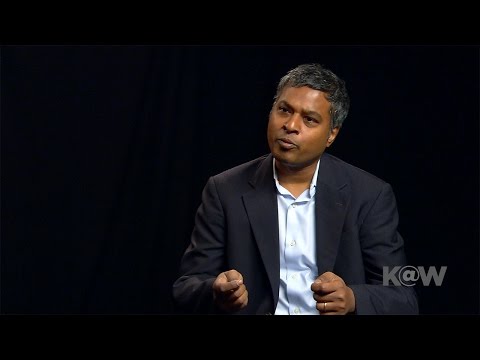
How Tariffs Drive Dynamic Pricing and Higher Consumer Costs
Ask about Knowledge at Wharton
Episode Description
ABOUT THE EPISODE John Zhang talks about how companies use tariff hikes as a chance to raise prices, knowing consumers may be more tolerant. He discusses how dynamic pricing lets firms charge more when demand is less price-sensitive and highlights the difference between raising prices and offering dynamic discounts. Zhang also talks about consumer reactions, competition as a check on pricing, and examples like Wendy’s surge pricing and happy hour discounts.
ABOUT THE PODCAST This Week in Business features interviews with Wharton faculty about the latest news, fascinating trends, and issues impacting both consumers and the business world. Episodes are recorded at the Wharton School and published twice per week.
#DynamicPricing #Tariffs #ConsumerBehavior #PricingStrategy #Inflation ----- The Wharton School of the University of Pennsylvania is committed to sharing its intellectual capital through Knowledge at Wharton, the school’s online business analysis journal.
Launched in 1999, Knowledge at Wharton offers free access to:
- Articles, podcasts, and videos highlighting Wharton faculty research and analysis of current business trends - Interviews with book authors from Wharton School Press - In-depth series of curated content like Wharton Executive Education’s Nano Tools for Leaders - A searchable database of more than 10,000 articles covering all aspects of business - A weekly newsletter that delivers Knowledge at Wharton insights directly to your inbox
Visit the Knowledge at Wharton homepage: https://whr.tn/3qUpSBE Subscribe to the Knowledge at Wharton YouTube channel: https://whr.tn/3DEAgAU
Read the full transcriptHide the full transcript
- Dan Loney: Well, as tariffs remain an important talking point in and around the US economy right now, we are seeing the price
- impact in stores, even really before the impacts hit companies. I have noticed, myself, at my local grocery store, the
- prices on things like orange juice and milk going up recently. And we've seen gas prices go up even before the
- latest conflict in the Middle East took place. So the question is, will companies raise prices faster than the tariffs
- themselves? It brings up some unique components of what is called dynamic pricing. And a pleasure to be joined by John
- Zhang, who is Assistant Professor of Business Economics and Public Policy here at the Wharton School. Hi, John, great
- to talk to you again. Yeah, good to be with you, Dan. Thank you. This element of dynamic pricing that you have talked
- about, it becomes important to discuss, in this scope of how companies kind of react to some of the things that are going on
- in the economy right now. There are two separate things I think that you mentioned. Number
- one, when tariffs goes up as a— let's suppose, retailer. Do you want to raise your prices? And I think what you observe is
- definitely right on the money, which is that a lot of companies do take advantage of what's going on with the
- tariffs to raise their prices. The reason is because when tariffs goes up, for instance, you can imagine
- that as consumers, we tend to be more tolerant of the price increases. We tend to be more receptive to price increases
- simply because we know the firms are struggling, their costs have increased, and therefore that we probably cut them some slacks.
- And firms actually know that, right? And also that— the other reason why, as a firm, we don't want to raise price normally
- aggressively, is simply because the competition may stay put and they're probably not going to increase their price. But in
- this kind of a situation, you can imagine that tariffs will increase the cost for just about everybody. So when you raise
- your price, you're not so worried that the competition is not going to raise their price. So because of that, you can see
- that as a firm, you probably have more incentive in this environment to raise prices. But the second issue you mentioned
- is really about dynamic pricing. And firms always want to, if they could, if they don't upset their customers, they want
- to do dynamic pricing. And many people began to think that these tariffs really could have created the environment where,
- if you have always been thinking about doing dynamic pricing, this might be your chance to initiate it.
- And dynamic pricing is something that we have had in and around us for a long time. It is a challenge, just as you
- mentioned, that if you're going to use it, you don't want to upset your customers in the process of using it.
- Absolutely. I think that dynamic pricing is something that firms will never forget about. And the reason is because there are lots
- of people out there. And for exactly the same product, they're willing to pay different prices. You can imagine, as a
- firm, you always have incentive to charge those people who are willing to pay a high price, a high price, and those people who
- are not willing to pay a high price a low price, right? In order for you to do that, of course, there are so many
- different ways to do it. Dynamic pricing is one way to implement that. And you just want to make sure that at a time when
- consumers are price insensitive, a certain time, you charge a higher price, and when consumers are price sensitive, sometimes,
- you will charge a low price. And definitely, as a firm, you want to implement dynamic pricing in some way. But of
- course, there is always a good way to do it and also a bad way to do it. I think what we tend to observe in the marketplace is
- that a lot of firms have not thought through, what's the impact of dynamic pricing on consumers, how consumers may
- react to it, how you should frame your pricing practice in such a way that consumers are receptive to what are you doing.
- So the companies see it as an opportunity to pad their bottom line a little bit?
- Well, they always want to do that. And this is definitely a good opportunity to use the dynamic pricing to do it.
- But of course, you notice that many firms mess it up. Like Wendy's, at one point, was talking about dynamic pricing,
- talking about surge pricing and for the lunch menu, right? And when you do something like that, of course, the customers,
- you can imagine, they will be really upset. Somebody— because at noon there are more people buying your hamburgers,
- and I'm hungry at that point in time, and all of a sudden you say, "Well, I'm going to charge you, let's say, 10% or 20%
- more." Right? But there is actually a better way to do it. You should—what you should do is that— dynamic pricing doesn't
- necessarily mean that you're gonna have to raise the price. You could have started with a high price and offer dynamic
- discounts, okay? Dynamic discounting probably will be a more palatable way to implement dynamic pricing.
- Similar to when we go out at happy hour and there's a— there's always a discount on appetizers or drinks,
- whatever it is, because the company really understands that they want to have as many people in their door as possible. It's
- better to have full seats than it is to have empty seats. Right. Remember, they can offer the happy hour discount
- pricing simply because their price, the menu price is very high in the first place, right? So you can imagine that in this
- particular case, you can easily keep your menu price very high and offer dynamic discounting.
- But is the expectation of the consumer, when they see prices go up—and let's just say that it is dynamic pricing— that the
- consumer expects that price to come back at some point as well? Well, when you do dynamic pricing, that definitely should
- be— that definitely should be something that happens, right? So if you keep just raising your price over time,
- never bring the price down, of course, that's not dynamic. And also, that destroys the whole purpose of doing dynamic
- pricing. And you do dynamic pricing simply because you want to make sure that at the times when consumers are price-
- insensitive, you charge a high price, and when consumers are price sensitive, you want to charge a low price. When
- consumers become more price sensitive— for instance, during happy hours— simply because you've got a lot of choices. You
- don't have to go to a particular bar, right? So in that case, the happy hour would definitely generate a lot more sales. And
- so that's why you want to draw them in. And of course, once they get in, they're going to buy a lot of other things where
- you're going to make money. So then the best way for the consumer to somewhat hold a
- company accountable, if they are using a version of dynamic pricing, is either using their competition or using, if they're
- going to the grocery store, using a— you know, not a name brand product, to be able to save a little money in that manner.
- Well, consumers can always discipline firms by voting by your feet. By their feet, right? You can just walk away and go
- somewhere else to buy the buy the drinks or the food, like in Wendy's case. They, for— one year ago, they
- implement the prices surge at lunch time. You can imagine that the lunch crowd is not going to show up at the Wendy's,
- and they're going to go somewhere else. And also, in most cases, firms are disciplined by the
- competition. So if you charge too high a price, the competition doesn't, and obviously you're gonna lose
- your customers, lose your market share. How prevalent is dynamic pricing, do you think, right now,
- and potentially, how long— I mean, is this something that consumers should get used to
- dealing with as we move forward here? Well, it used to be the case that it's pretty rare, right? If
- you look at the history, I would say that dynamic pricing has become more and more popular today. And it first started with
- the airline industry after deregulation, of course, that they change the prices all the time. And then, of course,
- you notice that nowadays for hotel rentals there is dynamic pricing, and for car rentals, it is dynamic pricing. You talk
- about theater tickets, they are dynamic pricing. Baseball tickets, in many cases, they are also dynamic pricing, and so on
- and so forth. There are more and more industries that are looking into this. And they definitely have incentive, economic
- incentive, to embrace this particular practice. It just would— it will just take some time for them to figure it out. By
- the way, as customers, you probably don't want to hate the dynamic pricing in general. The reason is because if a price
- goes up and down like this, right, you can imagine that if you really care about the prices, if you are really price-
- sensitive and you have a chance to pay low prices, you can become more vigilant and take advantage of low prices. For
- instance, if you really care about the pricing for their drinks, of course, you always just show up at the happy hour,
- right? Imagine that if you take that away. And then, of course, you don't show up at all.
- Yeah. Hey, John, great to talk with you and get your insight. Thanks very much. Thank you, Dan.
- You got it. John Zhang, who is Assistant Professor of Business, Economics and Public
- Policy here at the Wharton School.
Brief Summary
John Zhang discusses tariffs and dynamic pricing's effects on consumer behavior and company strategies.
Key points
- Dynamic Pricing and Tariffs. As tariffs rise, companies may raise prices faster than expected, leveraging consumer tolerance.
- Consumer Tolerance During Crises. Consumers are more receptive to price increases during economic struggles, impacting pricing strategies.
- The Rise of Dynamic Pricing. Dynamic pricing has become increasingly popular across various industries, changing consumer expectations.
- Consumer Discipline in Pricing. Consumers can hold companies accountable for pricing through their choices and competition.
Episode highlights
- Dynamic Pricing and TariffsAs tariffs rise, companies may raise prices faster than expected, leveraging consumer tolerance.“Companies take advantage of tariffs to raise their prices.”1:16Jul 23, 2025
- Consumer Tolerance During CrisesConsumers are more receptive to price increases during economic struggles, impacting pricing strategies.“Consumers tend to be more tolerant of price increases during tough times.”1:37Jul 23, 2025
- The Rise of Dynamic PricingDynamic pricing has become increasingly popular across various industries, changing consumer expectations.“Dynamic pricing is something firms will never forget about.”3:09Jul 23, 2025
- Consumer Discipline in PricingConsumers can hold companies accountable for pricing through their choices and competition.“Consumers can always discipline firms by voting with their feet.”7:29Jul 23, 2025