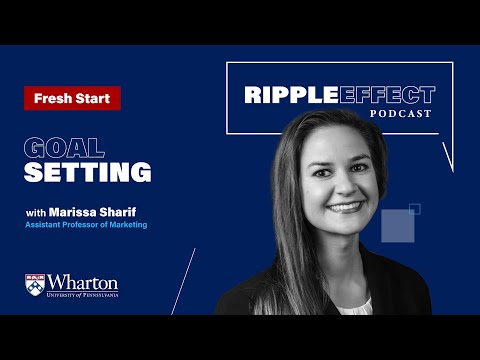
What Duolingo Gets Right About Motivation and Goal-Setting
Ask about Knowledge at Wharton
Episode Description
EPISODE OVERVIEW Why do streak-based rewards—like those used by Duolingo—keep people engaged longer than flat incentives? This episode featuring Wharton professor Marissa Sharif explores research on how reward structure influences goal persistence, showing that rewards tied to consecutive effort can increase commitment and motivation, even when the monetary value is lower.
PODCAST OVERVIEW Every day, business scholars answer pressing questions in their research - but what do their insights mean for you? In this podcast, Wharton faculty dive into what inspired their studies and how their findings resonate with the world today. Learn how research insights translate into knowledge you can use, with host Dan Loney.
Learn more at http://whr.tn/rippleeffect.
----- The Wharton School of the University of Pennsylvania is committed to sharing its intellectual capital through Knowledge at Wharton, the school’s online business analysis journal.
Launched in 1999, Knowledge at Wharton offers free access to:
- Articles, podcasts, and videos highlighting Wharton faculty research and analysis of current business trends - Interviews with book authors from Wharton School Press - In-depth series of curated content like Wharton Executive Education’s Nano Tools for Leaders - A searchable database of more than 10,000 articles covering all aspects of business - A weekly newsletter that delivers Knowledge at Wharton insights directly to your inbox
Visit the Knowledge at Wharton homepage: https://whr.tn/3qUpSBE Subscribe to the Knowledge at Wharton YouTube channel: https://whr.tn/3DEAgAU
Read the full transcriptHide the full transcript
- Marissa Sharif: A lot of people struggle to keep doing the same action and reach their end goal. They kind of give up before they
- get there. And that applies to personal goals, right, like learning a new language or trying to get fit, as well as
- goals that are beneficial for an organization and a goal an employee might have. And it's important in particular in our
- context, and I'll— I can elaborate on it a little bit later— is that streak rewards boost commitment towards a goal.
- People feel more committed, and commitment is especially important with things like goal persistence.
- Welcome to <i>The Ripple Effect</i>, the podcast that takes you on a journey through the minds of Wharton faculty. I'm your host,
- Dan Loney, and in each episode, we'll be diving deep into the inspiration behind the groundbreaking research that
- Wharton professors have conducted and exploring how their findings resonate with the world today.
- One of the ways that companies look to say thank you to employees is through the
- use of financial incentives. But do employees increase their efforts when the incentives are increased in the process,
- thereby creating somewhat of a streak? Marissa Sharif is an Associate Professor of Marketing here at the Wharton School, and
- has been part of research taking a look at this. I guess, let's start by taking us— what was kind of behind the want to look at
- this in the first place? Yeah, so it was motivated by noticing a lot of apps are using
- gamified rewards to try to motivate people to do a variety of different actions. And one popular one is actually rewards
- that encourage streaks or encouraging people to do actions in a row or to do an action every day. So for example,
- Duolingo is one of the companies that does this. They try to encourage people to learn a language, and so they give
- people rewards when they try to study or do a lesson daily. So we saw that this was a common thing that a lot of companies
- were doing. But we wanted to see, is it actually effective, right? Is there actually research to show this does
- motivate people? So that's kind of where it started, just by noticing it's a common phenomenon. Let's test if it
- actually is effective or not. And so part of this was also whether or not people
- complete the work better when there was more on the line, correct? Yeah. So the idea here was kind of, we already know,
- there's a lot of research that shows incentives and rewards motivate people, right? We know that. And we also know that
- rewards can be more effective when they're designed with psychology and human behavior in mind, right? So we kind of know
- that from from past research. And what we were really interested in here is examining whether people persist more or
- complete more work tasks with a specific type of reward structure, which is a reward structure that encourages
- consecutive behaviors, or streak- like behaviors. And we wanted to compare to see if these rewards that encourage streaks are more
- effective than other rewards, such as just a flat reward. Every time you do something beneficial, you just get the
- same amount. So it's kind of specifically looking at the streak reward structure.
- But that element of persistence, I know, is an important component to this research as well.
- Yeah, so it's important because it's a common problem. A lot of people struggle to keep doing the same action and reach
- their end goal. They kind of give up before they get there. And that applies to personal goals, right, like learning a
- new language or trying to get fit, as well as goals that are beneficial for an organization and a goal an employee might
- have. And it's important in particular in our context— and I'll— I can elaborate on it a little bit later— is that streak
- rewards boost commitment towards a goal. People feel more committed. And commitment is especially important with things
- like goal persistence. And so I guess, to a degree, if you're having people more
- committed to doing projects and doing work, that probably helps the company in general, to a degree,
- in terms of retaining employees. Yes, exactly. And what we find is, like, it's specific to the
- task or the goal they're working towards, right? So they feel more committed to reach their goal. And so that will
- definitely be more beneficial to the company in that they're going to probably reach that goal sooner and/or be more
- likely to reach the goal to begin with. So there were a variety of different studies that you did
- to kind of collect this research. Give us a little bit of a synopsis as to what you— how you went about this.
- Sure. So lots of studies in the paper. That— there's kind of one paradigm that we used in different ways throughout, which
- is basically, we have people make a series of choices. So they make a choice between doing a work-like task versus doing
- something more fun. So for example, in some studies, we have them define a series of words. In others, we have them
- type a series of CAPTCHAs. Things that people don't like that much versus something they might like a little bit more.
- So, for example, watching a short clip of a comedy show. And so we did this because we're trying to mirror what happens in
- the real world, that we often have choices about whether we want to engage in work right now or do something we like better
- instead, right? So if I'm an employee, maybe I'm doing some type of gig work. I'm delivering a bunch of orders. I could
- choose to deliver another food order, right? Or choose to do something else that I might like instead. If I'm in sales, maybe
- I choose whether I want to do another call versus do something else I like instead. So that's the basic idea. We're looking at
- the number of times people choose to do work rather than fun. While the financial component, that's obviously
- important then, it sounds like there's an element of actually completing the goal that's very important for
- the employees as well. - Yes. So we were looking here to see kind of if they're willing to
- keep going towards the work or keep going towards the goal, compared to kind of giving in and doing something of a "want"
- behavior instead, right, something that is immediately gratifying instead. But what we wanted to look at in particular,
- in this paradigm, right, is, how do the different reward structures shift people's choices such that they choose to
- do work more often than they choose to do kind of these should or immediately gratifying behaviors? So we had one group
- of people, every time they chose to do the work task, they would be paid the same amount, which is on top of their participation
- payment. They were paid, for example, in one study, just a three cent bonus for choosing the work. So every time they
- chose the work, they would get that three cent bonus. The streak condition, on the other hand, they started actually with a
- lower payment, right? So the first time they chose to do work, they would get one cent. And then if the next choice, the
- next consecutive choice, they again decided to do work, they would get two cents. If they chose again after that to do
- work, they would get three cents, right? So it increases their reward if they do a consecutive choice of choosing the work, and
- if they don't do a consecutive choice, they break their streak, they go down to a lower payment or just don't have the ability
- to go up. We kind of varied that throughout our paradigms. And what we found is that even though with the stable, flat
- reward, it's a little bit more than the streak reward in terms of payment, people end up doing work more with the streak reward
- structure than the work reward structure. And basically what happens in the paper is we generalize it, we do a bunch of
- robustness checks where we change what the tasks are, we change the payment levels to be a little bit higher, a little
- bit lower, and we try to disentangle it, to really show it's about encouraging people to do consecutive actions that
- really motivates them. So that element of the streak, does that tie into, for many
- people, our competitiveness, you know, in the workplace or in life in general, that once we that first taste of
- success, we want to have that next taste along the line? Yeah, it's related to why we think it works, which is basically— what
- we think is happening is the streak rewards encourage commitment, or increase commitment, because once you do
- that first task, like you said, you don't want to miss out on the potential earnings, you get, that increase in earnings, if you
- don't do the next task, right? So you want to see your effort kind of reap maximum rewards. I don't want to miss out on that
- potential increase in bonus by not doing the next task. And there's a lot of research kind of related to this idea that
- people don't like to see their effort wasted. When people are reminded of their effort in general, they feel more
- committed to that process. So what you're speaking of is related to why we think it is effective
- and why it boosts commitment. So seeing what you did in this research, how then does that
- relate back to companies in terms of their thought process of having these types of incentive programs?
- Yeah. So I think the easiest conclusion here, right, is incorporating the idea of streaks and rewards can be
- motivating to people and help them keep persisting and do better work compared to just these flat, basic rewards. And
- broader, right, just thinking more about how you can incorporate ideas of psychology and human behavior into your
- reward structures to motivate people more in general. I guess it's also a component of, while the finances are nice,
- it's not always the be-all end- all to have the level of success that you want to have, you know, from a project in the office.
- Yeah. So we find, right, compared to rewards that are a little bit smaller, right— like, I think there's a small
- magnitude difference here— - Right. Right. — that streak rewards end up being more
- effective than slightly larger rewards. And that's because, right, we end up being more motivated by elements related to
- human psychology and human behavior than just the pure finances of it, right? But we have to take caution that it's
- not going to be a huge difference in financial payment, right? But, yeah, a little bit, I think.
- I know you wrote in the paper, though, that this is an important area of research right now because of, probably, a
- variety of different factors. So take us through—we'll finish up there—why this is so important from a research perspective.
- Yeah. So in general, it's a really broad problem, right? It's a broad problem. It extends to organizations and employees,
- but it's— it's for all of us, right, that we all struggle to persist towards our goals. Anyone you've talked to, I'm
- sure they have an experience of, hey, I wanted to reach this goal, but I just couldn't quite get there. I started, but I
- didn't complete it, right? So that, in general, is an important area. And then second, it's thinking, hey, we have this
- great tool. We have a way to motivate people, which is rewards. How do we make those rewards even more
- effective for such a big, common problem? So I think it's speaking to this important area in that way.
- Marissa, great to talk to you today. Thanks very much for your time. Yeah, thanks for having me. - Thank you. Marissa Sharif,
- who is Associate Professor of Marketing here at the Wharton School. Thank you for listening to <i>The Ripple Effect</i>. We hope
- you found this episode informative and engaging. Don't forget to subscribe and leave us a review so that we can continue
- to bring you the best insight from the Wharton School.
Brief Summary
Marissa Sharif discusses how streak rewards enhance motivation and commitment towards achieving goals in personal and organizational settings.
Key points
- Importance of Commitment in Goals. Marissa highlights how commitment is crucial for achieving both personal and organizational goals.
- Marissa Sharif on Streak Rewards. Marissa Sharif discusses her research on how streak rewards can enhance employee commitment and productivity.
- The Ripple Effect Podcast Introduction. Join host Dan Loney as he explores groundbreaking research from Wharton faculty.
Episode highlights
- Marissa Sharif on Streak RewardsMarissa Sharif discusses her research on how streak rewards can enhance employee commitment and productivity.“Streak rewards boost commitment towards a goal.”0:27Jul 22, 2025
- The Ripple Effect Podcast IntroductionJoin host Dan Loney as he explores groundbreaking research from Wharton faculty.“Welcome to The Ripple Effect, the podcast that takes you on a journey through the minds of Wharton faculty.”0:38Jul 22, 2025