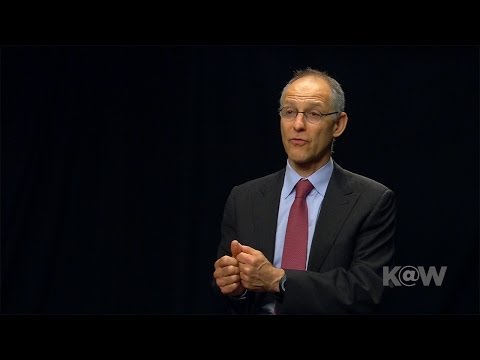
MOOCs on the Move
Ask about Knowledge at Wharton
Episode Description
📂 Innovation
Read the full transcriptHide the full transcript
- [Music] [Music] uh dhan thank you so much for joining us today thank you well how does a massive
- open online course or a Muk as it is called like those thought through corsera differ from the traditional
- educational experience and what are the pros and cons so if by the traditional education experience you mean the
- face-to-face teaching um I think that there are differences that um vary based on what audience you're talking about so
- these mukes as they're called have been offered separately both to the general public at large but also as a way of
- transforming the educational experience of oncampus students so in terms of the students in the general public there is
- this um tremendous opportunity for them to be exposed to the kind of knowledge that has until now only been available
- to a tiny sliver of the world's population and they don't get the same experience necessarily as the on-campus
- students because they don't get that you know one-on-one connection with the instructor but on the other hand um the
- availability of the content is just a tremendously enabling experience for those students and there's still a
- hugely interactive experience in terms terms of um interaction with the material which is not just video there's
- also a lot of exercises and assessments as well as this Rich community that is based on um that is based around the
- material where students interact with each other in a kind of peer teaching format at the same time students on
- campus can benefit from that same content and have the experience of going and watching the content separately
- outside the classroom and then coming into class and having a lot more time for an active learning interactive
- experience with her instructor let just just take a step back how would U corera
- fit into the higher education landscape uh does a Muk supplement uh traditional learning as you just described or do you
- see it as a substitute as well I think it depends on the population again for those students who are privileged enough
- to be enrolled in an academic institution such as Wharton or Princeton or Stanford um there is uh a tremendous
- opportunity to supplement the stand instruction and then again repurpose the classroom time for a much more
- meaningful and interactive experience for a lot of students out there however they will never have access to this
- quality of education and so you can view this as a substitute for the education that they would have liked to have um
- for many students they that are taking our courses they are in fact already educated professionals they have a
- degree sometimes they have even an advanced degree but they would like to expand their minds and learn new things
- things and they will never go back to school um whether for financial or geographical constraints and this is a
- tremendous opportunity for them to learn something great so now I understand that
- uh do 33 institutions offer muks through corsera that's right uh and how many students have they served So currently
- enrolled on the platform we have over 1.5 million students um that uh are currently enrolled in there's 5 million
- distinct course enrollments because students often enroll from more than one class um a lot of these students have
- not yet been served because a lot of our close to 200 classes have not yet started to run and so um uh you know I
- think we've served hundreds of thousands of students uh so far but you know not the full 1.5 million that have been
- enrolled and what have you learned so far about um participation completion Dropout rates of this online population
- so one of the things that we see is that you know because enrolling is so easy it's a matter of just clicking a button
- and it's free a lot of students do that um and then when it comes time for the course to actually begin about 70% of
- them show up because maybe their life has moved on and they're now busy doing something else of the ones that show up
- we see a bifurcation of the population there's students who come in and they really are there primarily to just get
- the benefit of the content they're just there to watch videos and of those who start watching videos about 30 to 40%
- continue watching the entire rest of the course to its completion uh with a sort
- of Fairly constant drop off rate week on week as students get busy and their life
- uh imposes some challenges on them similarly there is the second population uh those students who really do intend
- to take the course for real and we kind of gauge that right now by seeing who submits the first assignment as an
- indicator that if you submit the first assignment you maybe really do intend to take the class for real and again the
- retention rate for that population is comparable it's about 30% % of the people who start the first assignment
- complete the last one now in terms of sort of overall what you might traditionally call retention that is the
- number of students who submit the last assignment uh relative to the population who initially enroll for the course that
- translates into a completion of 7% or so 9% depends on the course but that's really the wrong way of looking at it
- because many of these students never really intended to take the class in the first place right not for real right so
- for example I I understand that the gamification course that was offered through Wharton uh had about 70,000
- people who enrolled initially but about 9,000 uh completed it now now that that's quite a big gap what have you
- learned about the different kinds of courses where uh you've seen greater success than others I don't view 9,000
- out of 70,000 to be a uh to be a bad statistic because I didn't say so yeah it was just a description
- criticism um you know I think we're still starting I mean we don't have a sufficiently large sample size right now
- to gauge what um makes for success and what doesn't and in fact one of the things that we've started to do is
- research that is intended specifically to try and determine what increases retention what increases engagement so
- we're now running a test in which students are getting encouraging emails once a week saying oh you know you did
- so well in the last couple of assignments and the next one is due tomorrow don't you think it's good if
- you log in and try and complete the next one you don't want to break your streak
- and we're doing an AB test in the same way that Google does AB test in in search quality to see whether that
- actually increases student engagement and one of the really beautiful things about having such a large po base of
- population that you can run these experiments and get statistically significant results so that we can learn
- how to improve the learning experience for our students right now some of the institutions that offer these courses
- off for credit and some don't is is why is the that difference exist well you know as of now only one institution
- offers credit uh that's the University of Washington and they're offering it for an enhanced version of the course
- where students have uh interaction with the instructor and and um you know some additional homework besides what's
- available on the corsera platform I think that you know the granting of credit is a very sensitive issue for um
- institutions and they need to think carefully about what makes a credit bearing class and what doesn't and this
- is such a new area and this whole transformational change that we're seeing is so new I mean a year ago today
- approximately September or October of 2011 was when the first real mukes launched and so so much has happened
- since that we are still I think all of us as a community are just trying to assimilate the change and figure out
- where we want to take this and I think over the course of time more and more institutions will move into the credit
- arena with this but um it's too early I think to have that step taken and do uh any institutions offer certification
- also so most of the institutions that we're working with have agreed to offer some kind of unofficial certification um
- as I mentioned earlier most of our population right now at least are people who already have a degree and will never
- go back to school to get another one so for them the question of whether the course carries credit is really of less
- relevant compared to whether they have a meaningful certificate that they can for
- example present to an employer to demonstrate competence uh in a particular topic and so I'm I'm very
- pleased that most of the institutions have decided to offer that benefit to students which allows them to really
- gain something substantial for the work that they did and is it corera that offers the certification or the
- institution and is there any charge for it so um what what we have been able to offer up to now is a what is often
- called a statement of accomplishment or um something along those lines and it is
- an unofficial letter from the instructor with the instructor signature that does
- not carry any kind of University authorization in the coming months we uh plan to be able to offer for some of the
- courses and not from all institutions a basically University branded certificate
- that would carry the university brand and it would say that this is an online non-credit bearing course so that to
- distinguish from the courses that the university offers its own enrolled students um and so it'll be a university
- brand certificate it'll also carry the corsera brand somewhere but in a clearly different role because the two roles are
- different we don't we do not produce the content we do not determine academic standards uh when we begin to offer
- those then yes we um we believe there will be a charge for something that has I think such a substantial value to the
- students but it won't be a huge charge so when you have U certification the question of assessment becomes very
- critical uh now given the large volumes we have in these mukes uh I I would imagine that'll be quite a challenge how
- have you dealt with that so the question of assessment is one to which we have devoted extensive attention in our work
- because uh we not even primarily for the purpose of certification at the end but
- because we believe that exercises for which one gets meaningful feedback the so-called formative assessments are a
- really critical part of the learning experience for the students if you don't get feedback on how well you're doing
- you really either don't do the work or you don't learn the material well because you don't know that you're not
- getting it and so we've developed a fairly extensive set of exercises that can be graded automatically by the
- computer and that ranges from The Fairly mundane multiple choice or fill-in the blank or numerical answers to some
- fairly in-depth assessments like like uh grading of programming assignments of Excel spreadsheets for example for
- marketing or financial models um grading of mathematical expressions and most recently one of our biggest efforts uh
- which we started to put out in the spring and has since gone out I think nine classes or maybe even more is the
- whole notion of peer grading where students critically assess each other's work providing both a quantitative grade
- as well as qualitative feedback back and by combining ideas from the kind of peer
- review process that has been used in the education Community with the crowdsourcing ideas that have been used
- in in websites like Wikipedia um uh where wisdom of the crowds is used to sort of uh compensate for lack of
- expertise among uh the people doing the work we believe that we can actually put
- together something that provides students with meaningful feedback for the kind of open-ended work that is so
- critical for example in Humanities and in business and in other disciplines yeah I mean I can certainly understand
- that peer reviewed um uh assessments uh help to address the scale question right
- uh but uh isn't the absence of uh feedback from a qualified instructor a limitation so I think that clearly the
- answer is that in certain um disciplines in certain contexts the it is a limitation so for example I would not
- use peer riew to grade 10,000w essays where an instructor would be able to provide a real in-depth assessment of
- the quality of the work and give the kind of substantial feedback that only an expert can give so I think um it
- comes back to an important component of this that we I think U discussed a little bit earlier which is that this is
- not going to be an experience that is comparable to the experience that a student who attends an institution like
- the University of Pennsylvania and person gets so there's going to be differences and the question that we
- should ask ask ourselves isn't whether we are going to achieve equality between the students at the University of
- Pennsylvania and the students out in the general public but whether by the use of
- Technology we have improved the quality of the experience for each of them separately so both of them are better
- than they were before even if they're still not quite the same that's very interesting and well
- you you said before that you know a lot of the people who take these courses are
- already professionals who have degrees and and that's fine but there may be some
- uh uh young people as well who are trying to become professionals um how do you address issues in the case of such
- populations about things like verifying the students Identity or plagiarism how how how have you dealt with those things
- so first of all um to speak to just the the um assumption behind your question I
- do think that as the mix of courses that we're offering changes to include more and more of these um introductory or
- Gateway classes we're seeing uh increase in the population of you know 18 to 25 year olds and often even younger
- students from high schools who would like to as you said become professionals and and get their degree and and so I
- think that's a really exciting Direction because it is an important segment of the population to which you want to
- offer high quality education um you know I think that there are a range of technological solutions that one can
- adopt in order to address issues of plagiarism detection and um identity verification and reducing the amount of
- cheating um keeping in mind of course that you will never be able to stop this entirely and we have heard recently and
- in the past of incidents of uh you know cheating and plagiarism on our own college campuses including at the
- highest ranked institutions um we have seen in uh incidents of cheating at the SAT exams which are supposedly the most
- proctored environment that one could have so it's always going to be an arms race and you're going to prevent some
- form ter of cheating and others will um emerge to replace them um so one has to keep one's expectations realistic I do
- think and there's been a bunch of uh you know discussion about you know cheating
- in online courses um on the web um I think that to some extent those have been a little bit overinflated um
- relative to the actual amount that takes place so uh for example our um in the Princeton Sociology class the TA graded
- every single one of the 2500 or so midterms they estimate the proportion of plagiarism at about 5% now even if
- that's an underestimate because they didn't actually plug this through a plagiarism texure so maybe it's double
- that 10% is that really that much higher than what we see in our oncampus classes
- not clear to me love to uh switch to some questions about the business model if you don't
- mind um csair is not the only moo initiative I wonder how you compare your approach to that of edex or
- Udacity so let me start from uh the Udacity comparison because I think that's a fairly easy comparison um we
- are a technology platform that enables the best institutions to offer their education to the rest of the world and
- we're not intending to become an educational institution on in our own rights we do not produce our own content
- we rely on the content experts which are some of the world's best instructors to
- provide the content and set the academic standards um and we do that by partnering with the institutions um so
- that faculty can basically teach under their um under the brand of their institution with the support of their
- institution and I think we get some really amazing um material by having that relationship with some of the
- world's best universities um so um so that's one comparison um the the edex initiative in some
- respects is more similar to what we're doing because it's also an Institutional level effort um in this case it's a you
- know Consortium of two of you know the world's outstanding institutions most recently joined by a third um and I
- think that it's uh wonderful for students around the world to have access to content from those universities as
- well uh we personally are very uh fond of this sort of notion of a broad Consortium of peer institutions because
- not only do we think that it provides economies of scale because a single platform that is a fairly expensive and
- complicated thing to develop is now the cost of that is advertised over a much larger set of courses and and
- institutions we also see tremendous benefit to the hub of having um you know a single place where people come for a
- very large amount of content we have almost 200 courses right now and more coming up and that's why we have 1.5
- million students in Rising is because of that Hub in the same way that you know Amazon is a hub or iTunes is a hub and
- then finally I think an advantage that maybe not quite as Apparent from the outside but you can clearly see it from
- the inside is having this collaboration across institutions allows institutions to learn a tremendous amount from each
- other because this is a completely new Paradigm in teaching this is not standard instruction sort of videotaped
- and placed online as used to be the case this is a um a real shift in how we teach and we're all kind of learning
- together and by having a bunch of peer institutions that are all communicating with each other and learning I think
- we're going to develop good pedagogy and good ways of exploiting this uh this new
- paradigm this new medium much much faster since knowledge at has been giving away free content and free
- knowledge for the past 14 years uh you know this is a question that is very dear to my heart uh there is clearly a
- cost to producing the content uh how do you plan to monetize your service presumably your investors are also
- interested in that yeah let me say that there's not only a cost to producing the
- content there's also a cost to hosting and disseminating the content there's also cost of developing the platform
- that does all that so yes there's costs all around and and um one of the decisions that we made was that
- recognizing these costs and recognizing that they are ongoing we realized that we couldn't count on some miraculous uh
- influx of funds from philanthropic foundations to keep us going indefinitely which is why we decided we
- had to make it sustainable and so we have several ideas on Revenue models all of which at this point remain to be
- tested because we're very very new to this um but one of them is when we touched on earlier which is the
- potential to charge for certification so even though we're committed to keeping the content free so that even a kid in
- Africa that doesn't have a credit card can still learn something to make their life better if you get a certificate at
- the end that allows you to go and apply for a job and gives you some kind of tangible benefit then that I think is a
- reasonable thing to charge for um we think that we can get employers to put in money into the effort by getting
- access to the records of students who have taken some of our courses only those who have opted in of course um and
- because there's some really amazing things about our student base first of all not only are they often educated
- they're ones who have demonstrated the interest in in in continuing their education so they're self- selected for
- some really good properties um furthermore employers would get much more quantitative and detailed
- information about those students than just the resume which is what they say about themselves but rather did they
- actually do well both in hard skills like on the exercises but also in soft skills like in helping each other on the
- discussion form and in study groups and so that's really important type of information in the 21st century
- workplace for which I think employers would be willing to pay and we've already had some interest from employers
- about that will the institutions who are part of corsera also monetize their content in some way so when we um when
- we bring in Revenue the university gets part of it we share the revenue back with the institution specifically to
- support content production let me ask end with one last question uh what's next for corsera and when I say next
- let's look next five years 10 years so I think that um in five years uh we will be able to offer most of the curriculum
- in most disciplines we're we're now um what eight months after starting off at 200 courses um typical instit tion even
- a large one like pen has something like 3,000 courses um you know I think in 5 years we'll have 3,000 courses so that
- if you want to be educated as uh you know as a mechanical engineer or as a business person or as a lawyer you will
- be able to get access to some of the world's best courses and gain an education along those lines I also think
- that in 5 to 10 years from the perspective of the higher education ecosystem people will look back on 20th century
- and say that I can't believe that we spent so much of our students time shoveling them into auditoria and having
- them sit there for 75 minutes while somebody lectured at them when we all so clearly recognize and even recognize
- today that that's not the best form for getting people to really learn on the material and and use it effectively and
- so I think that our no of what makes for a good education will shift drastically
- I hope in five but maybe it'll take 10 years the old model has been good for teaching but perhaps not so good for
- learning so I would say that the old model has been good for scaling because up until now it was the only way that we
- had as a society to really convey that material to the larger number of students who came in through our
- institutional doors but I don't think it's the right way to teach and um and what we would hope to be able
- to see is that by placing the content in a way that can be assimilated easily by
- students in an online format we can go back to teaching the way it should have been okay well well good luck to you and
- thank you so much for joining us today thank you [Music]
Brief Summary
Coursera's Dhan discusses MOOCs, their impact on education, enrollment stats, and future plans for online learning.
Key points
- The Rise of MOOCs. MOOCs provide unprecedented access to education for millions, transforming traditional learning.
- Engagement Challenges. Despite high enrollment, completion rates for online courses remain low, raising questions about engagement.
- Peer Grading Innovations. Peer grading offers a solution to scale assessments in online courses, enhancing feedback.
- Future of Education. In five to ten years, the education model will drastically change, moving away from traditional lectures.
Episode highlights
- The Rise of MOOCsMOOCs provide unprecedented access to education for millions, transforming traditional learning.“These MOOCs have been offered separately to the general public.”0:49Nov 7, 2012
- Engagement ChallengesDespite high enrollment, completion rates for online courses remain low, raising questions about engagement.“About 70% of students show up when the course begins.”4:08Nov 7, 2012
- Peer Grading InnovationsPeer grading offers a solution to scale assessments in online courses, enhancing feedback.“We believe that we can actually put together something that provides meaningful feedback.”11:49Nov 7, 2012
- Future of EducationIn five to ten years, the education model will drastically change, moving away from traditional lectures.“The old model has been good for teaching but perhaps not so good for learning.”23:06Nov 7, 2012
Tension
40/ 100Low tension