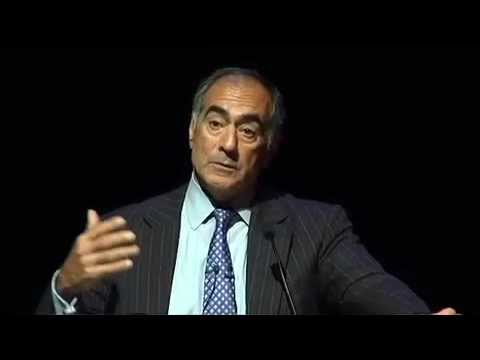
CEO Pay: How Much Is Too Much?
Ask about Knowledge at Wharton
Episode Description
CEO compensation at large U.S. corporations jumped 11% to $9.3 million on average last fiscal year, according to a new study sponsored by The Wall Street Journal. Some executives received stand-out amounts. Philippe Dauman of Viacom, for instance, earned $84 million in the latest fiscal year, double the year-earlier figure. So, is the era of outsized CEO pay back? Martin J. Conyon, a senior fellow at Wharton's Center for Human Resources considers this and related questions in this Knowledge@Wharton video interview.
Read the full transcriptHide the full transcript
- [Music] We're speaking today with Martin Kan, a research fellow at Wharton, about the
- news this week that CEOs at the largest US companies saw their pay jump on average about 11% to about 9.3 million.
- And that's according to a survey sponsored by the Wall Street Journal. Um, in n in 2009, CEOs got no raise at
- all. And these figures apply to 2010. So tell me uh is the error of big CEO pay back because in addition to that we had
- Philipe Demon of Viacom uh earning $86 million or double his pay from last year which is tends to be what what folks
- focus on right so there I mean there are a couple of uh important issues that we
- can raise there. I mean first it does seem that uh CEO compensation according to this survey has increased by
- approximately 10% in the fiscal year 2010. I think one of the important points and one of the comforting
- elements that comes out of this survey is that although we've seen pay increase we've also seen the performance of these
- firms increase too. The same survey shows that sort of corporate profits have increased um by about 18% 19% and
- similarly stockholder returns have increased by about that about the same amount. So um in terms of uh whether
- CEOs have earned this um extra compensation this growth in pay of about 10%. We do seem to be seeing uh a link
- here between the compensation received by CEOs and the performance of their firms which in that sense is comforting
- and is part of the good news of this survey. On the other hand, overall wages and salaries in the US actually drop by
- 1% over the calendar year. Um, and so maybe that raises the question, did did the improved corporate performances did
- that come through shrinkage and and layoffs and becoming more efficient and or how much was attributed to topline
- growth? Right. Uh, well, for sure the determination of executive compensation is a reasonably complex issue. Um, the
- uh evidence seems to suggest that compensation of CEOs is correlated to the growth in their corporate size,
- corporate value and and this is a good thing. Um like all factors of production within the firm, there's going to be a
- myriad of factors which are going to determine the level of pay uh received by CEOs or other u individuals within
- firms. Um I think one of the um encouraging factors uh that's um arrived on the corporate governance landscape in
- the last couple of years um is the DoddFrank Act. And as part of the DoddFrank Act, uh, one of the things
- that we're going to see is, uh, even more transparency and and disclosure of executive compensation and other
- compensation matters. Uh, specifically, companies are going to start revealing how much they're paying their typical
- employees. They're going to be uh, um, explaining um, how much their CEOs are receiving. And in consequence, um,
- investors, the media, the public are going to be able to see much more, um, the relation between CEO pay and typical
- workers within the firm over time. We've gotten used to hearing that statistic that 20 years ago or 30 years ago,
- typical CEO pay was about 50 times or so more than the their average employee, and now it's 4 or 500. So, that's the
- ratio that they'll be looking at, right? Um, they um I'm not sure whether there is an ideal or an optimal ratio here. uh
- like many factors of production um it's not clear why you would necessarily want
- to benchmark um one uh particular individual against another individual but it's a useful thing to know about in
- the wider uh scheme of scheme of things um shareholders when they're trying to design compensation policies must try
- and find an optimal compensation uh package that recruits retains and motivates a CEO um in that context if we
- think about um uh the CEO labor market in recent years becoming more global. Um uh that CEOs are having to run
- increasingly complex uh enterprises. That may might be part of the explanation why CEO compensation is
- increasing at a faster rate than other employees within the firm. Um there is no easy answer to this but the goal of a
- compensation policy must be to sort of try and find the right um uh the right set of instruments that aligns uh the
- CEO's interests with those of shareholders. Um and I think this is I mean as I looked at the um uh results of
- this survey in the Wall Street Journal I mean there were some other encouraging factors there. It is true that the level
- of compensation has uh increased uh over time. Um but one of the interesting uh features about this study is the amount
- of pay that is at risk um for the CEO. So if one was to look at um the salary element only. So this is the cash
- compensation that's guaranteed to the CEO. Um and then what's on their W2? Um well uh it's other things as well but
- it's but in addition to just a salary these the CEOs are receiving um annual incentive plans which tend to be related
- to the um uh budgeted performance of the uh company stock options restricted stock and other equity awards. So if we
- were take the whole package together, this is the number that we're seeing which was about $910 million. But the
- salary element of that is only about uh probably about 15 to 20% on average. So four-fifths of the CEO's compensation is
- at risk in the sense that it's contingent upon the performance of the firm. If the firms don't perform well in
- the future, those elements won't pay off and the CEO won't be receiving those kinds of those kinds of compensation
- benefits. Have there been any major changes that would uh shift or encourage CEOs to do more long-term planning
- rather than short-term quarter by quarter planning where their compensation might be more on the line.
- Yeah. So um the governance of executive compensation is uh often shifting and um
- um there can always be improvements in the way that we can structure compensation. So for example um uh
- compensation arrangements can actually be explicitly made performance contingent. So one can say these payouts
- of these equity awards are contingent upon achieving particular hurdles. And in that sense actually um uh European
- firms uh uh publicly traded firms in the United Kingdom do make the award of um uh compensation components contingent
- upon the achievement of various EPS targets or um uh total shareholder return targets that beat the market. So
- these are relative performance measures. Um in the United States again with the passage of DoddFrank we are seeing uh
- much more accountability um and much more transparency um even compared to a very high level of uh transparency and
- accountability that existed in the United States already. Uh but the additional I think some of the
- additional elements and I think this goes back to your um original question about is the era of big CEO payback?
- Well, uh maybe um but with the passage of DoddFrank, what we're seeing is now shareholders um are going to be able to
- vote on on the compensation packages uh received by CEOs and presumably boards of directors, compensation committees,
- CEOs themselves will have an eye to what shareholders are going to think about this when they come to vote on these
- matters in the future. And perhaps that um if one thought that uh compensation packages were a little on the high side
- uh this would uh tend to have a dampening effect on uh compensation going forward. So my my thoughts my
- guess is that uh when 2011 rolls around uh and the and the uh the same survey is
- done again next year, I suspect we won't see quite the same uh increase um that we saw this year. That's an interesting
- lever for shareholders. What about employees? How does it change the culture of a company when the CEO in the
- company earns $86 million? On the one hand, we can sort of we can see sort of high levels of uh compensation as a goal
- to which employees might aspire. Um and in that sense, we might think of it as a
- as a potentially motivating device. Um however on the other hand we know that uh uh in terms of if the differences
- become too big uh this can actually uh demotivate sort of employees. And so it's there isn't a really clearcut
- answer to sort of what uh uh to what the overall effect is going to be on um uh uh on the morale if you like the
- performance consequences of employees. We know that there is some evidence to suggest that um uh employees when they
- receive um stock-based compensation and equity payments uh tend to uh see that as a good thing in the sense that it
- creates um an extra kick in their sort of motivation and and in consequence we see those kinds of companies which are
- um spreading the rewards sort of doing better uh than those companies who are less likely to do it. Okay. Well, thank
- you very much for joining us today. Okay. Thank you very much. Pleasure.
Brief Summary
Martin Kan discusses the rise in CEO pay and its correlation with corporate performance and implications of the Dodd-Frank Act.
Key points
- CEO Pay Increases. CEOs at major US companies saw an average pay jump of 11% this year.
- Dodd-Frank Act Impact. The Dodd-Frank Act will increase transparency in executive compensation.
- Employee Morale and CEO Pay. High CEO compensation can motivate or demotivate employees depending on the context.
Episode highlights
- CEO Pay IncreasesCEOs at major US companies saw an average pay jump of 11% this year.“CEOs saw their pay jump on average about 11%!”0:25May 11, 2011
- Dodd-Frank Act ImpactThe Dodd-Frank Act will increase transparency in executive compensation.“More transparency and disclosure of executive compensation is coming!”2:44May 11, 2011
- Employee Morale and CEO PayHigh CEO compensation can motivate or demotivate employees depending on the context.“High levels of compensation can be a goal or a demotivator for employees.”8:34May 11, 2011
Tension
40/ 100Low tension